
In my last post I said I built Dayzle partly because I didn’t like how other games treat their players, and that the more I learned about finding players, the more I understood why they do it. Once you pay to get players, the money has to come from a handful of them, and the numbers say that they have to pay you a lot - or else paid acquisition doesn’t work. That’s why so many games end up built around squeezing their best players, and why you can’t rely on paid acquisition if you don’t want to do that.
Why we built it
I like puzzles, and I’ve played a lot of puzzle apps that didn’t quite do what I wanted. I wanted to see my stats and whether I was getting better. When I was stuck, I wanted the hint to explain the next move so I’d learn something, instead of just filling in a square. And I didn’t want to watch an ad every time I finished a puzzle.
Most of that list is easy to fix: you build the product the way you want it. The ads are harder, because they depend on other people’s behaviour: how many players you can find, what each one costs you, and how much they play.
Two kinds of cost
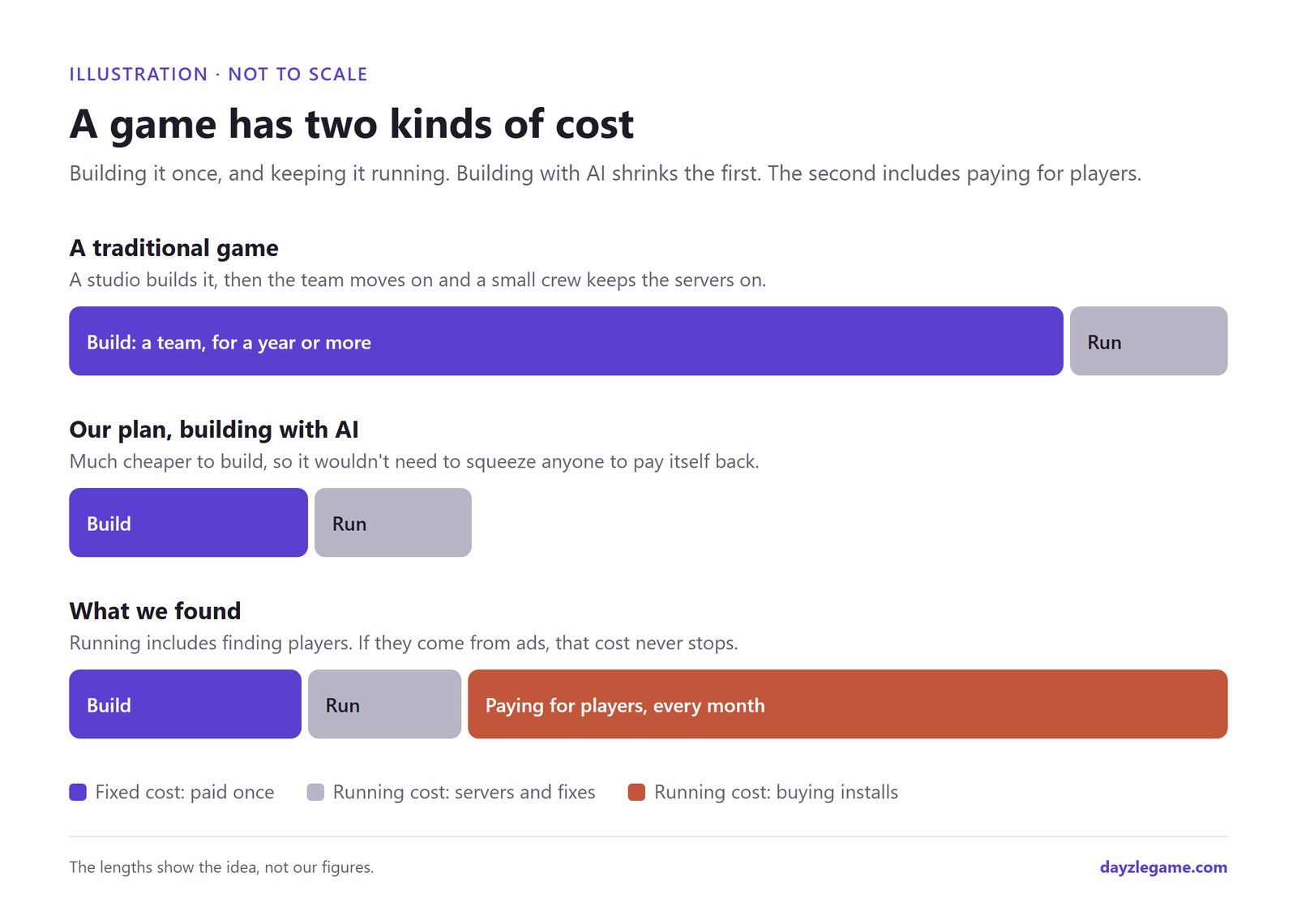
A game has two kinds of cost. The first is building it: getting an app that does the thing you want. That’s the fixed cost, and for most of the history of games it has been huge. The second is keeping it running: servers, fixes, a small team to maintain it. That’s the variable cost, and it’s small. Traditionally, a studio builds a game, the developers move on to the next project, and a skeleton crew keeps the servers on.
Our idea was that building with AI could shrink the first cost dramatically, and that a game that was cheap to build wouldn’t have to squeeze anyone to pay itself back.
What we realized later is that the fixed cost barely matters. Before a game can pay back what it cost to build, it has to make money just running, and running includes paying for players. That second part is where we’ve learned a lot.
If you build it, they won’t come
I wrote about this last week: a good product doesn’t matter if nobody finds it. There are really only two ways for people to find a game: organic (word of mouth, press, a post that takes off) and paid (ads).
Organic takes some luck. Wordle is the example everyone knows. About 90 people played it on November 1, 2021. By early January it was over 300,000, after the shareable grid of coloured squares took off on Twitter. Wordle was just as good a game on November 1, the explosion of users was a bit of luck. Don’t get me wrong - a good product is a prerequisite for going viral, it just doesn’t guarantee it.
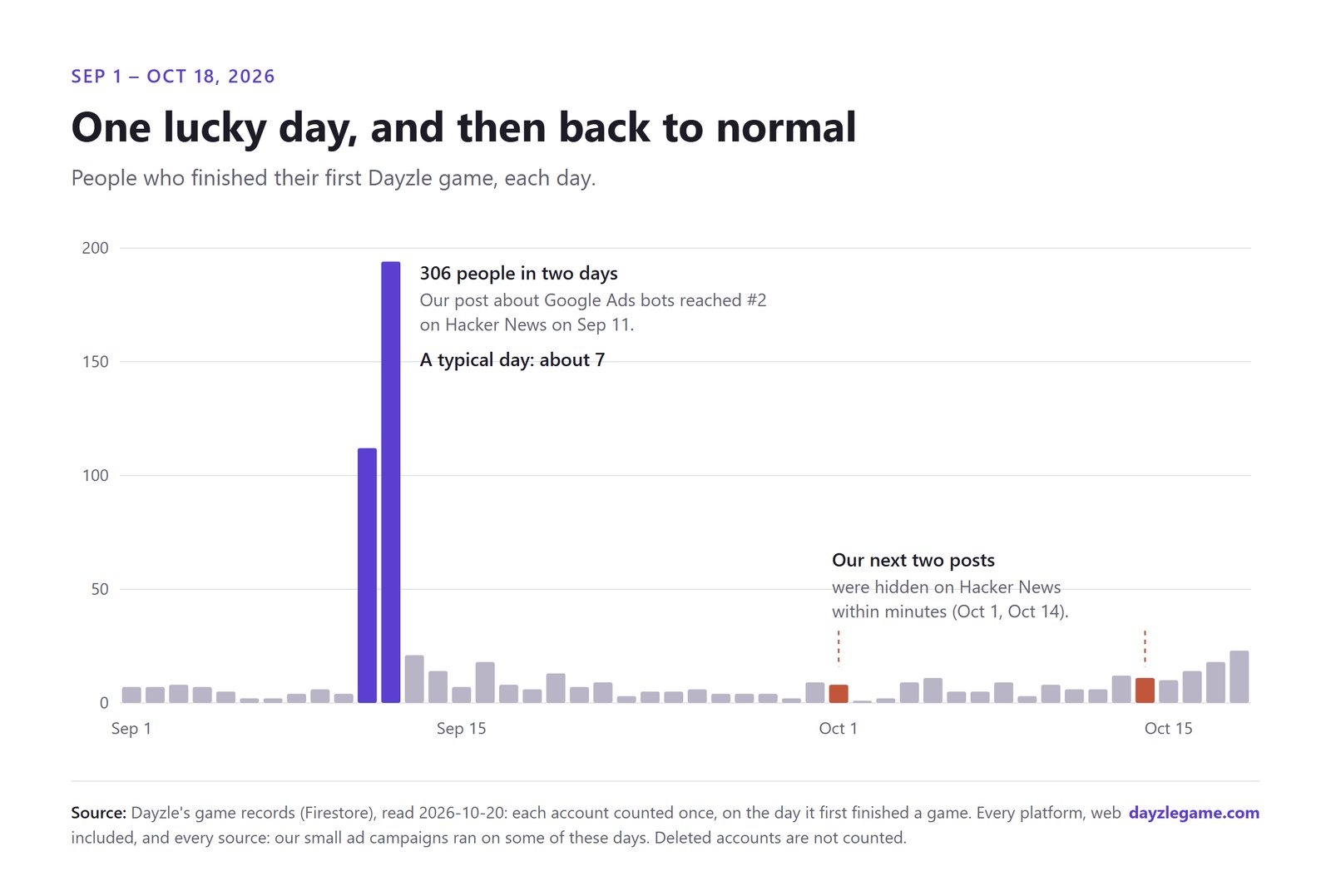
We’ve had our own small taste of this. My first post about Google’s bot farm hit the top of Hacker News, and about 300 people finished a game in the next two days. That’s the best two days we’ve ever had. After that, no new players from that article, and the next two posts I submitted were hidden (theoretically because they think I’m a bot). Same writer, same kind of story, very different luck.
Paid acquisition is just math
Paid acquisition, in theory, takes no luck at all. It’s a chain of percentages: how many people who see your ad tap it, how many of those install, how many of those play, how many come back. You improve each step, and at the end you get a cost per install. Initially, ours on Apple’s search ads was about CA$7.50.
But the moment you know your cost per install, you have a new question: what is an install worth? If an install costs CA$7.50, the average install has to bring in more than CA$7.50 or every ad you buy loses money.
What 100 installs are worth
So I looked at what our installs actually do in their first month. Here’s what 100 installs from strangers look like (I left out Canada, where most of our friends are):
- 72 never play a practice game. They play the daily puzzles, which have no ads, or they don’t play at all. They never see an ad.
- 20 play a little practice, a few games in the month, a few minutes in total. They see an ad now and then, if at all.
- 8 play regularly, and 5 of those play over 100 practice games in their first month, about half an hour a day.
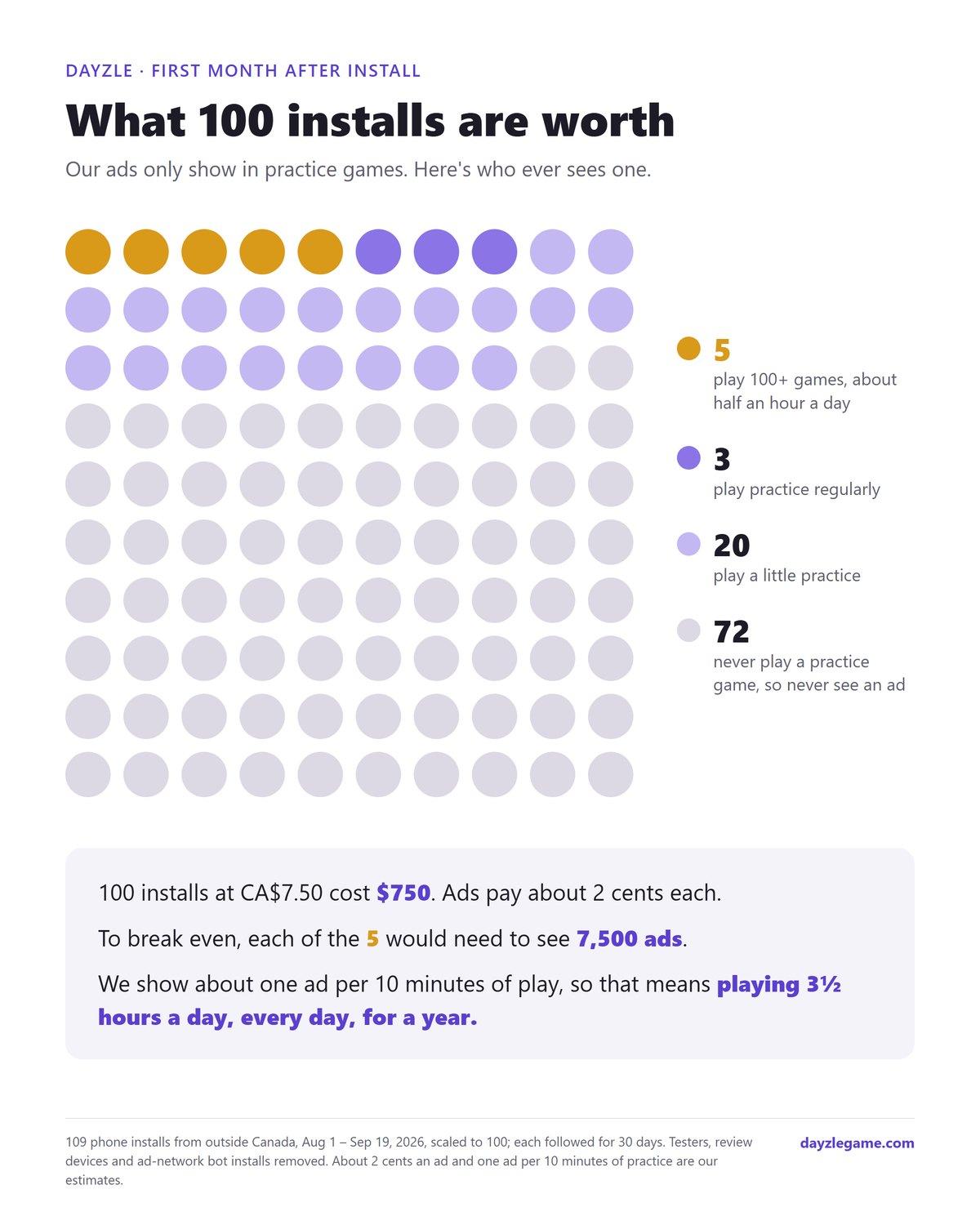
So it comes down to those 5. Ads pay about $20 per thousand views, which is 2 cents an ad. 100 installs at CA$7.50 cost $750, so to break even, each of the 5 has to see 7,500 ads. Counting the ads players choose to watch for a hint or an extra life, a practice player sees about one ad every 10 minutes. So that’s 1,250 hours of play: about three and a half hours a day, every day, for a year.
What they actually do is about half an hour a day. If all 5 kept that up for a full year without quitting, each would see about 1,200 ads, worth about $23. Add in everyone else and those 100 installs bring in roughly $125 a year. At that rate, paying back the $750 takes six years, and that assumes nobody quits.
Subscriptions don’t change the picture much. A subscription turns the ads off, so it replaces ad money rather than adding to it. Say all 8 regular players subscribed at $2 a month. That’s $16 a month, so they’d all have to stay subscribed for about 4 years to pay back the $750.
We’ve since got our cost per install down to $2–4, which helps a lot. At $3, 100 installs cost $300. To pay that back in a year, the 5 heavy players would each need to see 3,000 ads, which means playing about an hour and a half a day. They actually play about half an hour a day, a third of that, so at the rate they really play it takes two and a half years, if nobody quits. On subscriptions, it’s 19 months of all 8 paying.
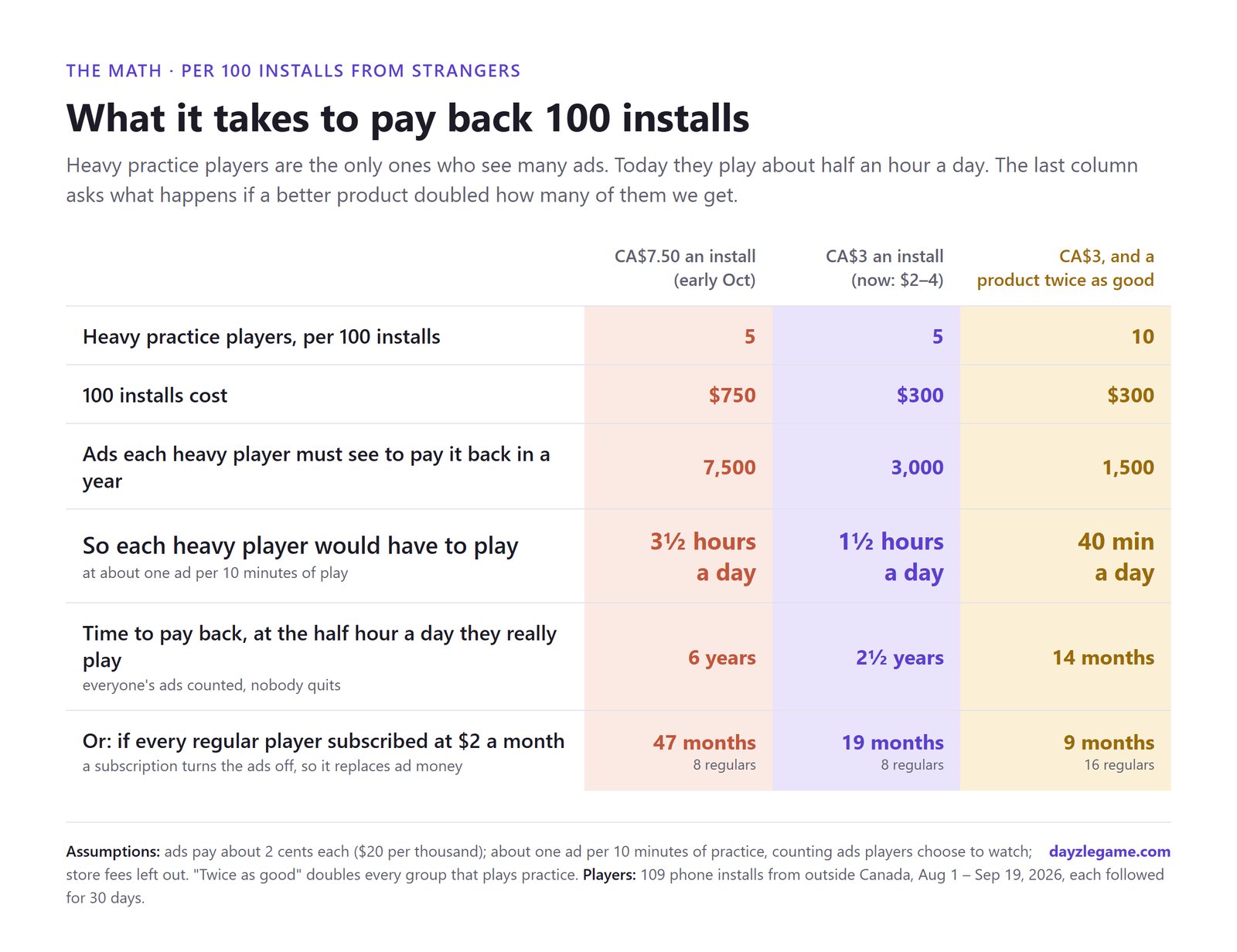
The obvious answer is a better product, so that more than 5 in 100 become heavy users. If we kept installs at CA$3 and made the product good enough that 10 in 100 played like our best players do now, each of them would only need to play about 40 minutes a day, and those 100 installs would pay for themselves in a little over a year. That’s the reason we still buy ads today, even though we know they don’t pay back: the players they bring in show us which changes move that number.
None of this is unique to us. In almost any game, a small group of players is worth far more than everyone else put together.
Why games squeeze their best players
Once you see that, a lot of things about other games make sense. If your business runs on 5 players in every 100, every decision gets judged by what it does to those 5. Ads every couple of minutes, energy timers, “watch an ad to continue”, a level that gets suspiciously hard right before an offer pops up: each one gets a little more out of the people who are already the most hooked. Everyone else barely moves the number either way, so making their experience worse costs almost nothing.
There’s been a viral video going around claiming Block Blast quietly changes its difficulty to get people to pay. I don’t know if it’s true. But what struck me is that everyone, including me, believed it the moment they saw it. We all already assume games work this way, because most of them do.
What you don’t see is WHY they do it. I don’t think the people building those games are bad people. They didn’t wake up one day and decide to have a psychotic business model that abuses their best customers. What happened (likely) is they were looking at their spreadsheet, with their cost per install and their revenue per player. They quickly realized their top players were “willing” to pay more, and that’s the easiest lever to pull.
A game that refuses to squeeze its best players has to find the money somewhere else, or it loses money and everyone loses their job. I can see why most choose the “exploitation” route.
Where we are now
My hope going in was that a game that’s good and doesn’t exploit anyone would work. The honest picture so far is that without luck you end up in paid acquisition, and paid acquisition pushes you toward squeezing your top players or losing money on every ad.
Where we are now is maybe the same place we started. I always knew paid acquisition wouldn’t work for this monetization model. We keep using it because it helps us refine the product and make it better, which gives us a better chance at our own “Wordle” moment. That moment may never come, but it’s why we do things like keep the daily puzzles free, with no ads. That’s likely our best chance at thousands, or hundreds of thousands, of “organic” players.