
Witness
A few clues about the culprit, shown once. Flip down every suspect they rule out, then name the one left standing.


- Four levels: Easy to Extra Hard
How Witness Works

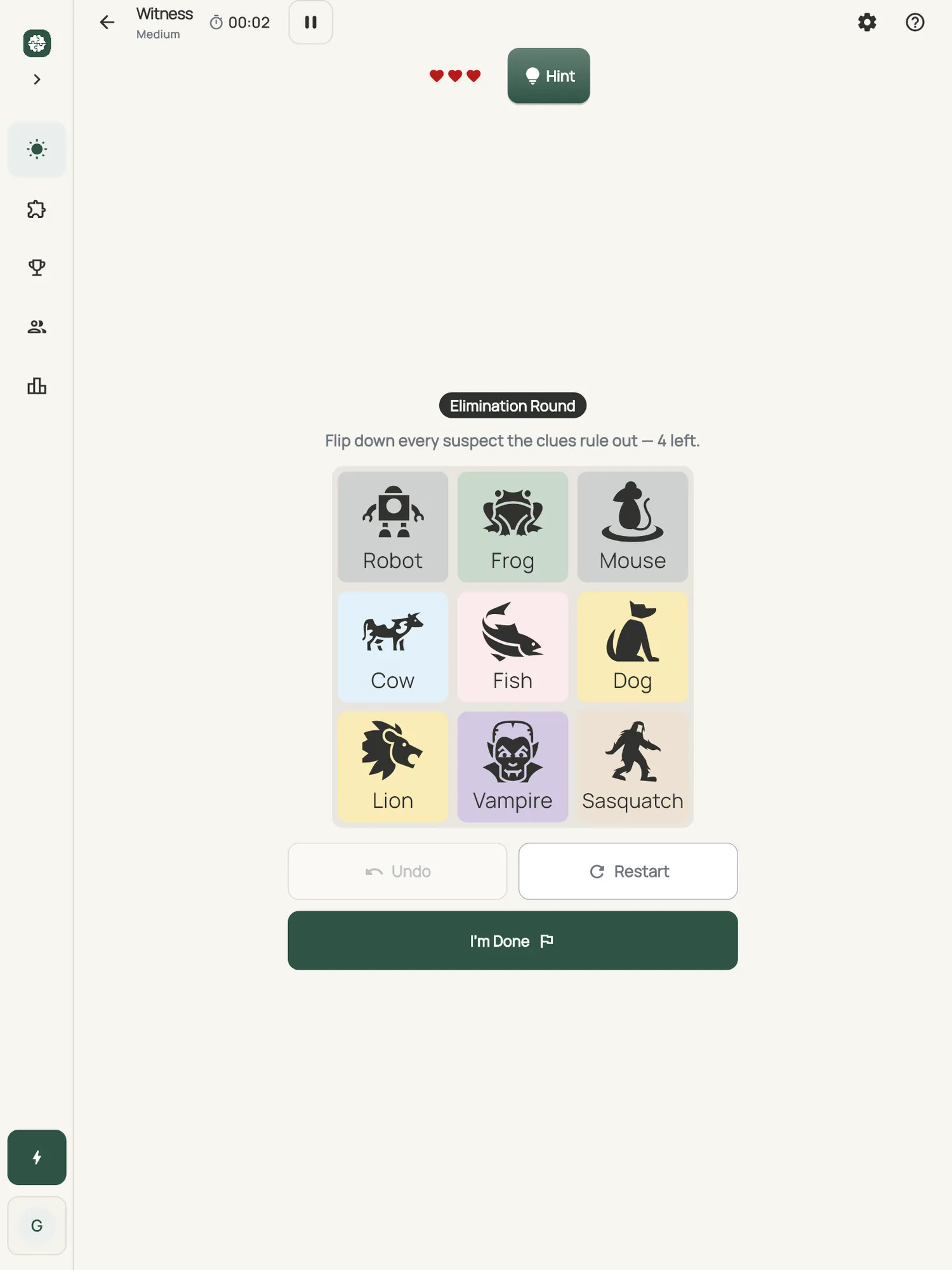
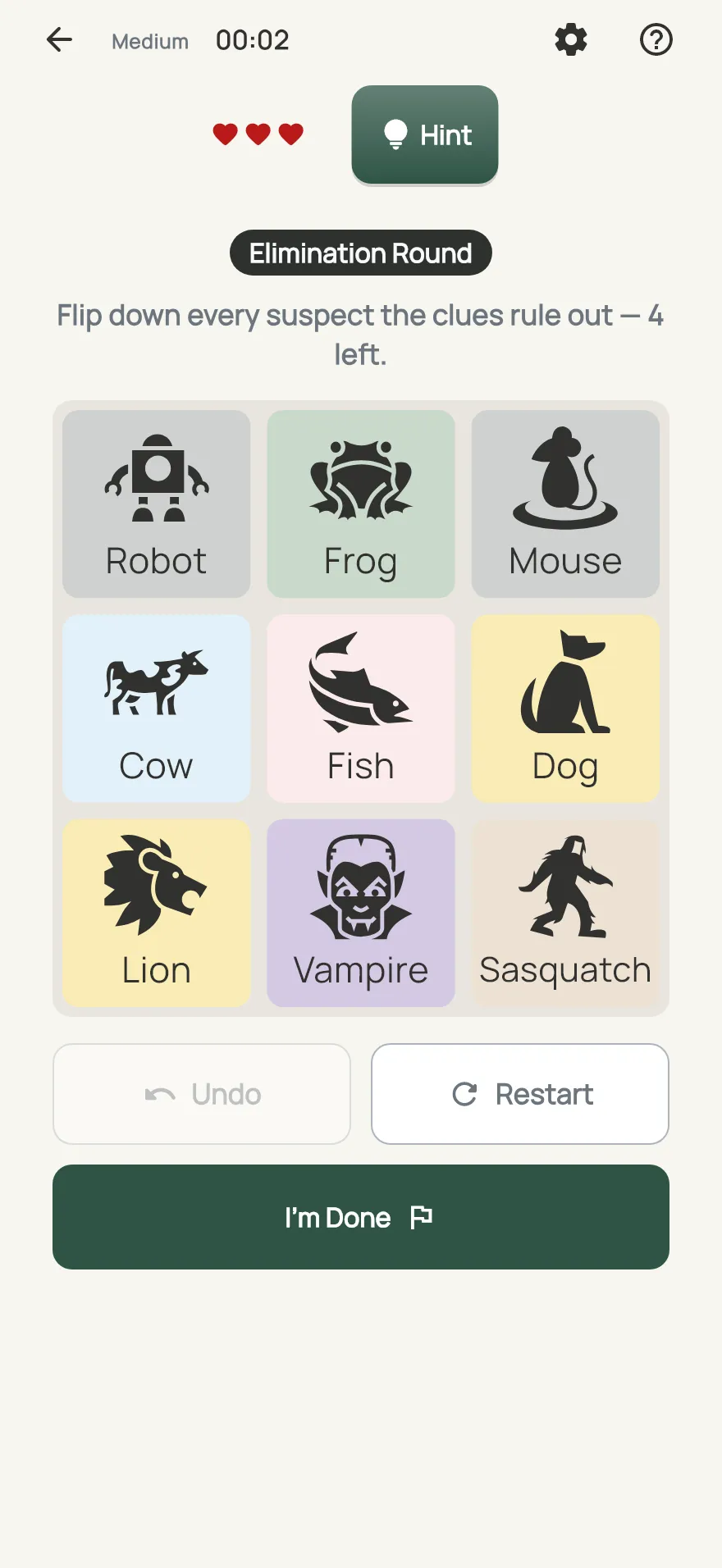
A witness saw the culprit and left a few clues, written as the culprit speaking: “I don't live in the water”, “I have four legs”. You read them for as long as you like and tap Ready. Then they are gone, and a board of suspects appears: animals, a robot, and five that are not real, including a dragon and a unicorn.
In round one you flip down every suspect who could not have given all the clues. A suspect who still fits will not go down, and trying costs a heart. When the round ends, the board shows who is left, and each clue over the suspects who could not have given it.
Round two brings a fresh set of clues about the suspects still standing, again shown once. These can be about habits and famous facts as well as looks — “I hunt for my food”, “I am usually more active at night”. Exactly one suspect fits every clue, and you accuse them.
When the case closes, a report goes through every suspect and its verdict. If you tried to rule out someone who still fitted, or accused the wrong one, the report opens on that card and goes through the clues one by one.
The Rules
- 1
Memorise the Clues
The culprit gave all of them, and nobody else could have given every one. They show for as long as you like, and they disappear when you tap Ready.
- 2
Round One: Flip Down Who They Rule Out
A card that contradicts any clue is out. A card that still fits will not go down, and trying costs a heart. Hearts never run out in the daily set.
- 3
Stop When You Have Gone as Far as You Can
I'm Done turns face down every suspect the clues rule out that you had not flipped yet, then moves the game on. You keep every suspect you found, and you still get to name the culprit.
- 4
Read the Second Set
Once the board is narrowed, a fresh set of clues arrives, shown once again, about the suspects who are left. These can be about what the culprit does or what it is known for, not just what the picture shows.
- 5
Round Two: Eliminate or Accuse
Tapping a suspect offers two choices. Eliminate turns the card over to keep track of your own working, and crossing off anyone but the culprit costs nothing. Accuse names them as the culprit, and a wrong name costs a heart. Exactly one suspect fits every clue.
- 6
Eliminate the Culprit and the Case Is Over
Crossing off the culprit in round two loses every heart at once, and the case closes on whoever you left standing. Nothing else you eliminate in round two costs anything.
- 7
Every Round Ends With Its Reasons
When a round closes, the board shows who is still standing and each clue over the suspects who could not have given it. The round is already over and scored, so reading costs nothing.
- 8
A Hint Gives a Clue Back
It hands you one clue you were shown, word for word, and never points at a card. It skips the clues you have already finished with.
Where Witness Comes From
Witness is a deduction game Dayzle made, and it borrows from yes-or-no guessing games. The oldest well-known one is Twenty Questions: in a letter of 1786 Hannah More wrote of teaching it to guests at a London dinner party, and Charles Dickens put a version called Yes and No into A Christmas Carol.
Witness changes who does the asking. Nobody answers your questions: the clues arrive all at once, you read them once, and after that you work from what you remember. A hint can hand one clue back, word for word.
How the Levels Differ
Easy: 6 suspects and 2 clues, and you are told that 4 will be left standing; round two brings 2 more clues. Medium: 9 suspects and 3 clues, with the count still shown; round two brings 3. Hard: 16 suspects and 4 clues in each round, and from here no count to check yourself against. Extra Hard: 24 suspects, 5 clues in round one and 4 in round two, and no count.
The clues you have to hold are what make a band harder: 4 across both rounds on Easy, 9 on Extra Hard. More suspects mean more cards to check against them, and without the count you cannot tell how many are left to flip until you have checked every card.
How a board gets harder.
Witness has one deduction — does this card contradict a clue I was told? — and a ladder with one step would teach nothing, so a hint gives back one of the clues word for word. What grows with the band is how much you hold and how many cards you hold it against: 4 clues and 6 suspects on Easy, up to 9 clues and 24 suspects on Extra Hard. The number left standing after round one — 4, 4, 6 and 8 — follows a different rule: it is always more than the standard 3 hearts, so flipping every card to find the survivors costs more hearts than a board starts with.
More word games.
Words
Beacon
Watch the words light up, tap them back in order
Words
Loom
A crossword with no clues — place each block's letters
Words
Cipher
Deduce the hidden word
Words
Word Search
Find the listed words hidden in a grid
Words
Tumbler
Turn one word into another, a letter at a time
Words
Forage
Build words from a bag of letters
Today's five are waiting.
Download it free on the App Store or Google Play, or log in and play today's set right in your browser. Same puzzles, same streak, wherever you play.