
Equinox
Fill every cell of a 6×6 grid with a Sun or a Moon, so each row and column holds three of each and never three of one side by side.


- Four levels: Easy to Extra Hard
- 8 techniques on its ladder
How Equinox Works

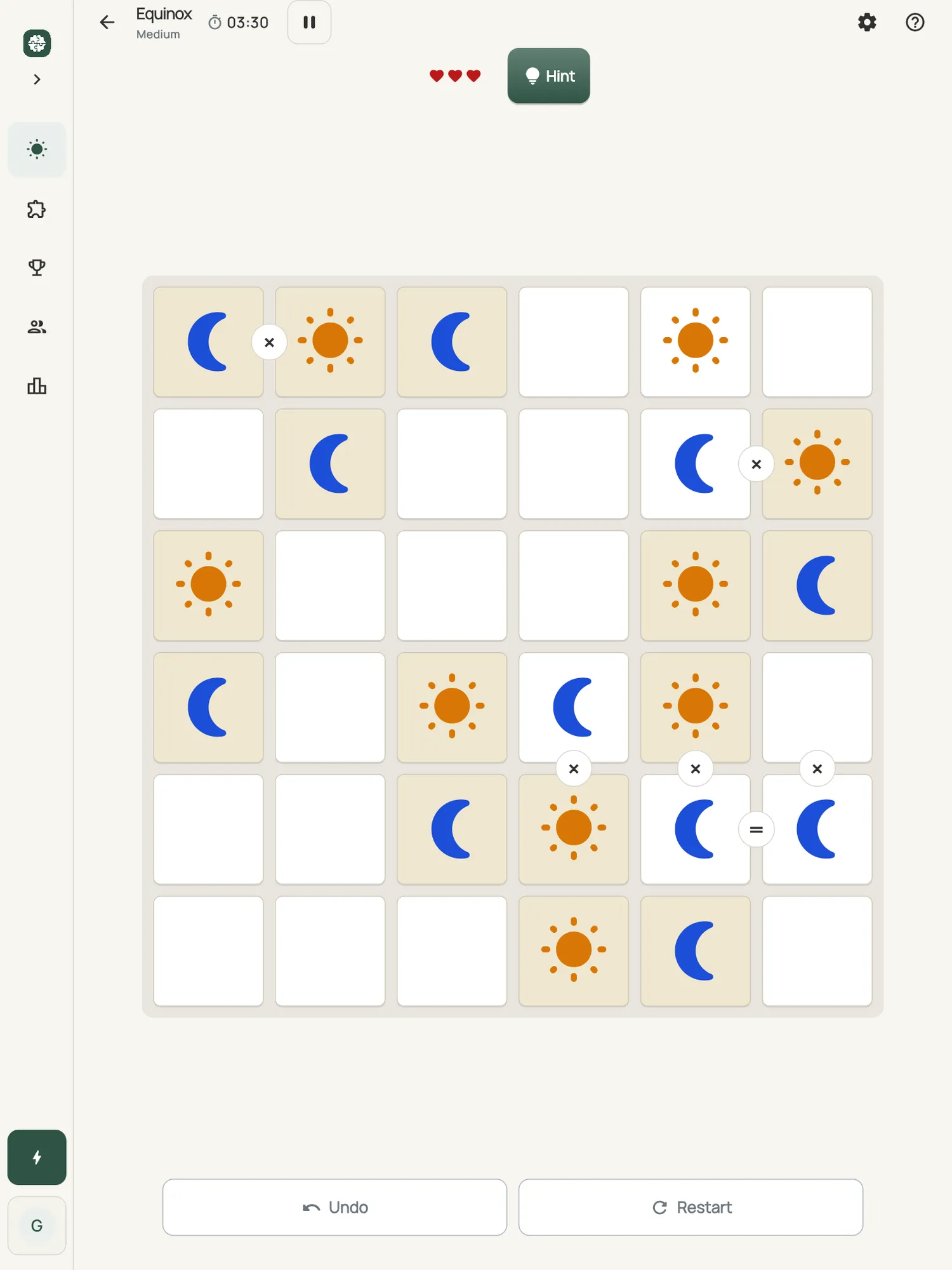
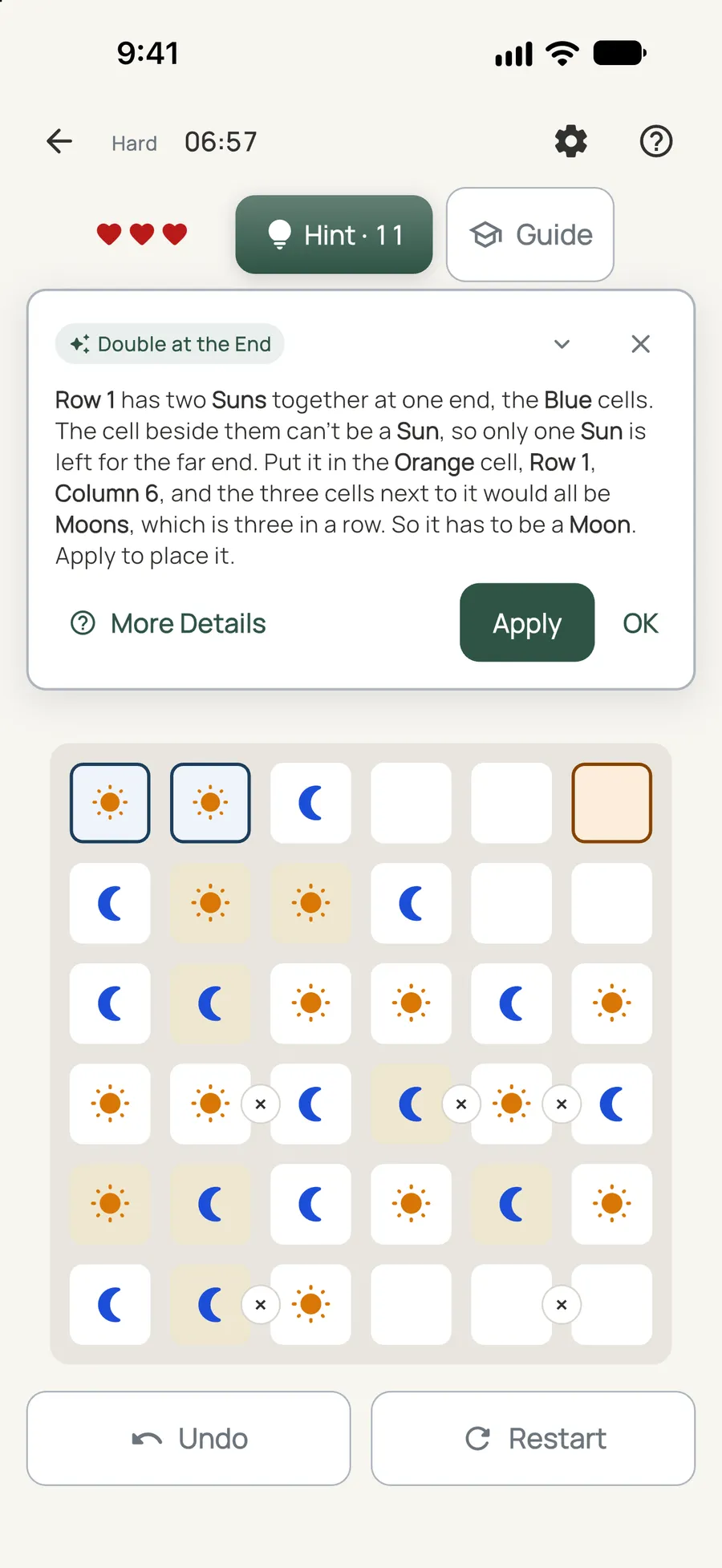
Equinox is a binary logic puzzle: every cell ends up holding one of two symbols. Some cells start filled and locked. A few pairs of neighbouring cells have a small marker between them: = means the two cells hold the same symbol, and × means they differ.
Every board has exactly one solution, and you can reach it one cell at a time without guessing. The grid is 6×6 on every band, and the number of cells filled at the start barely moves: an Extra Hard board starts with 8.4 filled cells on average and a Hard board with 10.6. What changes is the reasoning a board asks for.
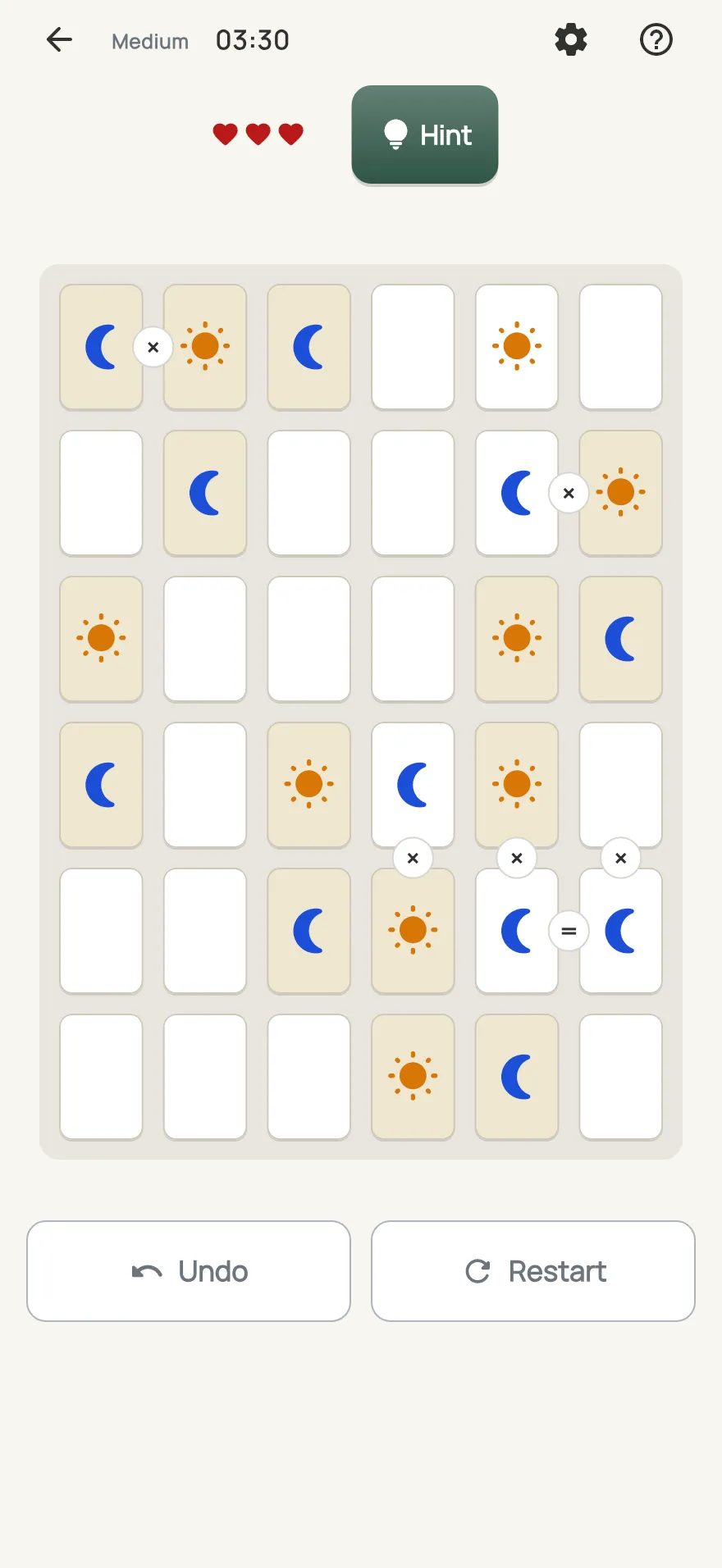
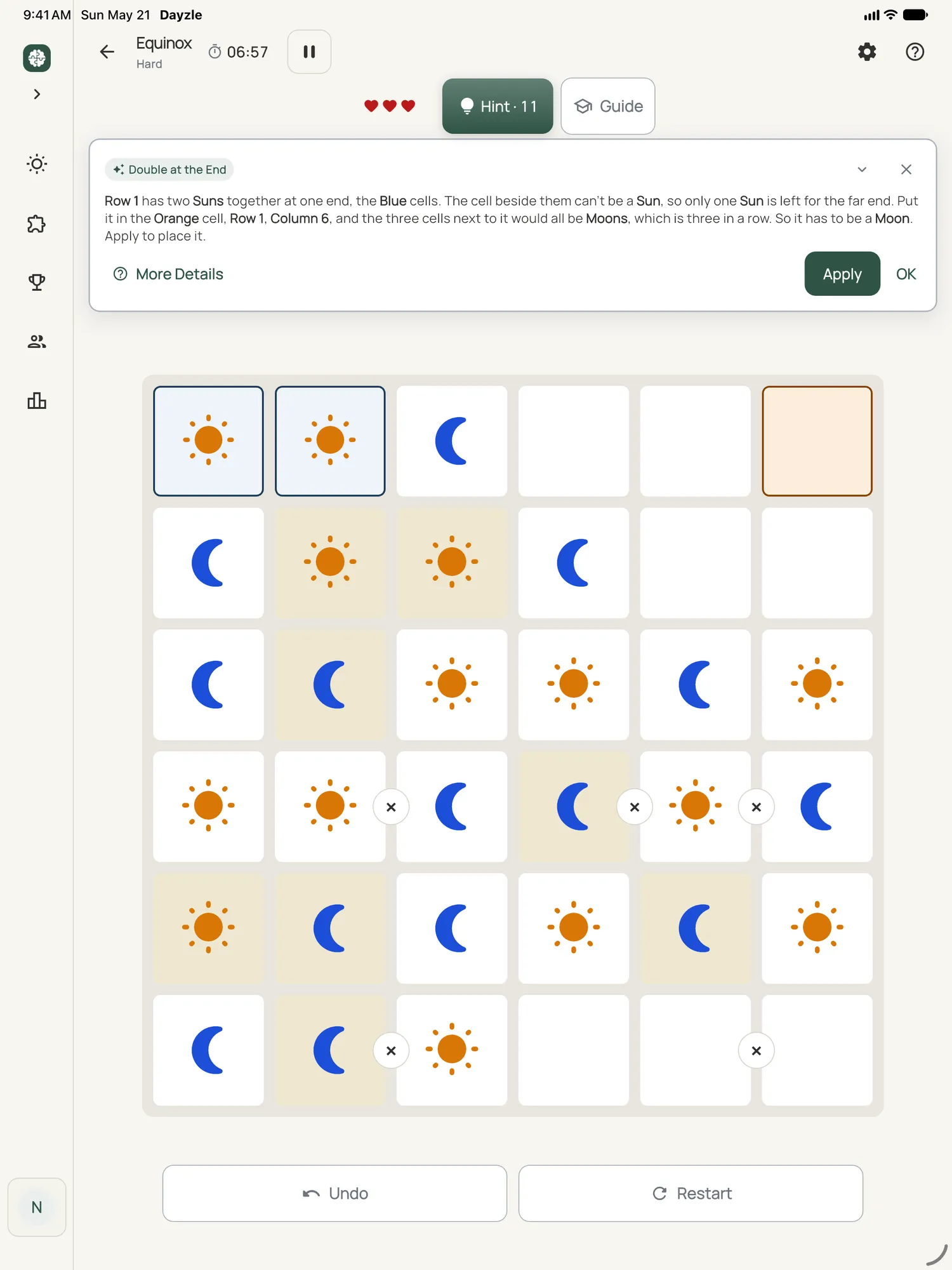
A hint lights the cells that prove the next step in Blue and the cell it fills in Orange. The card explains the step by trying the other symbol and showing which rule it would break, and nothing is written until you press Apply.
The name comes from the balance rule. An equinox is one of the two days in the year when daylight and darkness come out even, and here every row and column comes out even too.
The Rules
- 1
Fill Each Cell
Every cell holds a Sun or a Moon. Each tap moves an open cell on one step: empty, Sun, Moon, then empty again. Cells that start filled are locked.
- 2
Keep the Balance
Each row and each column needs three Suns and three Moons.
- 3
Never Three in a Row
Three of the same symbol may never sit side by side in a row or a column.
- 4
Mind the Markers
Two cells with an = marker between them must match. Two with a × marker must differ.
- 5
A Rule Break Left on the Board Costs a Heart
Passing through a rule break on the way to the right symbol is fine. A break still on the board after two seconds is marked, and costs a heart. A practice board has three hearts, and hearts never run out in the daily set.
The real screens.
Every picture on this page is the app itself, on a board from the game.
Where Equinox Comes From
Equinox belongs to the binary puzzle family, best known as Takuzu or Binairo. Binairo was created by the Belgians Peter De Schepper and Frank Coussement in 2009, and Tohu-Wa-Vohu, invented by the Italian Adolfo Zanellati, is another early version. The puzzle has since been published under more than ten names, among them Binero, Binoxxo and Tic-Tac-Logic.
The classic fills a grid with 0s and 1s. Every row and column holds equal numbers of each, no more than two of the same digit may sit side by side, and no two rows or columns may be identical. Equinox keeps the first two rules on a 6×6 grid of Suns and Moons, leaves out the identical-rows rule, and adds the = and × markers between neighbouring cells.
How the Levels Differ
The board is always 6×6, so the bands differ in the hardest technique a board requires. Easy boards take about 21 moves and need only No Three in a Row and Line Balance. Medium boards take about 22 moves, carry about 4 markers, and need Edge Marker at least once.
Hard boards take about 26 moves and add Double at the End, Matching Ends and Touching Pair, at least two and at most five of them per board. Extra Hard boards take about 28 moves, carry about 5 markers, and add Pair and Balance and Only One Way to Finish, at least three and at most seven per board. Easy and Medium boards never require a Hard technique.
8 techniques, easiest first.
In Dayzle the hint and the solver are one engine, so these are the steps it takes to solve a Equinox board, from the first you'll meet to the rarest. Open one for a worked example and a clip of the hint teaching it on a real board.
No Three in a Row Basic Find two of a symbol side by side, or two with one gap between them. The cells beside the pair, or the gap, take the other symbol.
Row 2 has Moons at Column 3 and Column 4. A Moon at Column 2 or Column 5 would make three in a row, so both are Suns.
The gap works the same way. With Suns at Column 1 and Column 3, a Sun at Column 2 would make three, so it is a Moon. Running your eye along each row and column looking only for pairs and gaps fills many cells before you count anything.


Line Balance Basic Find a row or column that already has three of one symbol. Every empty cell left in it is the other symbol.
Column 5 already has three Suns. Every line has exactly three of each symbol, so a fourth Sun is impossible, and the column's three empty cells are all Moons.
Counting is the second thing to try, after looking for pairs, and it often finishes a whole line at once.

Edge Marker Intermediate Find a marker next to a filled cell. The cell on its other side follows at once.
Row 4, Column 1 is a Sun, and a × marker sits between it and Row 4, Column 2. The two cells must differ, so Row 4, Column 2 is a Moon.
A marker is a rule of its own, separate from the counting and the three-in-a-row rule. Check the markers each time you fill a cell next to one, because they carry what you know from one line into another.

Double at the End Intermediate Find two of a symbol together at one end of a line. The cell at the far end takes the other symbol.
Row 1 has Moons at Column 1 and Column 2, so Column 3 is a Sun. That leaves one Moon for Columns 4 to 6. Put it at Column 6 and Columns 3, 4 and 5 would all be Suns, three in a row. So Column 6 is a Sun.
The rule also reads backwards. With a Moon at Column 1 and another at Column 5, a third Moon at Column 6 would leave Columns 2, 3 and 4 all Suns. So Column 6 is a Sun here too.

Matching Ends Advanced Find a line with the same symbol at both ends. The two cells next to the ends take the other symbol.
Column 2 has a Sun in Row 1 and a Sun in Row 6. Two of its three Suns are used, so one is left for the four cells between them.
Put that Sun in Row 2 and Rows 3, 4 and 5 would all be Moons, three in a row. The same happens if it goes in Row 5. So Row 2 and Row 5 are both Moons.

Touching Pair Advanced Find an = marker with both cells still empty. If one filling would make three in a row, the pair is the other symbol.
An = marker joins Row 3, Column 4 and Row 3, Column 5, and both are empty. They hold the same symbol, so they can only be two Suns or two Moons.
Row 3, Column 3 is already a Sun, so two more Suns beside it would make three in a row. The pair is two Moons, and both cells fill at once.

Pair and Balance Advanced Count a marked pair against what its line still needs. A pair can settle the line's other cells, or itself, before you know either of its cells.
An = pair holds two of the same symbol. Row 5 already has two Moons, so it has only one left and can't afford a pair of them. The pair is two Suns.
A × pair always holds one Sun and one Moon. Row 6 has two Suns and one Moon placed and three empty cells, two of them a × pair. The row still needs one Sun and two Moons. Set one of each aside for the pair and the third empty cell must be a Moon, while the pair itself stays unknown.

Only One Way to Finish Expert Write out every allowed way to finish one line. If they all agree on a cell, that cell is settled.
Try a Sun in Row 1, Column 4, then list every way to fill the rest of Row 1 that keeps three of each symbol, never three in a row, and every marker on the row. If none of them works, Row 1, Column 4 is a Moon.
The hint's More Details lists each of those fillings and the rule it breaks, so you can check the claim yourself.

More visual games.
Visual
Crowns
One crown per row, column, and colour — none touching
Visual
Parcel
Divide the board into rectangles that match their clues
Visual
Crowns Hive
Star Battle on a hexagon: one crown per line, three ways
Visual
Mosaic
Fit the pieces to cover the board exactly
Visual
Mosaic Hive
Pack polyhex pieces into a hexagonal board
Visual
Trailhead
Draw one closed loop that satisfies every clue
Today's five are waiting.
Download it free on the App Store or Google Play, or log in and play today's set right in your browser. Same puzzles, same streak, wherever you play.