
Mosaic
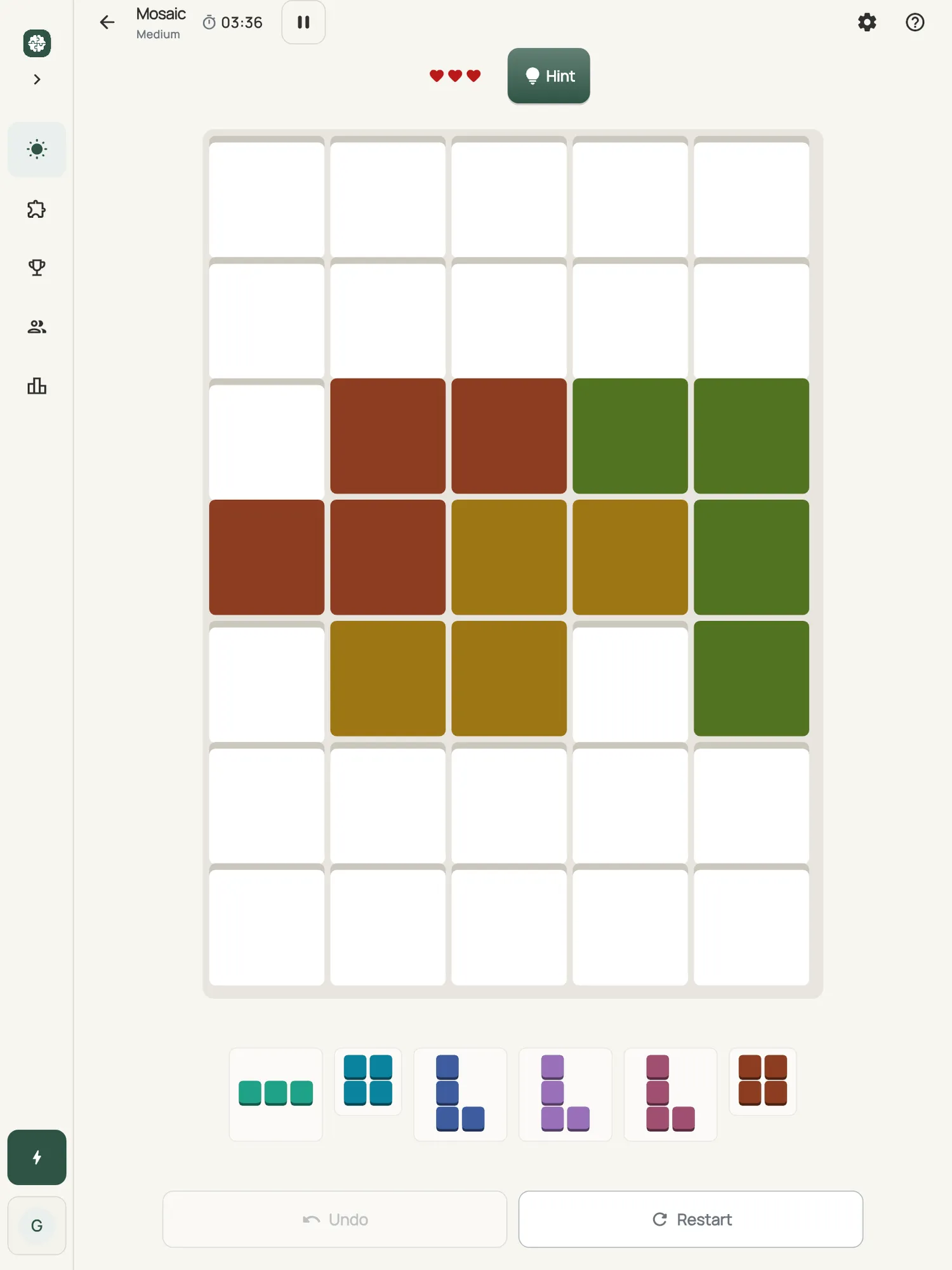
Fit the pieces into the board so they fill it exactly. Turn a piece if it does not fit.


- Four levels: Easy to Extra Hard
- 3 techniques on its ladder
How Mosaic Works

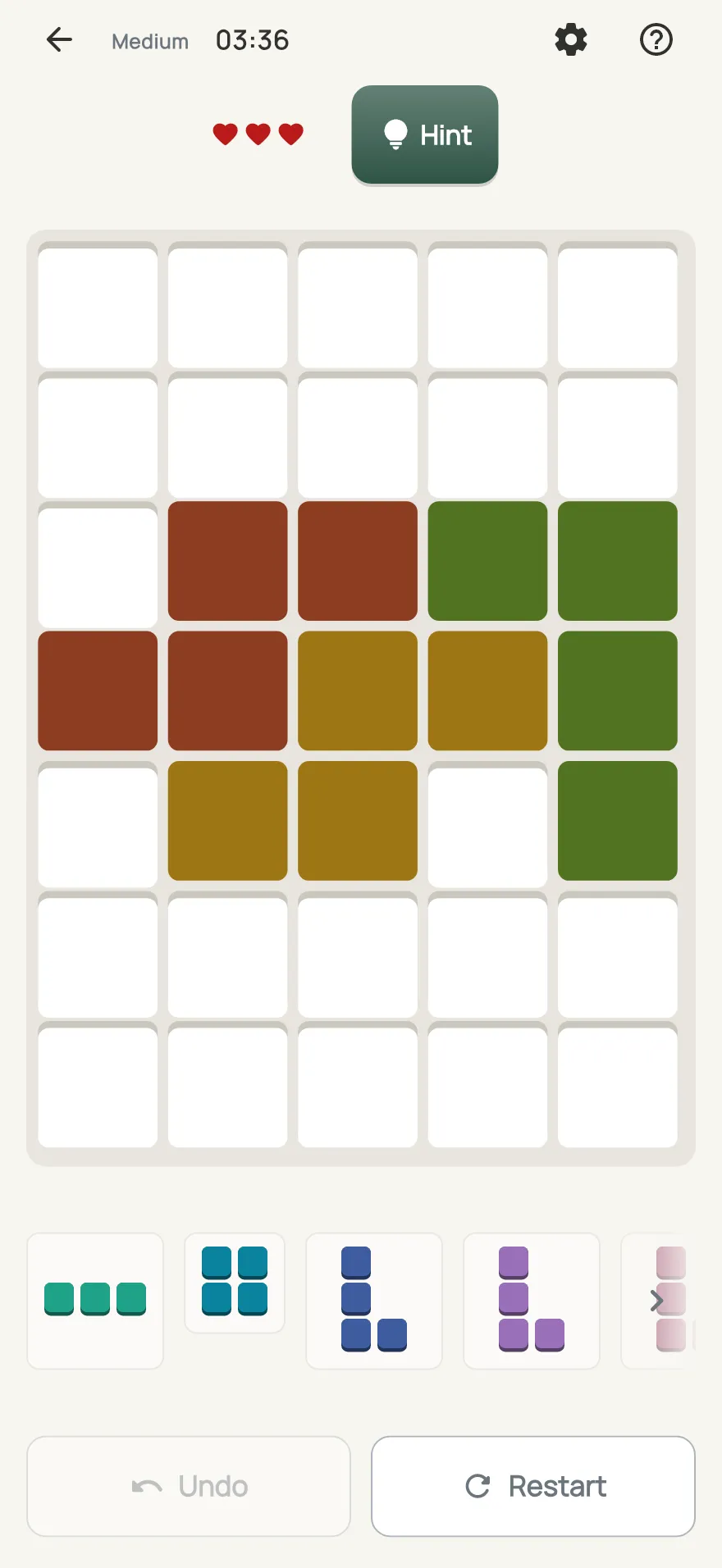
Mosaic gives you a rectangular board and a tray of pieces, each made of three, four or five squares joined edge to edge. You turn the pieces and drag them onto the board until every cell is covered, with nothing overlapping and nothing hanging off the edge. A few pieces start already placed and locked.
Every board can be worked out from its starting pieces without guessing: at each step some piece has only one place left, or some square can only be covered by one piece. That is checked for every board before it ships.
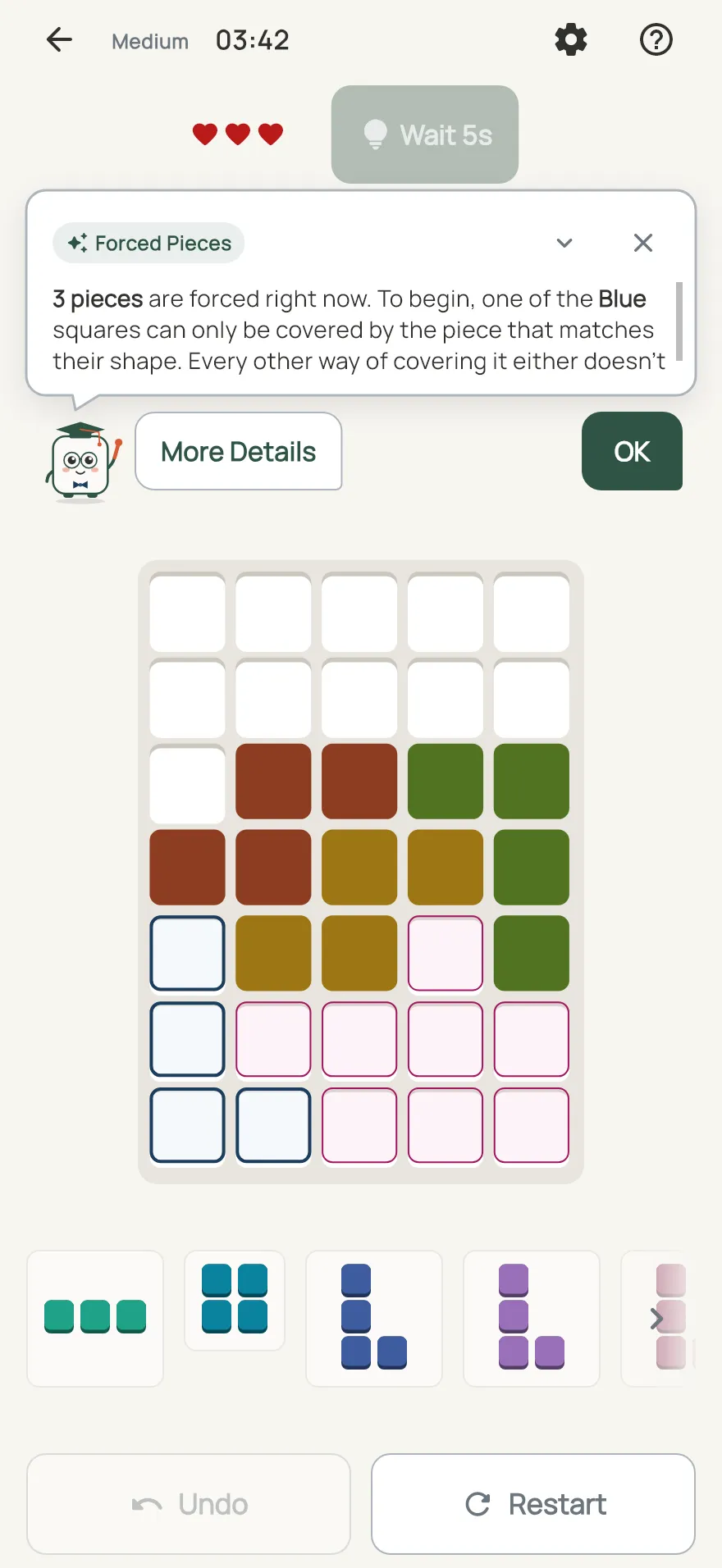
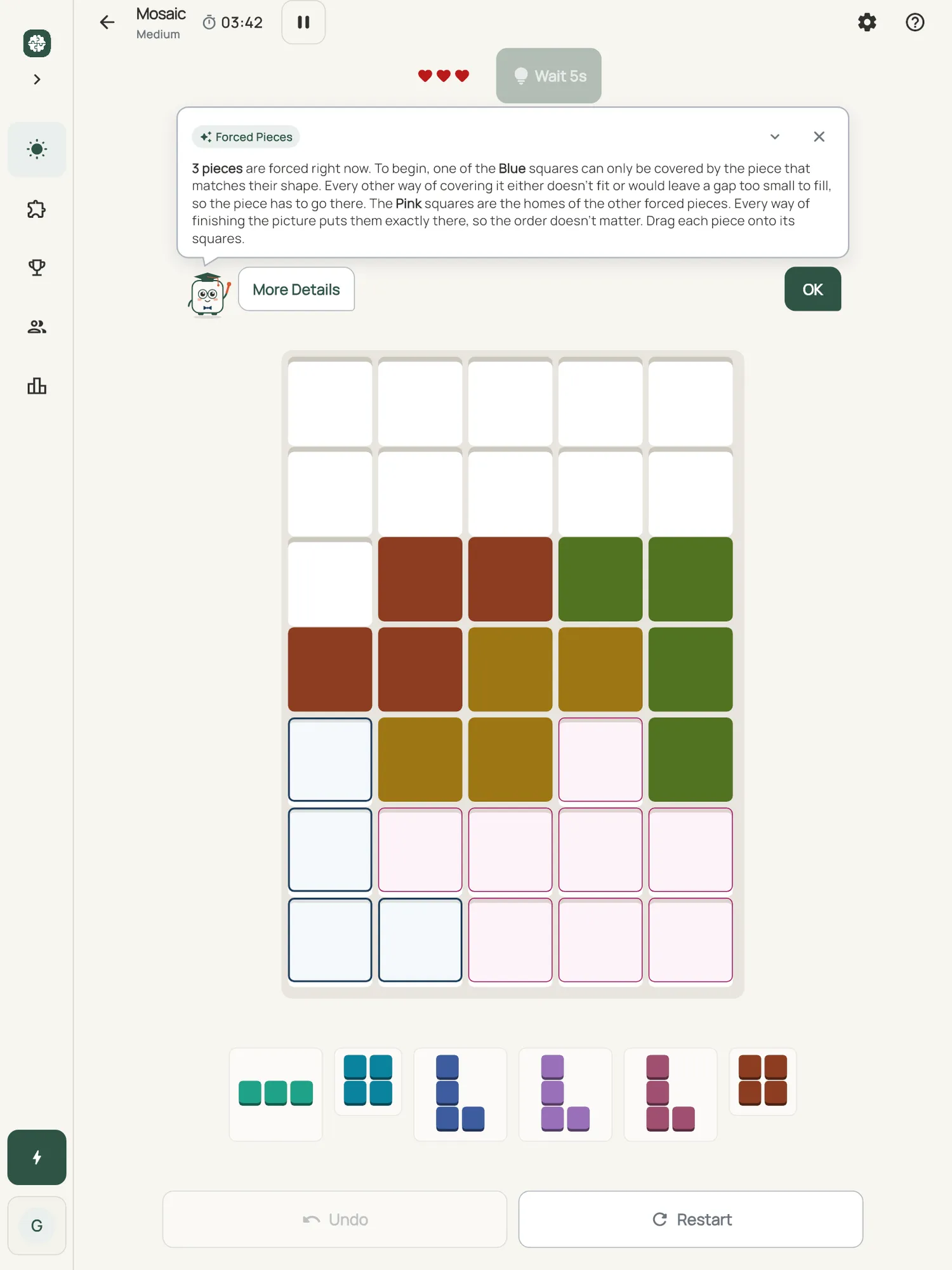
A hint lights the spot for a piece whose place is forced and says why. When several pieces are forced at once, it shows all of them and says they can go down in any order. The hint never places a piece for you; you still turn it and drag it yourself.
Mosaic Hive plays the same way on a hexagonal board, with pieces made of hexagons.
The Rules
- 1
Drag to Place
Drag pieces from the tray onto the board.
- 2
Rotate to Fit
Tap a piece in the tray to turn it a quarter turn clockwise. Pieces turn but do not flip. From Hard up, the tray can hold a shape and its mirror image as two separate pieces.
- 3
Move It If It Is Wrong
Drag a piece already on the board to shift it, or drag it off the board to put it back in the tray. A tap puts it back too. The pieces the board starts you with stay put.
- 4
Cover Everything
Fill every cell with no overlaps and nothing hanging off the edge.
- 5
A Dead End Costs a Heart
A piece that leaves the board impossible to finish costs a heart, and stays where you dropped it until you move it. A drop that overlaps a piece or hangs off the edge is refused: your score counts it as a mistake, but it costs no heart. Moving or lifting a piece is free. A practice board has three hearts, and hearts never run out in the daily set.
The real screens.
Every picture on this page is the app itself, on a board from the game.
Where Mosaic Comes From
Shapes built from squares joined edge to edge got their name in 1953, when the mathematician Solomon Golomb coined the word polyomino in a talk to a Harvard maths club. The puzzles are older than the word: Henry Dudeney's book The Canterbury Puzzles, published in 1907, already set a puzzle with a full set of five-square pieces. A magazine column in 1957 brought them to a wide audience, and the name stuck.
Mosaic is a polyomino packing puzzle using pieces of three, four and five squares. Dayzle's boards are taller than they are wide, to fill a phone screen, and every one is built so it can be solved by reasoning from the pieces already placed.
How the Levels Differ
Easy is a 4×6 board with 5 pieces, 2 of them already placed, so you place 3. Medium is 5×7 with 9 pieces and 3 placed, so you place 6. Hard is 6×8 with 11 pieces and 3 placed, so you place 8, and the tray can hold a shape and its mirror image. Extra Hard is 7×9 with 16 pieces and 5 placed, so you place 11.
The reasoning climbs too. Easy needs only Only Fit. From Medium up, boards also need Only Cover and Gap Check: on Medium 17% of steps only work once you rule out spots that would leave a gap too small to fill, on Hard 37%, and on Extra Hard 40%. Hard and Extra Hard are also built so the middle of the board has fewer obvious moves: on Extra Hard about 6 in 10 moves in the middle fill an obvious hole, against about 9 in 10 at the start.
3 techniques, easiest first.
In Dayzle the hint and the solver are one engine, so these are the steps it takes to solve a Mosaic board, from the first you'll meet to the rarest. Open one for a worked example and a clip of the hint teaching it on a real board.
Only Fit Beginner Find a piece that has only one spot left on the board. That is where it goes.
Take the straight piece of four and try it in every spot, in both of its turns. Laid across, it no longer fits anywhere without overlapping a placed piece or hanging off the edge. Standing up, it fits only in Column 1, Rows 3 to 6. So that is where it goes.
Easy boards can be solved with this step alone.


Only Cover Basic Find a square that only one piece, in one position, can cover. That piece has to go there.
Look at the top-left corner square, Row 1, Column 1, and ask what could ever cover it. Try every piece in your tray, in every turn, in every position that reaches it. All but one overlap a placed piece or run off the board.
So the one that fits is the only piece that can cover the corner, and it goes there. Corners, notches and tight spots are the squares worth asking this about.

Gap Check Intermediate Rule out any spot that would seal off a hole too small, or the wrong shape, for the pieces left in your tray.
A piece can fit a spot and still be wrong because of the hole it leaves. If putting a piece in Row 5 walls off 3 empty squares and the smallest piece left in your tray has 4, that hole can never be filled, so the spot is out.
Once those spots are gone, a piece or a square is often down to one choice, and Only Fit or Only Cover finishes the step. When a hint needed this check, its card says so: every other spot for the piece "would leave a gap too small for anything still in your tray".
More visual games.
Visual
Mosaic Hive
Pack polyhex pieces into a hexagonal board
Visual
Parcel
Divide the board into rectangles that match their clues
Visual
Crowns
One crown per row, column, and colour — none touching
Visual
Crowns Hive
Star Battle on a hexagon: one crown per line, three ways
Visual
Equinox
Balance suns and moons in every row
Visual
Trailhead
Draw one closed loop that satisfies every clue
Today's five are waiting.
Download it free on the App Store or Google Play, or log in and play today's set right in your browser. Same puzzles, same streak, wherever you play.