
Mosaic Hive
Fit the pieces into a hexagonal board so they fill it exactly. A piece has six turns, not four.


- Four levels: Easy to Extra Hard
- 3 techniques on its ladder
How Mosaic Hive Works

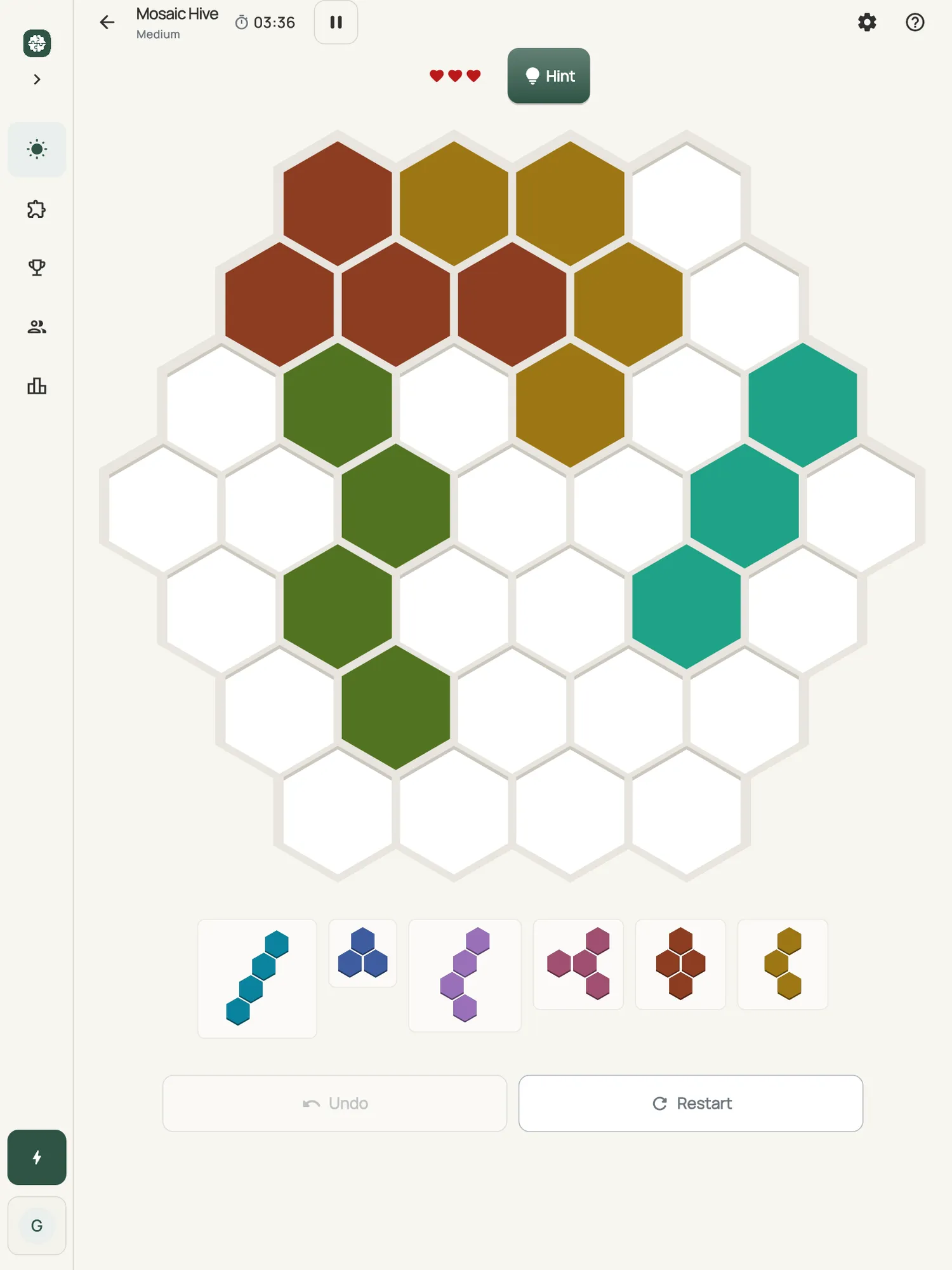
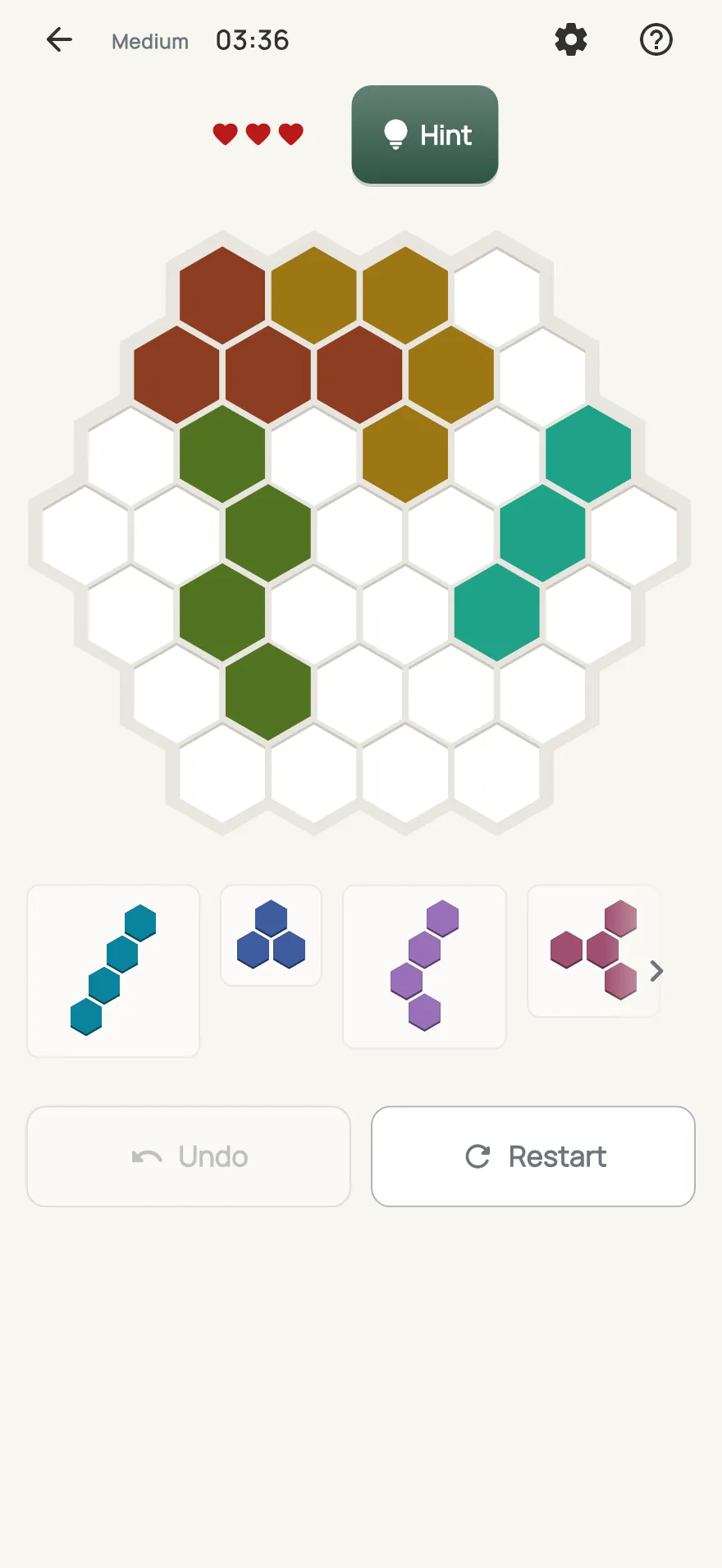
Mosaic Hive is Mosaic on a hexagon. The board is a hexagon of six-sided cells, and the tray holds pieces made of three or four hexagons joined edge to edge. Cover every cell, with nothing overlapping and nothing hanging off the edge. A few pieces start already placed and locked.
The pieces come from a set of ten shapes: the three made of three hexagons and the seven made of four. Every board draws from those ten, so you meet the same shapes again and again. Tap a piece to turn it one step clockwise, and press and hold to turn it back.
The hard part is reading a gap. On Mosaic's square board you can usually tell at a glance whether a piece fits a hole. On a hexagon, a hole that looks fillable often isn't, so count the cells a placement would close off before you drop it.
Mosaic Hive is played in practice. It is not part of the daily set.
The Rules
- 1
Drag to Place
Drag pieces from the tray onto the hexagonal board.
- 2
Tap to Turn, Hold to Turn Back
A piece has six turns. Tap it in the tray to turn it one step clockwise; press and hold it to turn it back a step.
- 3
Move It If It Is Wrong
Drag a piece already on the board to shift it, or drag it off the board to put it back in the tray. A tap puts it back too. The pieces the board starts you with stay put.
- 4
Cover Everything
Fill every cell with no overlaps and nothing hanging off the edge. A hole on a hexagon board is harder to read than one on a square board, so count the cells a placement closes off.
- 5
A Dead End Costs a Heart
A piece that leaves the board impossible to finish costs a heart, and stays where you dropped it until you move it. A drop that overlaps a piece or hangs off the edge is refused: your score counts it as a mistake, but it costs no heart. Moving or lifting a piece is free. Each board gives you three hearts.
The real screens.
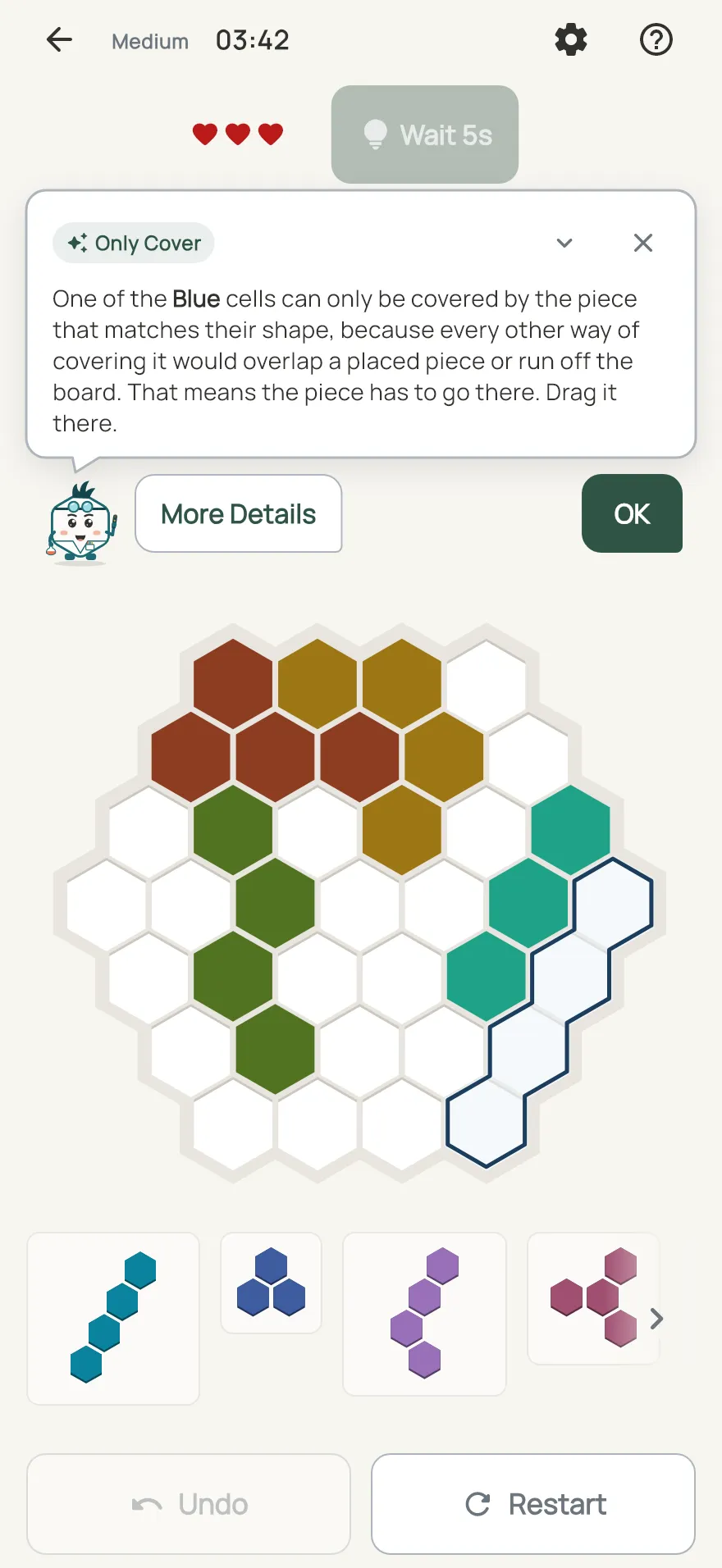
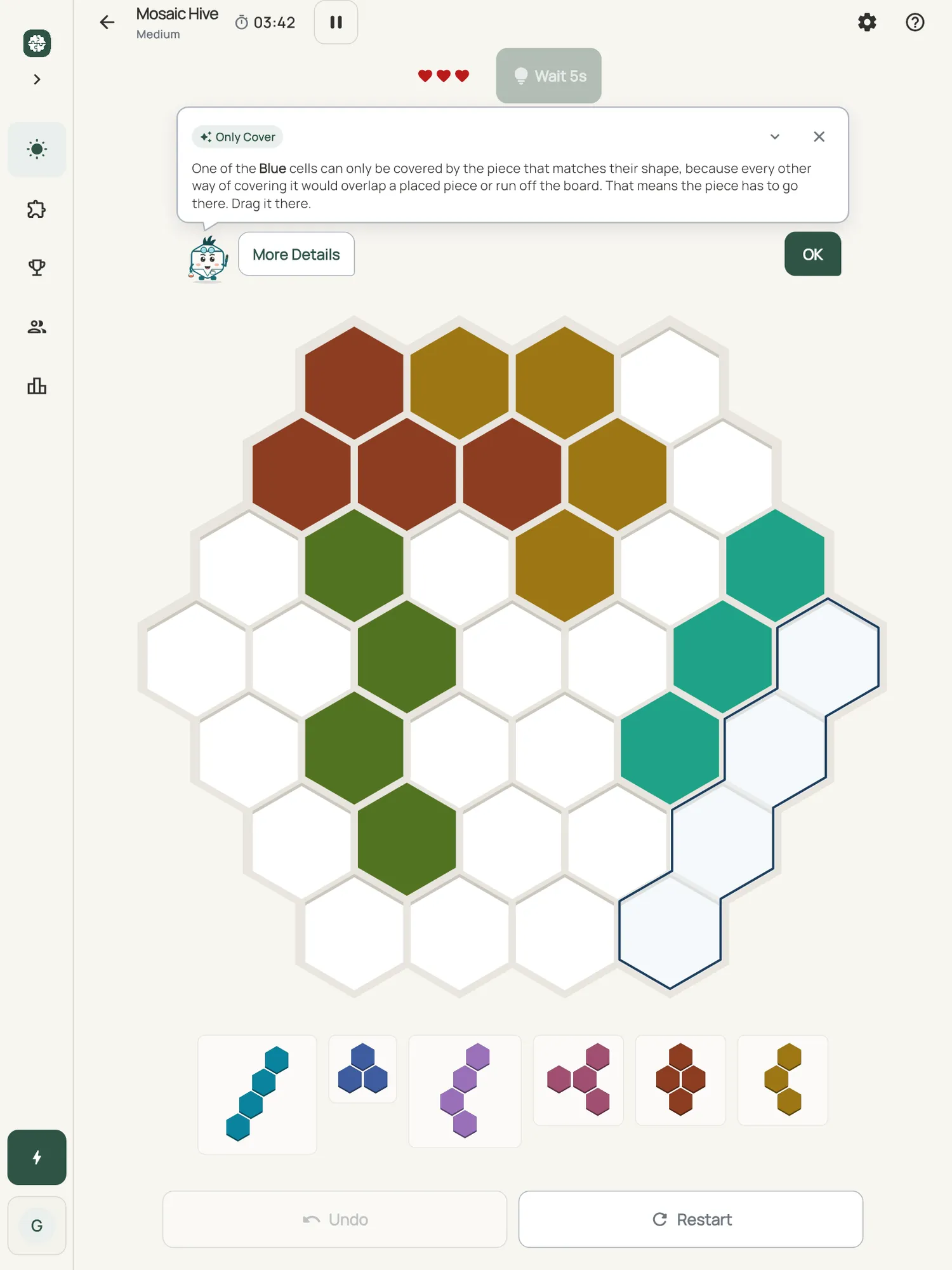
Every picture on this page is the app itself, on a board from the game.
Where Mosaic Hive Comes From
Shapes built from hexagons joined edge to edge are called polyhexes. The mathematician David Klarner named them in the 1960s, about a decade after Solomon Golomb named the square pieces, polyominoes, that Mosaic is built from. There are 3 polyhexes of three cells and 7 of four, and 22 of five.
Dayzle built Mosaic Hive in September 2026 by moving Mosaic's rules and solver onto a hexagon. It uses only the ten shapes of three and four cells and leaves out the 22 five-cell shapes, so that every shape becomes familiar. Three of the four-cell shapes have a separate mirror image, and only Extra Hard deals those.
Two playtests reshaped the bands, and both came back to the same finding: a tray that repeats one shape many times is easier, because a spot that fits the repeated shape is probably right. A tray now holds at most two copies of any shape, and Medium deals one of every shape.
How the Levels Differ
Easy is a hexagon of 19 cells with 5 pieces, 2 of them already placed, so you place 3. Medium is 37 cells with 10 pieces and 4 placed, so you place 6. Hard is 61 cells with 16 pieces and 7 placed, so you place 9. Extra Hard is the same 61 cells and 16 pieces with 6 placed, so you place 10, and its tray adds mirror-image pieces: a shape and its reflection fit in different places.
Easy needs only Only Fit. From Medium up, boards also need Only Cover and Gap Check, and the number of spots a piece could go at each step climbs from about 5 on Easy to about 28 on Medium, 65 on Hard and 76 on Extra Hard. Hard and Extra Hard are also built so that no more than 6 in 10 moves in the middle of the board fill an obvious hole.
3 techniques, easiest first.
In Dayzle the hint and the solver are one engine, so these are the steps it takes to solve a Mosaic Hive board, from the first you'll meet to the rarest. Open one for a worked example and a clip of the hint teaching it on a real board.
Only Fit Beginner Find a piece that has only one spot left on the board. That is where it goes.
Take the straight piece of three hexagons and try it in every spot, in every one of its six turns. Every try but one overlaps a placed piece or hangs off the edge. The one that is left, along Row 2, is where it goes.
Easy boards can be solved with this step alone.


Only Cover Basic Find a cell that only one piece, in one position, can cover. That piece has to go there.
Pick a corner cell of the hexagon and ask what could ever cover it. Try every piece in your tray, in every one of its six turns, in every position that reaches that cell. All but one overlap a placed piece or run off the board.
So that one piece has to go there. The corners of the hexagon, and any cell walled in on most of its six sides, are the ones worth asking this about.

Gap Check Intermediate Rule out any spot that would seal off a hole too small, or the wrong shape, for the pieces left in your tray.
A piece can fit a spot and still be wrong because of the hole it leaves. If a placement walls off 2 empty cells and every piece left in your tray has at least 3, that hole can never be filled, so the spot is out. On a hexagon a hole like that is harder to see than on Mosaic's square board.
Once those spots are gone, a piece or a cell is often down to one choice, and Only Fit or Only Cover finishes the step.
More visual games.
Visual
Mosaic
Fit the pieces to cover the board exactly
Visual
Crowns Hive
Star Battle on a hexagon: one crown per line, three ways
Visual
Crowns
One crown per row, column, and colour — none touching
Visual
Equinox
Balance suns and moons in every row
Visual
Trailhead
Draw one closed loop that satisfies every clue
Visual
Mirror
Flip the cards, find the pairs
Today's five are waiting.
Download it free on the App Store or Google Play, or log in and play today's set right in your browser. Same puzzles, same streak, wherever you play.