
Parcel
Divide the whole board into rectangles, one per clue. Each rectangle matches the shape its clue names, and its number of cells when the clue gives one.


- Four levels: Easy to Extra Hard
- 4 techniques on its ladder
How Parcel Works

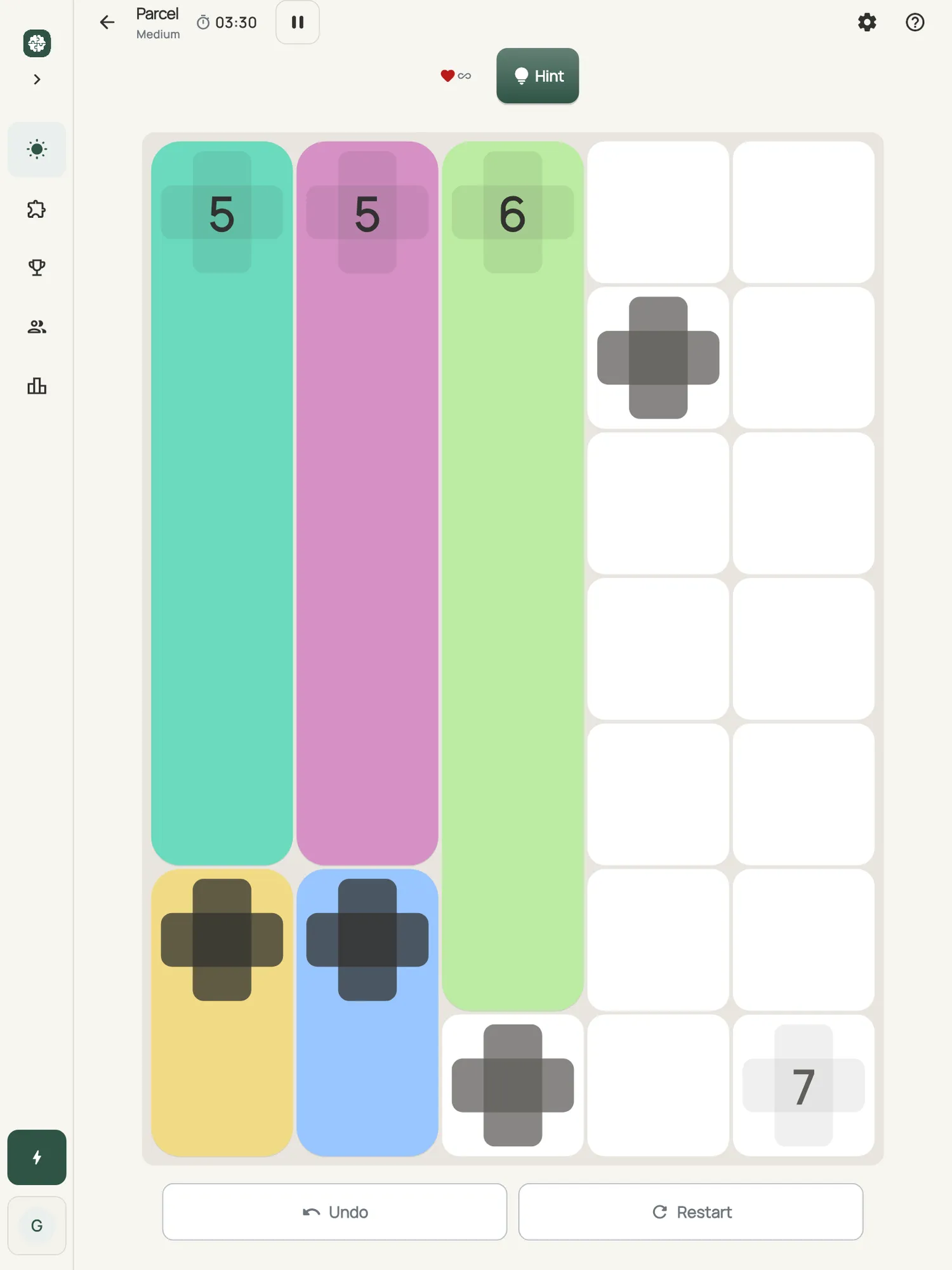
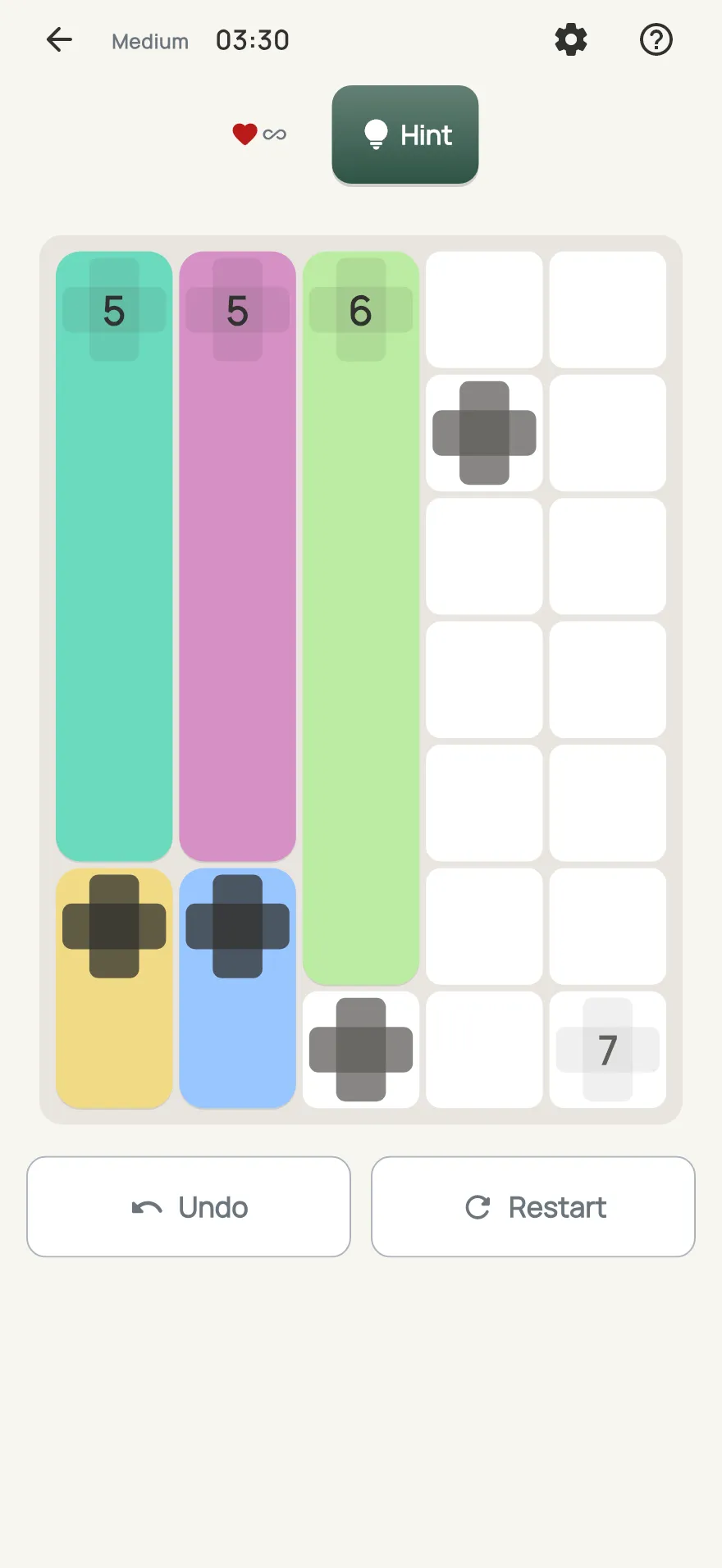
Every cell belongs to exactly one parcel, and every parcel is a rectangle holding exactly one clue, so the number of clues is the number of parcels. A clue always names a shape: Square, Flat (wider than tall), Tall (taller than wide) or Any Rectangle (anything but a square). Some clues also give a number of cells.
A clue of 12 could be a 2 by 6, 3 by 4 or 1 by 12 rectangle. A prime like 7 can only be a single strip, and only a square number like 4 or 9 can be a Square. No parcel is ever a single cell.
You draw a parcel by pressing a cell and dragging, with the rectangle's size shown as you go. A rectangle that is still too small for its clue is placed anyway, drawn faded, so you can claim the cells you are sure of and stretch it later. Every board can be divided in exactly one way, reachable by logic.
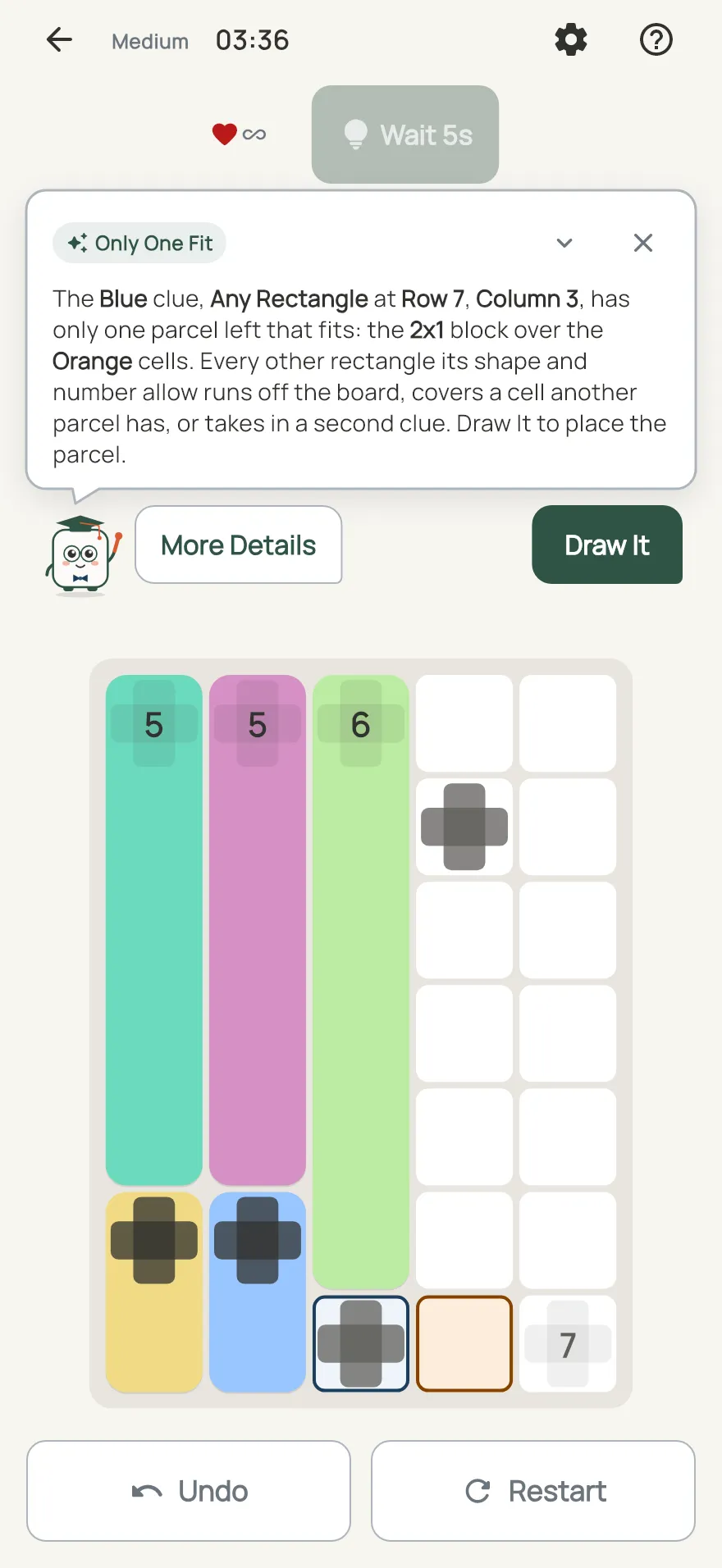
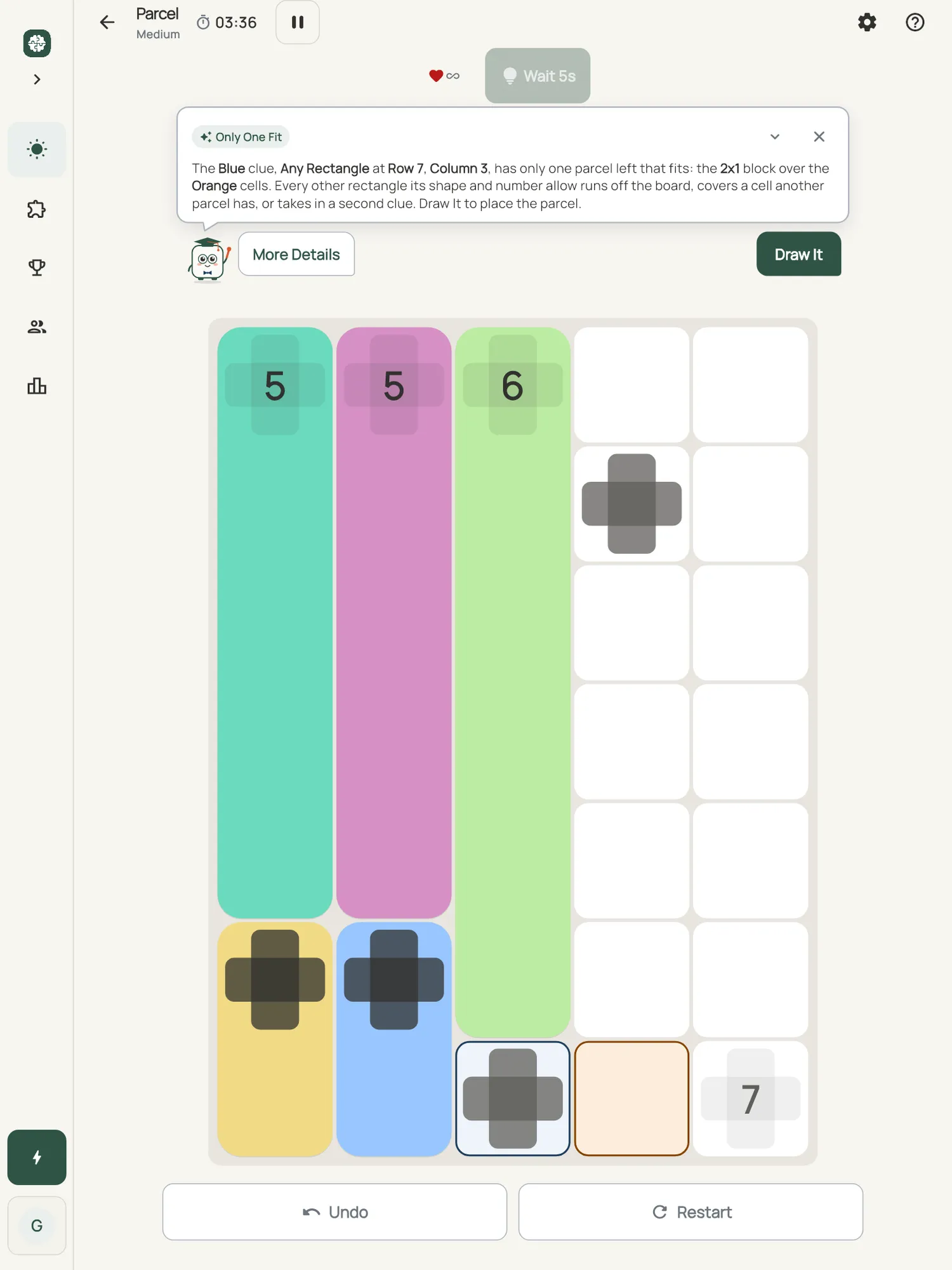
A hint names one of four techniques, lights the clue or cell it reads from in Blue and the cells it settles in Orange, and explains the step in plain words.
The Rules
- 1
Cover the Whole Board
Divide every cell into parcels: rectangles that never overlap and leave no gaps.
- 2
One Clue per Parcel
Every parcel holds exactly one clue, so you know how many parcels there are before you start: one for each clue.
- 3
Match the Clue
A Square parcel has equal sides, Flat is wider than tall, Tall is taller than wide, and Any Rectangle is anything but a square. A number means exactly that many cells, and a parcel is never a single cell.
- 4
Drag to Draw
Press a cell and drag. The rectangle follows your finger with its size shown, and it is placed when you let go. Tap a parcel to take it back, or draw straight over it.
- 5
Start a Parcel Before You Know Its Size
A rectangle that can still grow into its clue is placed, drawn faded until it matches the clue's shape and number. To stretch a parcel, press on one of its cells and drag outward: it keeps the cells it has and grows to reach the cell you let go on. A drag is only refused when the block holds no clue or two clues, is a single cell, is already bigger than its number, or could never grow into its clue's shape.
- 6
Each Number Allows Only a Few Shapes
A number fits only a few rectangles: 12 could be 2 by 6, 3 by 4, or 1 by 12. A prime like 7 can only be a single strip, and only a square number like 4 or 9 can be a Square.
- 7
Too Big or the Wrong Shape Counts as a Mistake
Parcel never takes a heart. A parcel can fit its clue and still turn out to be in the way, and finding that out costs nothing. A drag refused for being bigger than its number, or the wrong shape for its clue, counts as a mistake on your score. The other refusals, like a drag with no clue inside, cost nothing.
- 8
Use Logic
Every board can be divided in exactly one way, reachable by pure deduction.
The real screens.
Every picture on this page is the app itself, on a board from the game.
Where Parcel Comes From
Parcel is a rectangle-division puzzle, the genre best known as Shikaku and also sold as Divide by Box and Rectangles. Japanese puzzle magazines have printed it for decades. It was invented in 1989 by Yoshinao Anpuku, a maths student at Kyoto University, and published by the puzzle magazine Nikoli.
In the classic, every clue is a number: the count of cells in its rectangle. Parcel adds shape clues (Square, Flat, Tall and Any Rectangle), so a clue with no number still tells you the parcel's shape, and it never allows a parcel of one cell.
How the Levels Differ
Easy is a 4×6 board of about 6 parcels, and every clue names both its shape and its size. Medium is 5×7 with about 8 parcels, Hard 6×8 with about 8, and Extra Hard 7×9 with about 9, and on all three more than half of the clues give a shape but no number. The largest parcel grows from 6 cells on Easy to 16 on Extra Hard, and no board has more than 12 parcels.
Each band has its own hardest technique, and every board from Medium up needs it at least once. Easy needs only Only One Fit. Medium adds Only One Owner, Hard adds Always Covered, and Extra Hard adds Would Strand.
4 techniques, easiest first.
In Dayzle the hint and the solver are one engine, so these are the steps it takes to solve a Parcel board, from the first you'll meet to the rarest. Open one for a worked example and a clip of the hint teaching it on a real board.
Only One Fit Beginner Find a clue that has only one rectangle left that works. Draw it.
A Tall 3 clue sits at Row 1, Column 1. Tall 3 can only be one column wide and three rows tall, and it has to contain its own clue, which is in the top row. So the only rectangle it can be is Column 1, Rows 1 to 3.
In general, go through every rectangle a clue could own. Every one that runs off the board, covers a cell another parcel already has, or takes in a second clue is out. When one is left, that is the parcel.


Only One Owner Basic Find a cell that only one clue can still reach. That clue's parcel has to cover it.
Start from a cell, not a clue. Row 6, Column 4 is the bottom-right corner of the board, and the only clue that can still stretch a parcel over it is the Square 4 at Row 5, Column 3.
So that clue's parcel covers the corner. A 2 by 2 square holding both cells can only be Rows 5 and 6, Columns 3 and 4, and every other option the clue had is out.

Always Covered Intermediate Find cells that every remaining rectangle of a clue includes. They belong to that clue.
A Flat 6 clue sits at Row 3, Column 2 of a board four columns wide. A 1 by 6 strip can't fit, so it is 3 wide and 2 tall: Columns 1 to 3 or 2 to 4, and Rows 2 to 3 or 3 to 4.
All four of those include Row 3, Column 3. Wherever the parcel ends up, that cell is in it, so it belongs to the Flat 6 and no other clue can use it.

Would Strand Advanced Suppose a clue took a rectangle. If some cell would then have no clue able to reach it, that rectangle is out.
Suppose the Tall 4 clue took Column 2, Rows 3 to 6. Now look at Row 6, Column 1. With that parcel in place, no clue on the board could still reach it.
Every cell needs a parcel, so that rectangle is out, and the clue has fewer options left. This is the one step where you have to picture a parcel that is not on the board.
More visual games.
Visual
Mosaic
Fit the pieces to cover the board exactly
Visual
Crowns
One crown per row, column, and colour — none touching
Visual
Crowns Hive
Star Battle on a hexagon: one crown per line, three ways
Visual
Equinox
Balance suns and moons in every row
Visual
Mosaic Hive
Pack polyhex pieces into a hexagonal board
Visual
Trailhead
Draw one closed loop that satisfies every clue
Today's five are waiting.
Download it free on the App Store or Google Play, or log in and play today's set right in your browser. Same puzzles, same streak, wherever you play.