
Quiver Hive
Quiver on a board of hexagons, where an arrow can point six ways. Tap one with a clear path and it slides off the board.


- Four levels: Easy to Extra Hard
How Quiver Hive Works

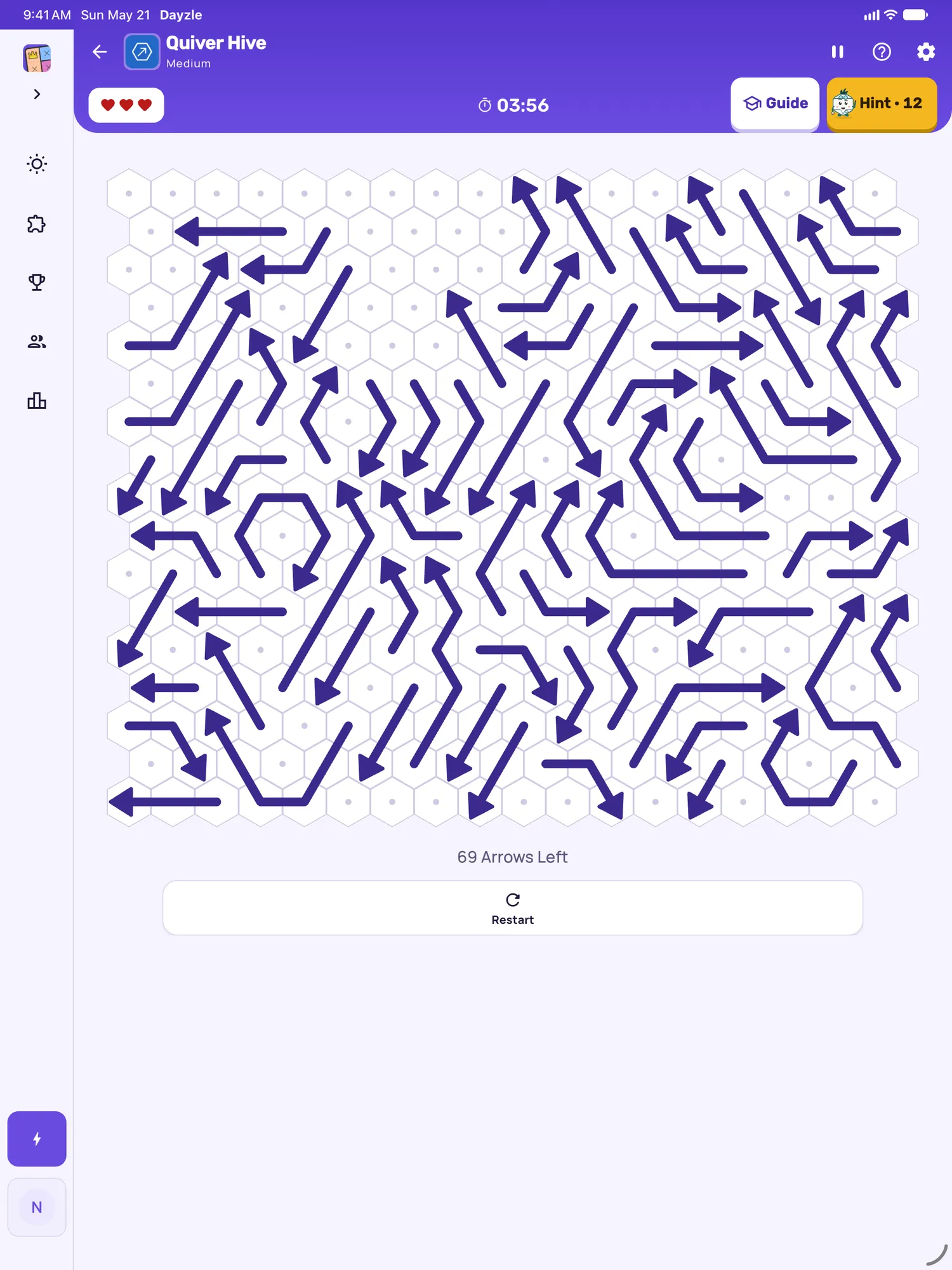
Quiver Hive is Quiver with hexagons for squares. The board is packed with bent arrows. Tap an arrow, anywhere along it, and if every hexagon between its head and the edge is empty, it slides off the way its head points. Clear every arrow to win.
On hexagons an arrow can point six ways: left, right, and four diagonals. Its bends are all gentle, a sixth of a turn, because a sharper bend made a short arrow hard to read under a finger. Six directions take more reading than Quiver's four: a path to the edge can run along a diagonal as well as a row.
Everything else is Quiver's. A tap on an arrow with another in its way costs a heart, and the arrow in the way lights up Orange. Sending an arrow off never blocks another, so the free arrows go in any order. Phones and tablets get different boards, with their own leaderboards. Quiver Hive is played in practice. It is not part of the daily set.
The Rules
- 1
Send Arrows Off the Board
Tap an arrow and it slides off the board the way its head points. On hexagons an arrow can point six ways. Clear every arrow to win.
- 2
Only a Clear Path Works
An arrow can go only when every hexagon between its head and the edge is empty. Tapping an arrow with another in its way costs a heart, and the arrow in the way lights up Orange. Each board gives you three hearts.
- 3
Any Order Works
Sending an arrow off never blocks another one, so you can clear the free arrows in whatever order you like.
- 4
Phone and Tablet Boards
A tablet plays bigger boards than a phone, with their own leaderboards, so friends compare phone boards with phone boards and tablet boards with tablet boards.
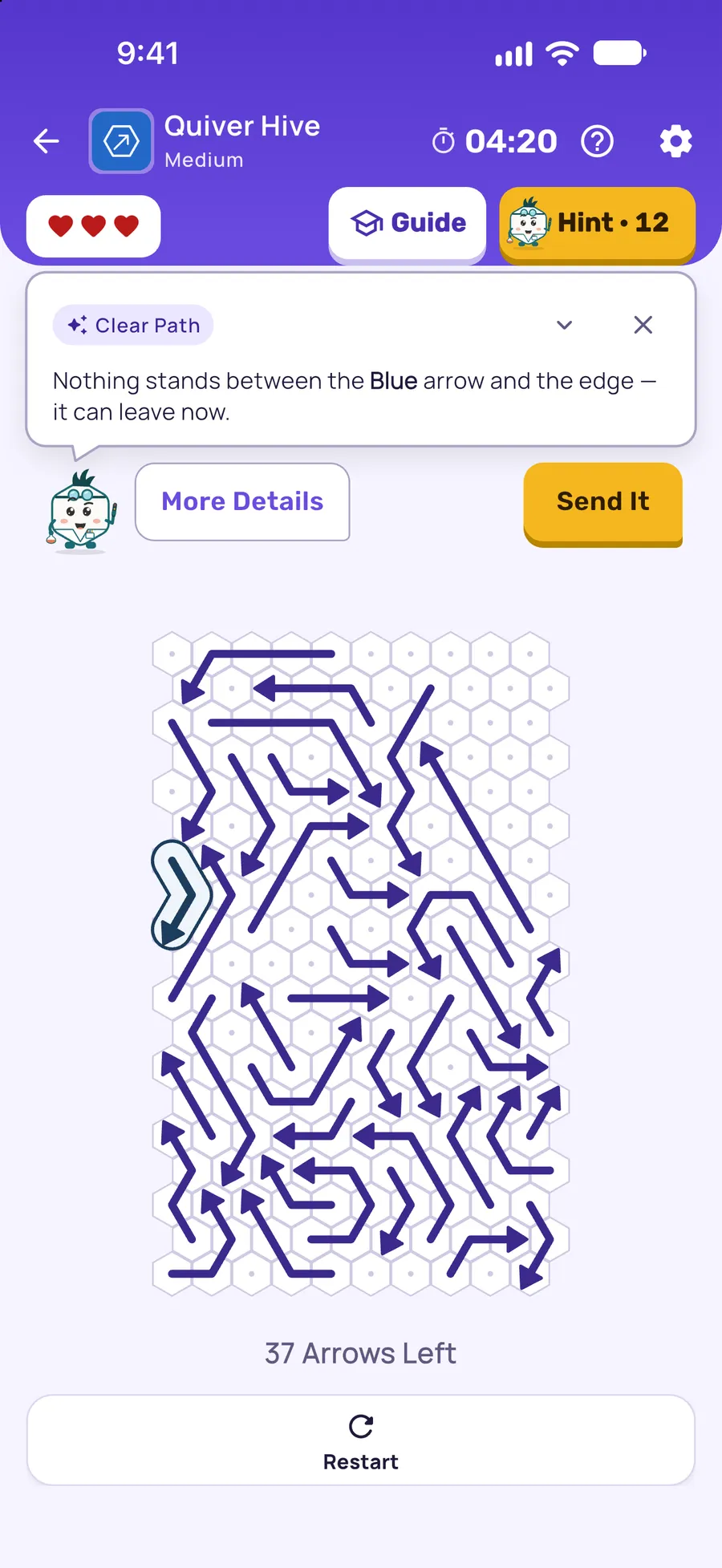
The real screens.
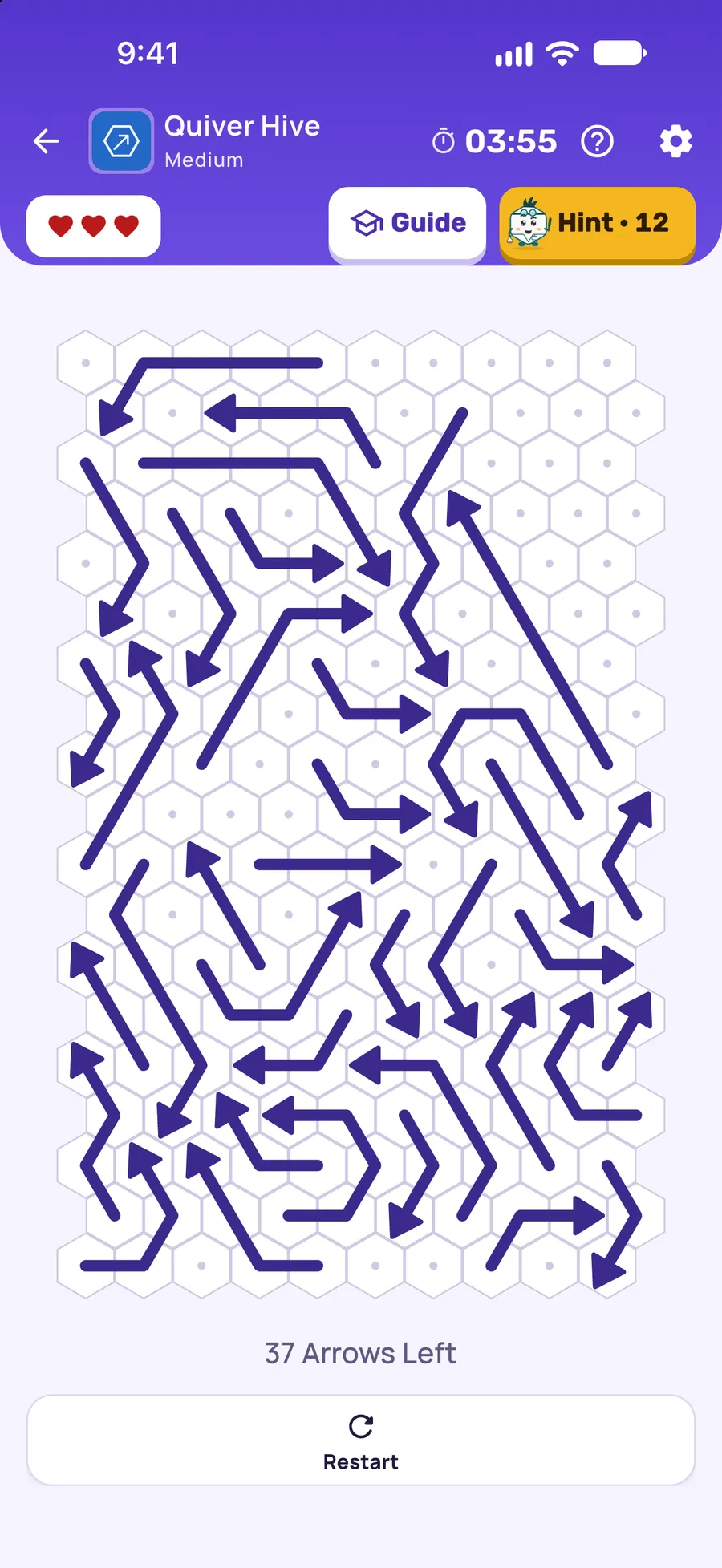
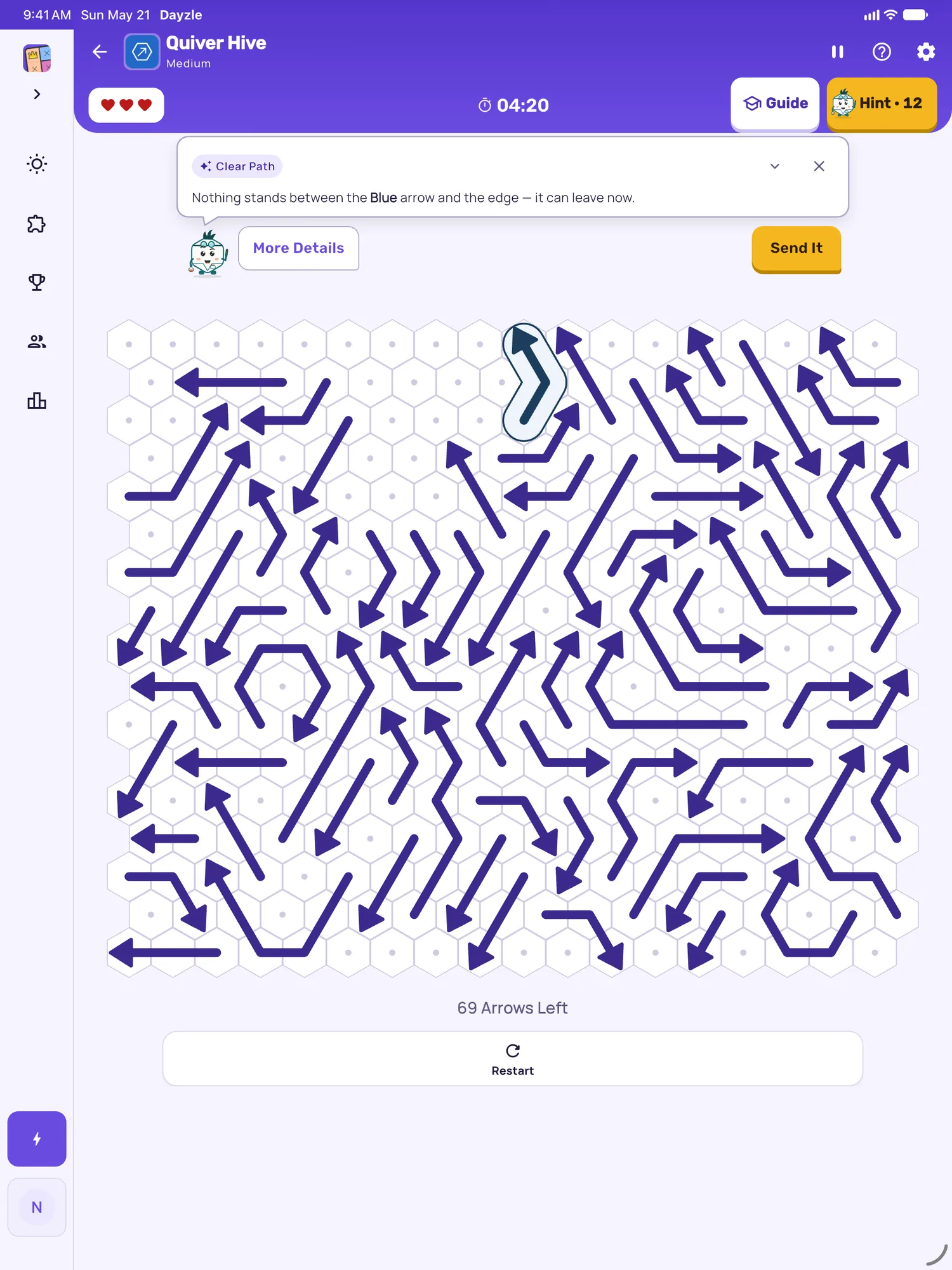
Every picture on this page is the app itself, on a board from the game.
Where Quiver Hive Comes From
Dayzle built Quiver Hive in October 2026, alongside Quiver, and the two share one engine: the rule, the hint and the way boards are built are the same, and only the grid changes.
Every other Dayzle hexagon game is played on a board shaped like a hexagon. Quiver's rule doesn't need one, since an arrow only needs a clear way to an edge, so Quiver Hive's board is a rectangle of hexagons, with every other row shifted half a hexagon along. That fills a phone's screen: on a phone's Extra Hard it holds 288 hexagons and about 66 arrows, where a hexagon-shaped board with cells the same size would hold 127 and about 33.
How the Levels Differ
On a phone, Easy is a board 8 hexagons wide and 16 rows tall with about 32 arrows, and its hexagons are the biggest. Medium is 10 by 19 with about 44 arrows, Hard 12 by 22 with about 61, and Extra Hard 12 by 24 with about 66. A tablet's boards are bigger: 14 by 13 with about 45 arrows on Easy, up to 19 by 36 with about 156 on Extra Hard. Hard and Extra Hard are tall, and when the tablet is held sideways the board turns to lie wide, its hexagons flat-topped, so they stay big either way.
As in Quiver, Hard and Extra Hard turn some arrows round after the board is built, so fewer can go at a time and more wait in a line, each blocked by the next. On a phone's Medium about 6 arrows can usually go at once and the longest such line is about 8 arrows; on Extra Hard it is about three at once and a line of about 28.
How a board gets harder.
Quiver Hive has Quiver's one rule, so its hint teaches one thing: Dr. Hex lights an arrow that can go now, Blue, names the step Clear Path, and Send It sends it for you. More Details says how you could have found it: start at the edge, or, after an arrow leaves, look at the arrows that pointed into the gap it left. A harder board has more arrows, fewer of them free at a time, and longer lines of arrows each blocking the next.
More visual games.
Visual
Quiver
Tap the arrow that has a clear way out
Visual
Mosaic Hive
Pack polyhex pieces into a hexagonal board
Visual
Crowns
One crown per row, column, and colour — none touching
Visual
Crowns Hive
Star Battle on a hexagon: one crown per line, three ways
Visual
Equinox
Balance suns and moons in every row
Visual
Mosaic
Fit the pieces to cover the board exactly
Today's five are waiting.
Download it free on the App Store or Google Play, or log in and play today's set right in your browser. Same puzzles, same streak, wherever you play.