
Abacus
Each outlined cage gives you a target and a sign. Fill the grid so every cage works out and no digit repeats in a row or column.


- Four levels: Easy to Extra Hard
- 12 techniques on its ladder
How Abacus Works

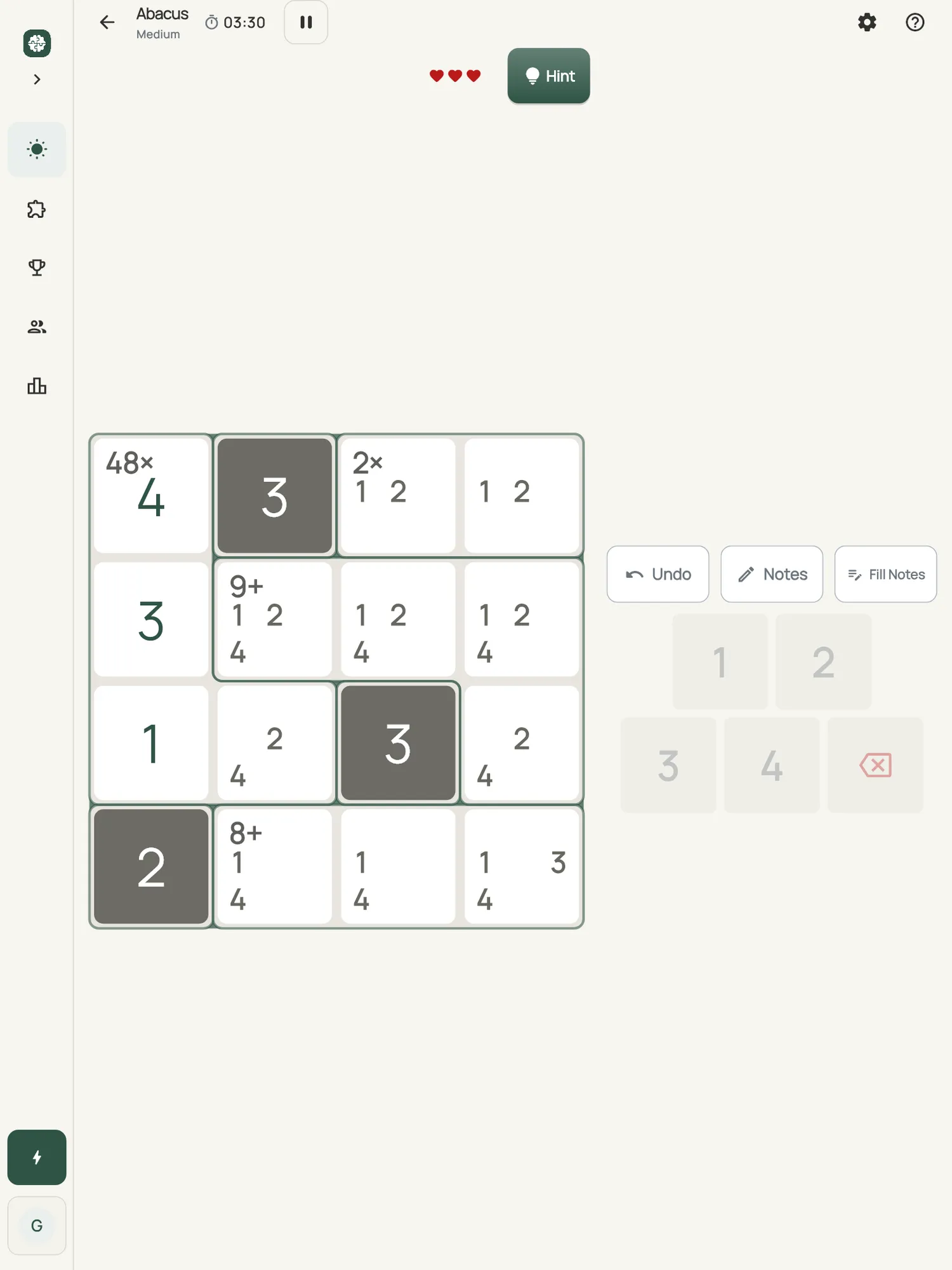
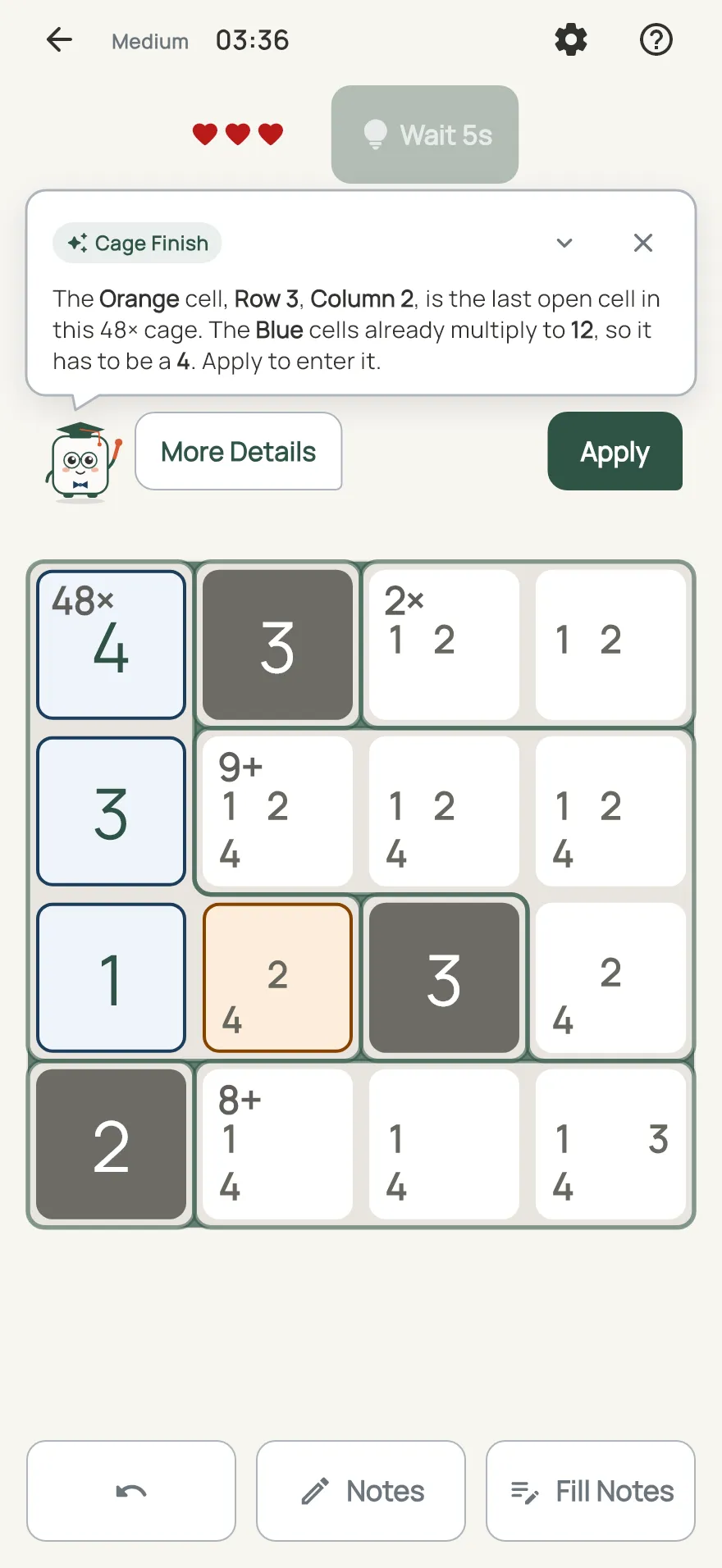
Abacus is a square grid from 3×3 to 6×6. Each row and column holds every digit from 1 up to the width of the grid, once: 1 to 4 on a 4×4. On top of that, the grid is divided into outlined cages, each with a target and an operator in its corner. A 6+ cage's digits add up to 6; a 12× cage's multiply to 12.
A cage of one cell is a free digit, its target, and the game fills those in when the board opens. Subtraction and division cages always have exactly two cells, and either cell can hold the bigger digit.
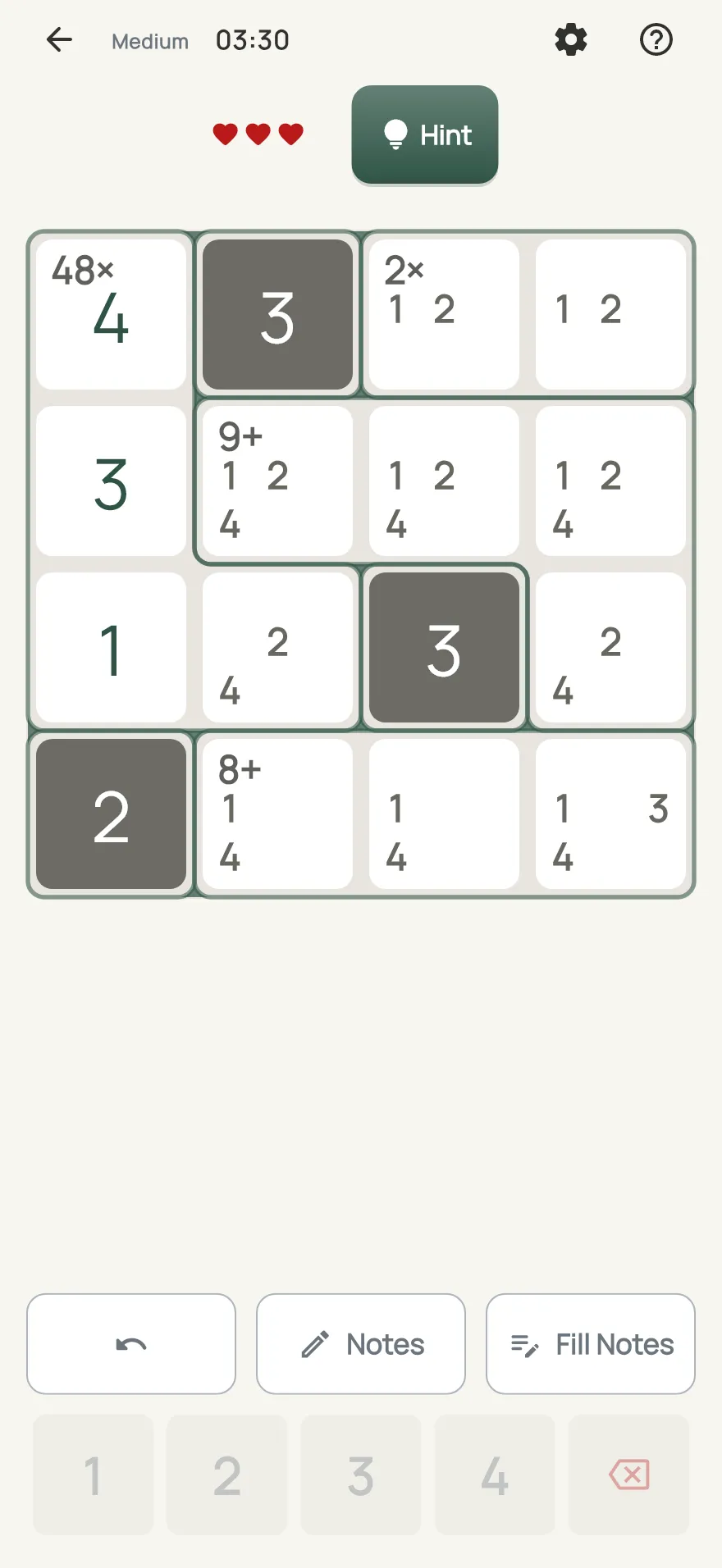
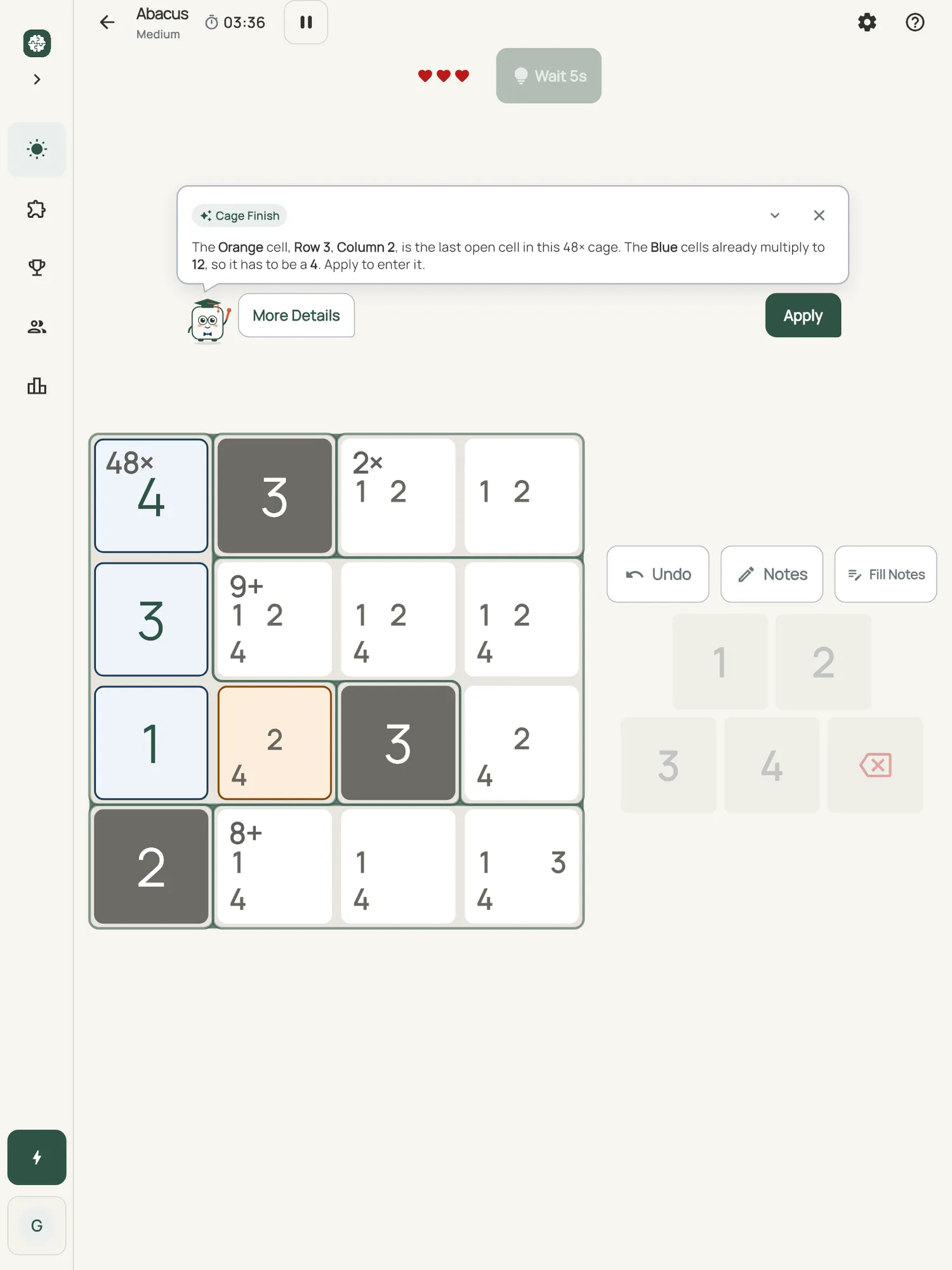
It plays like a small Sudoku where the clues are sums and products instead of given digits. Pencil notes, Fill Notes and Undo work as they do in Sudoku, and a hint names its technique and shows the arithmetic on the card: “the rest of this 6+ cage adds to 4, so its last open cell has to be a 2”.
The Rules
- 1
Fill the Grid
Each row and column holds every digit exactly once. The digits run from 1 up to the width of the grid: 1 to 4 on a 4×4.
- 2
Solve the Cages
Each outlined cage shows a target and an operator. Its cells must combine to that target: add for +, multiply for ×.
- 3
Subtract and Divide
A − or ÷ cage always has exactly two cells, and either cell can hold the bigger digit. A 2− cage accepts 3 and 1 in either order.
- 4
Place a Digit
Tap a cell, then a number. A digit that is right stays put; a wrong one you can change.
- 5
A Wrong Digit Costs a Heart
A digit that does not belong in a cell costs a heart the moment you place it. Changing it to another wrong digit costs nothing more, and notes are always free. In practice you have three hearts a board; in the daily set they never run out.
The real screens.
Every picture on this page is the app itself, on a board from the game.
Where Abacus Comes From
The cage puzzle was invented in 2004 by Tetsuya Miyamoto, a Japanese maths teacher who taught his pupils with puzzles. His method was what he called teaching without teaching: hand over a puzzle, explain nothing, and let the pupils work it out for themselves.
Outside its trademarked name, the puzzle is published as Calcudoku or Mathdoku. Dayzle's version shipped as Coda and was renamed Abacus in August 2026, so that the name says there is arithmetic in it before the first tap.
How the Levels Differ
The grid grows one size a difficulty, and the operators come in as it does. Easy is a 3×3 grid whose cages only add and subtract, none bigger than 3 cells, with about a quarter of the cells given as one-cell cages. Medium is 4×4, and multiplication joins in with small products.
Hard is 5×5 with all four operators, division included, and cages of up to 5 cells. Extra Hard is 6×6 with all four operators, and only about 2 of its 13 cages are single cells, so nearly every digit has to be worked out from the cages.
12 techniques, easiest first.
In Dayzle the hint and the solver are one engine, so these are the steps it takes to solve a Abacus board, from the first you'll meet to the rarest. Each one has its own worked example and a clip of the hint on a real board.
Beginner
Intermediate
Advanced
More number games.
Numbers
Sudoku
The classic 9×9, with hints that name each technique
Numbers
Tally
Cross-sums — make every row and column add up
Numbers
Mini Sudoku
Sudoku on a 6×6 grid
Numbers
Tally Hive
Cross sums in three directions, on a hexagon
Numbers
Terminus
Route one unbroken line that serves every stop
Numbers
Terminus Hive
The same line, through every hex
Today's five are waiting.
Download it free on the App Store or Google Play, or log in and play today's set right in your browser. Same puzzles, same streak, wherever you play.