
Terminus
Draw one line across the map that passes through every district and reaches the numbered stations in order, finishing on the last one.


- Four levels: Easy to Extra Hard
- 3 techniques on its ladder
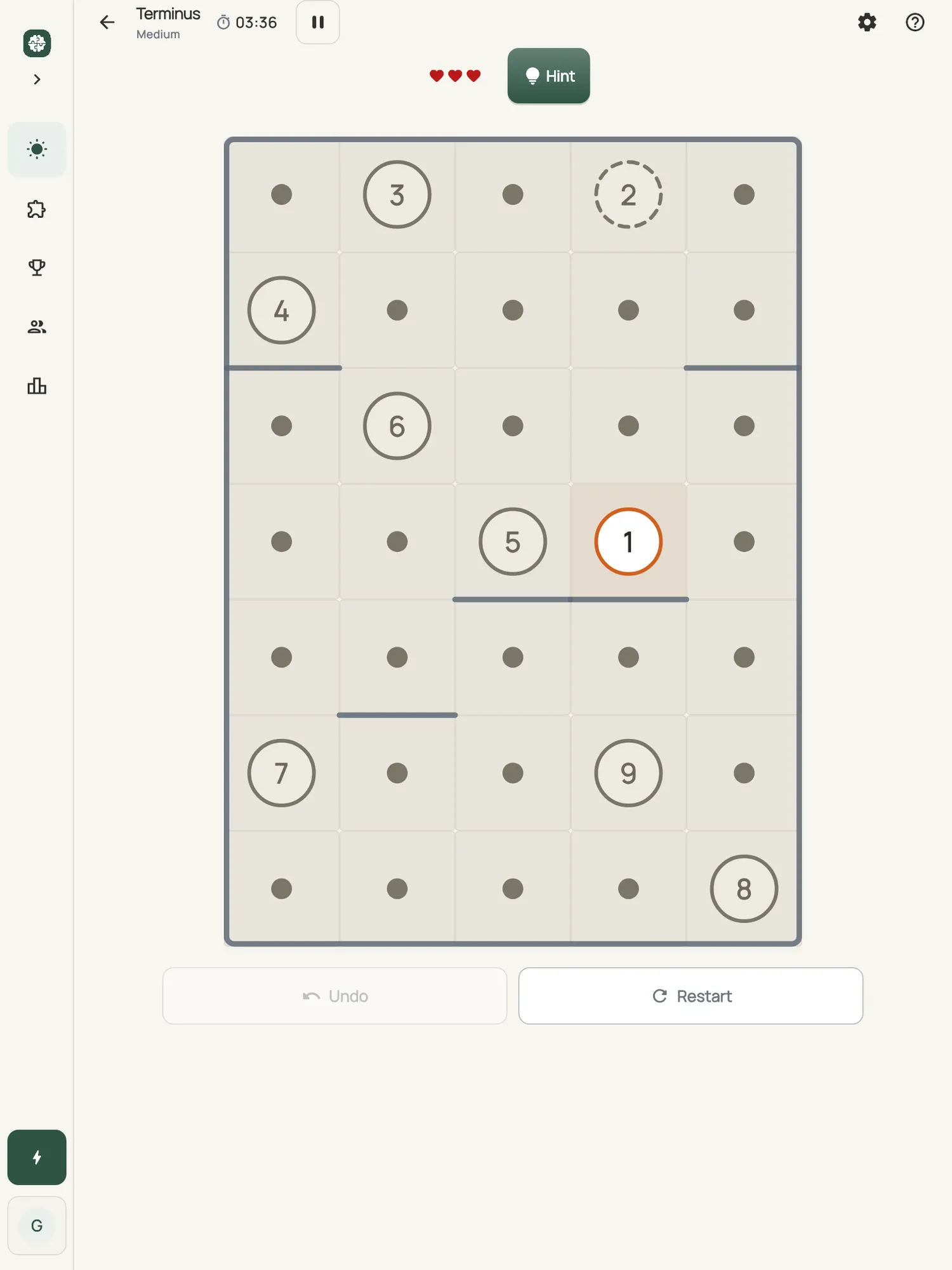
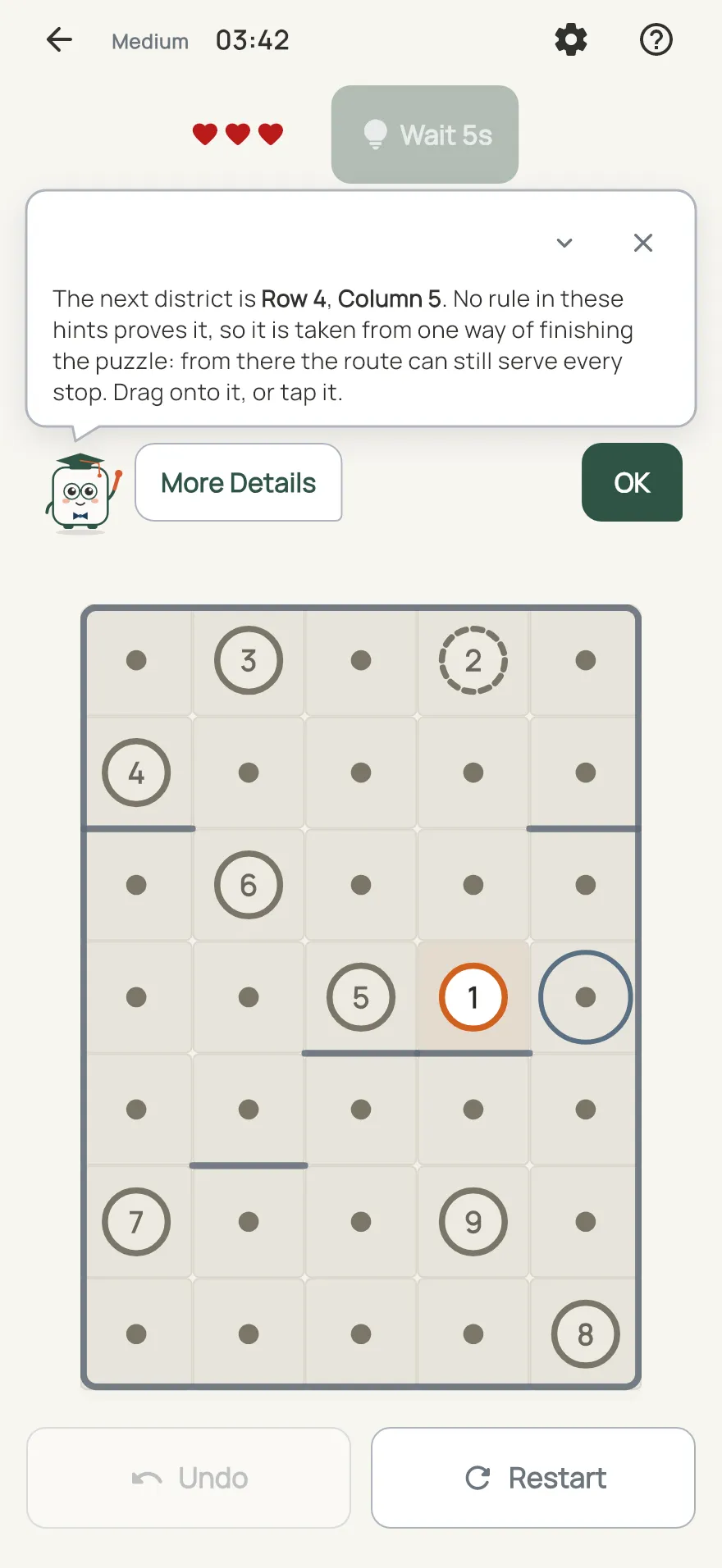
How Terminus Works

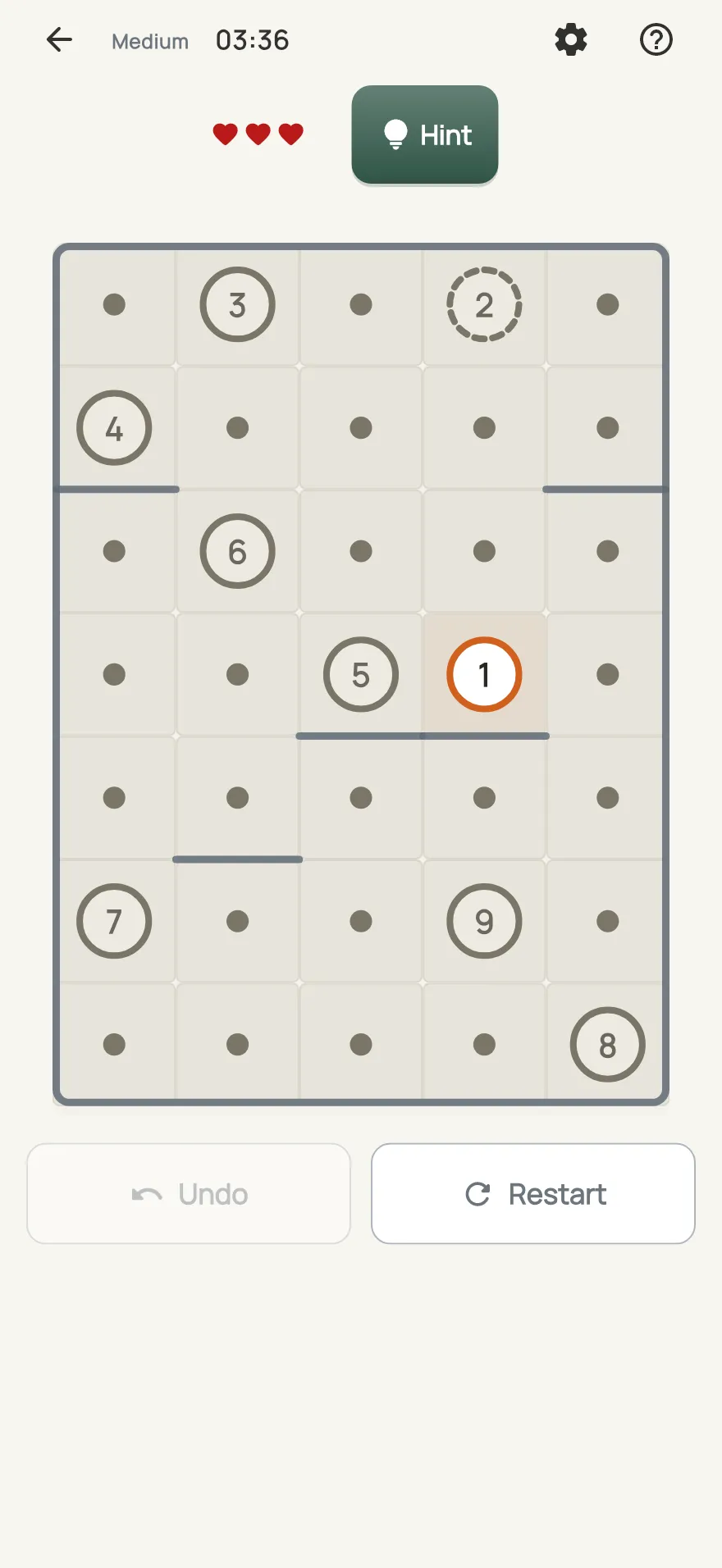
The board is a map of square districts, each with a stop drawn on it. Your line starts at station 1 and steps from district to neighbouring district, up, down, left or right, by tapping or by dragging your finger. It can never serve a district twice, never jump, and never pass a closed crossing, drawn as a thick bar between two districts.
Numbered stations are scattered across the map, and the line has to call at them in order. The numbers say what order to call in, not how far apart the stations are. The line ends on the highest station, so arriving there with districts still unserved is a dead end. The work is covering the whole map without cutting off a corner you can no longer reach.
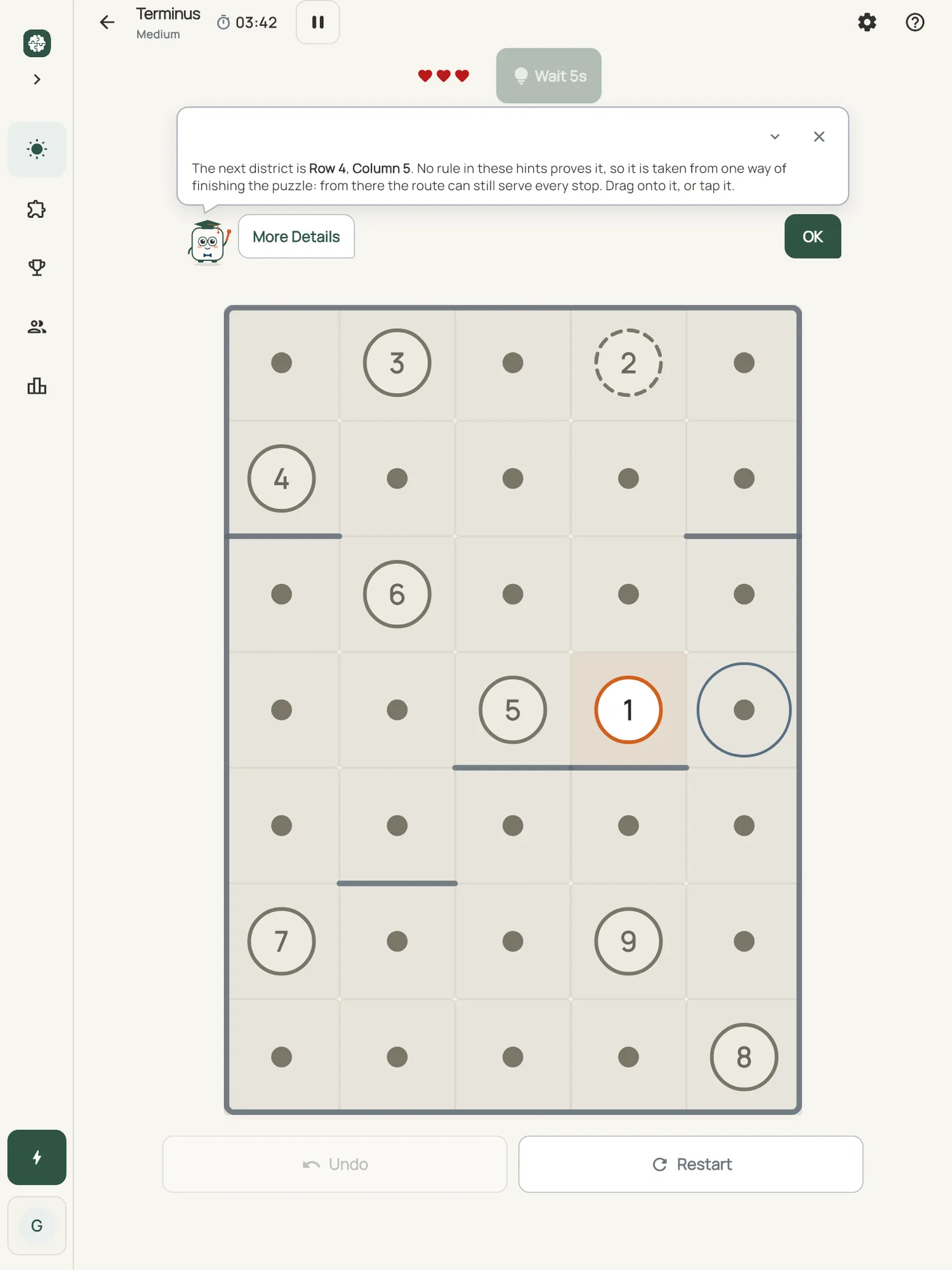
Each stretch between two stations draws in its own colour. Undo steps back one district, and tapping a station already on the line wipes everything after it. A hint either points at the next district and says which way is a trap, or, if your line has gone wrong, names the district it stranded and offers to step back.
The Rules
- 1
Call at the Stations in Order
Reach the numbered stations 1, then 2, then 3, building one route. The route ends on the last station, so only arrive there once every other district is served.
- 2
Stay Connected
The route only steps to a neighbouring district, never diagonally. It never lifts or jumps, and a closed crossing cannot be passed.
- 3
Serve Every Stop
Each district holds one stop. A finished line has picked up every one of them, exactly once.
- 4
A Wrong Route Costs a Heart
Every map has exactly one route that serves every district. If your line has left it when it reaches the next station, or when it has nowhere left to go, that costs a heart. Carrying on costs nothing more until you back up onto the right route. A step the map does not allow is refused for free, and backing up is always free. In practice you have three hearts a board; in the daily set they never run out.
The real screens.
Every picture on this page is the app itself, on a board from the game.
Where Terminus Comes From
A route that visits every point of a map exactly once is what mathematicians call a Hamiltonian path, after the Irish mathematician William Rowan Hamilton. In 1856 he invented the icosian game, which asked players to trace a route along the edges of a dodecahedron through all 20 of its corners, each once. Grid puzzles where one line must pass through every square ask the same question on a smaller map.
Dayzle's version adds numbered stations that must be visited in order, and closed crossings the line cannot pass. It was first called Constellation. In August 2026 it was redrawn as a transit line across a district map, with a stop in every district so the rule to serve all of them is visible, and renamed Terminus after its least obvious rule: you may only arrive at the last station once everything else is served.
How the Levels Differ
The map grows one size a difficulty. Easy is 4×6, 24 districts, with about 10 numbered stations and usually 1 closed crossing. Medium is 5×7, with about 5 closed crossings. Hard is 6×8, with about 11. Extra Hard is 7×9, 63 districts, with about 19.
Size is not what decides the difficulty on its own. Before a board ships, the game walks its route and counts the real choices left at each step after ruling out every move that would strand a district or cut the line off from the next station. A choice between two ways counts as one; a choice between four counts as two. Easy boards carry 1 to 3.5 of these, Medium 3.5 to 6, Hard 6 to 9.5, and Extra Hard 9.5 or more. More closed crossings do not make a board harder: each one removes a move, so a heavily blocked map has less to work out.
3 techniques, easiest first.
In Dayzle the hint and the solver are one engine, so these are the steps it takes to solve a Terminus board, from the first you'll meet to the rarest. Open one for a worked example and a clip of the hint teaching it on a real board.
Terminus has no graded technique ladder. Applied from the start of a board, the three rules above settle between 6% and 26% of the route before a real choice comes up, where more than one way forward survives them. At those points a hint says plainly that no rule it knows forces the next district, and shows one taken from the route that finishes. A harder board is one with more of those real choices, counted as described under Difficulty.
Only Way Out Beginner Every district beside the end of the line but one is already served, closed off, off the map, or a station whose turn has not come.
Look at the districts touching the end of your line. Cross off the ones already served, the ones behind a closed crossing, and any station whose turn has not come. If one is left, the route goes there.
Say the line ends at Row 3, Column 2. The district above is served, the one below is behind a closed crossing, and the one to the left is station 5 while you are heading for 3. The line goes right, to Column 3. Long stretches of a route are forced this way, so check it first on every step.


Stranded District Basic A step that would leave some unserved district with no way in and out.
The line has to get into every district and out again, so an unserved district needs at least two open neighbours (the last station needs only one). Take each district you could step to, picture the line going there, and look at the districts you would be turning your back on.
Say the line has just reached Row 1, Column 2, and the corner beside it, Row 1, Column 1, is unserved and not a station. The line could go left into the corner or down to Row 2, Column 2. Going down would leave the corner with one open neighbour, Row 2, Column 1: the line could get in but never out. So down is a trap, and the line goes left.

Cut Off Intermediate A step that would leave the line unable to reach the next station, or the districts it has to serve on the way.
When more than one step is still safe after checking for stranded districts, look further ahead, at the next station. From each district you could step to, can the route still reach that station, and every district it has to serve before it?
Say the next station is 4, in the top right. Stepping left would put a column of served districts between the line and station 4, with no way round. So left is a trap, and the line steps the other way.

More number games.
Numbers
Terminus Hive
The same line, through every hex
Numbers
Sudoku
The classic 9×9, with hints that name each technique
Numbers
Mini Sudoku
Sudoku on a 6×6 grid
Numbers
Tally
Cross-sums — make every row and column add up
Numbers
Tally Hive
Cross sums in three directions, on a hexagon
Numbers
Abacus
Fill the grid so every cage's arithmetic works out
Today's five are waiting.
Download it free on the App Store or Google Play, or log in and play today's set right in your browser. Same puzzles, same streak, wherever you play.