
Sudoku
Fill the grid so every row, column and 3×3 box has the digits 1 to 9 in it, once each. Every board can be worked out without guessing.


- Four levels: Easy to Extra Hard
- 17 techniques on its ladder
How Sudoku Works

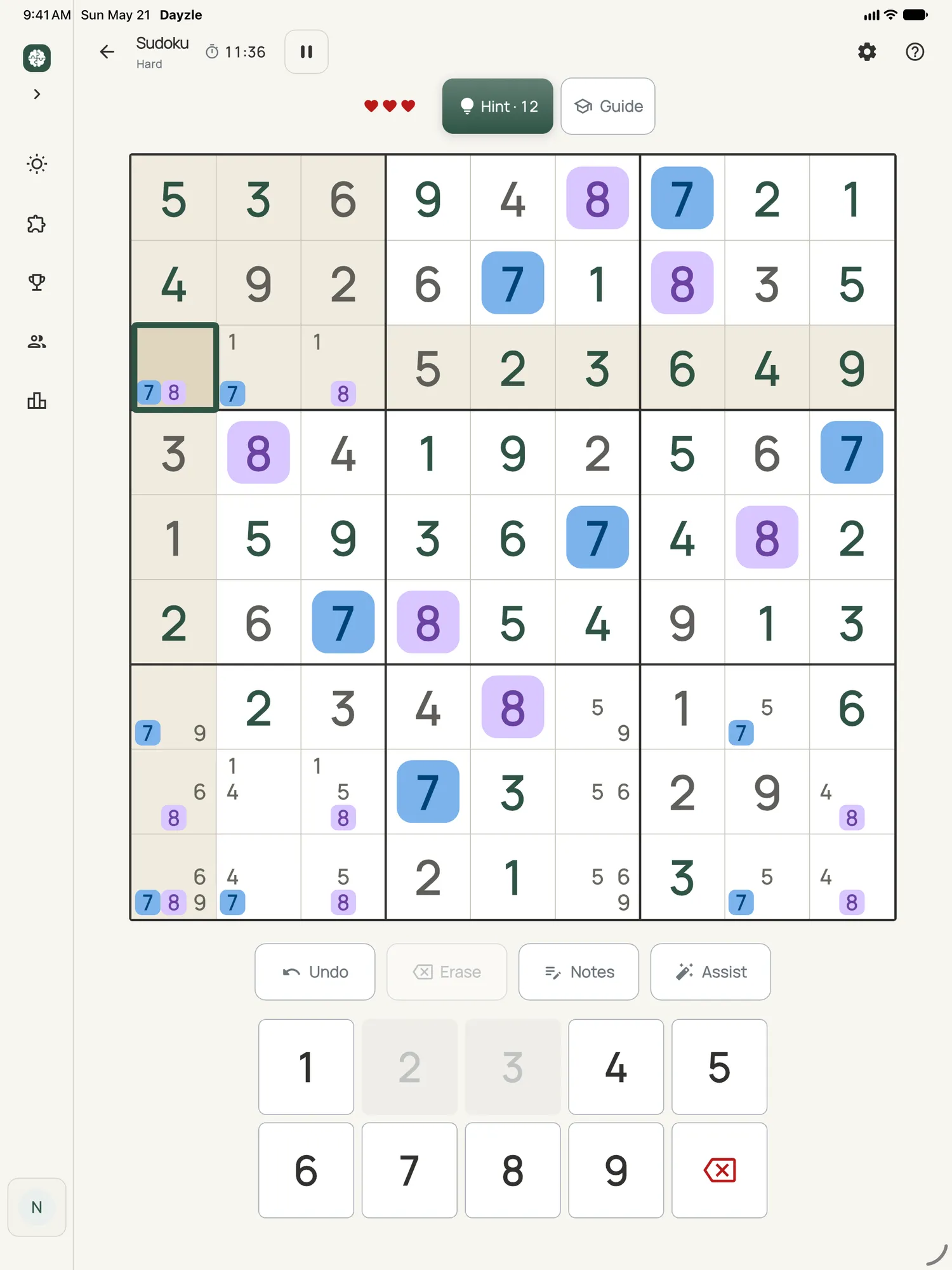
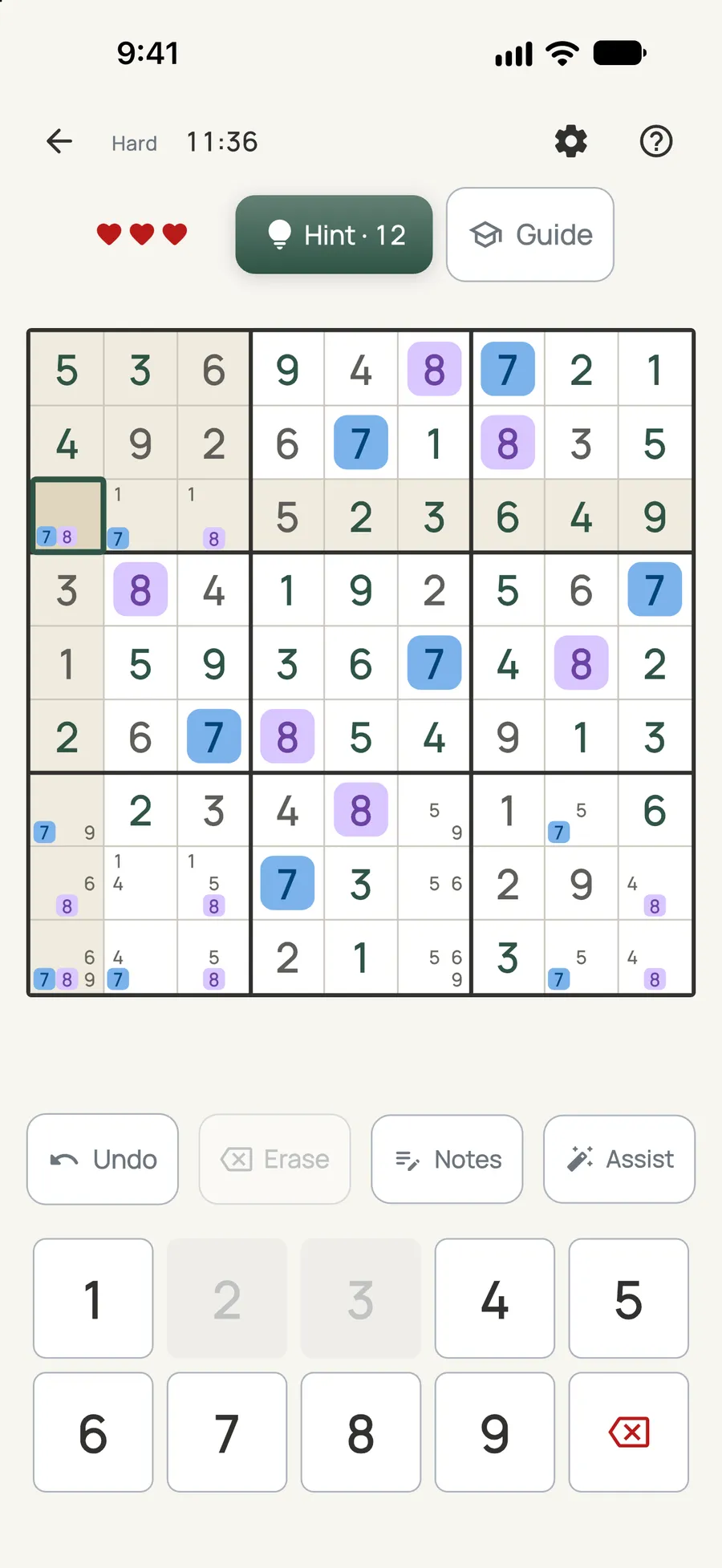
The full 9×9 Sudoku, with 81 squares in nine rows, nine columns and nine 3×3 boxes. You tap a square, then a digit. Pencil notes let you keep track of the digits a square could still hold, and one button fills them in across the whole board if you would rather not write them yourself.
Each difficulty has a practice pool of hundreds of boards, and every board has exactly one answer that can be reached by logic alone. Today's Sudoku is one extra board per difficulty per day, the same for everyone who picks that difficulty, with its own leaderboard. Finishing it counts toward your daily streak.
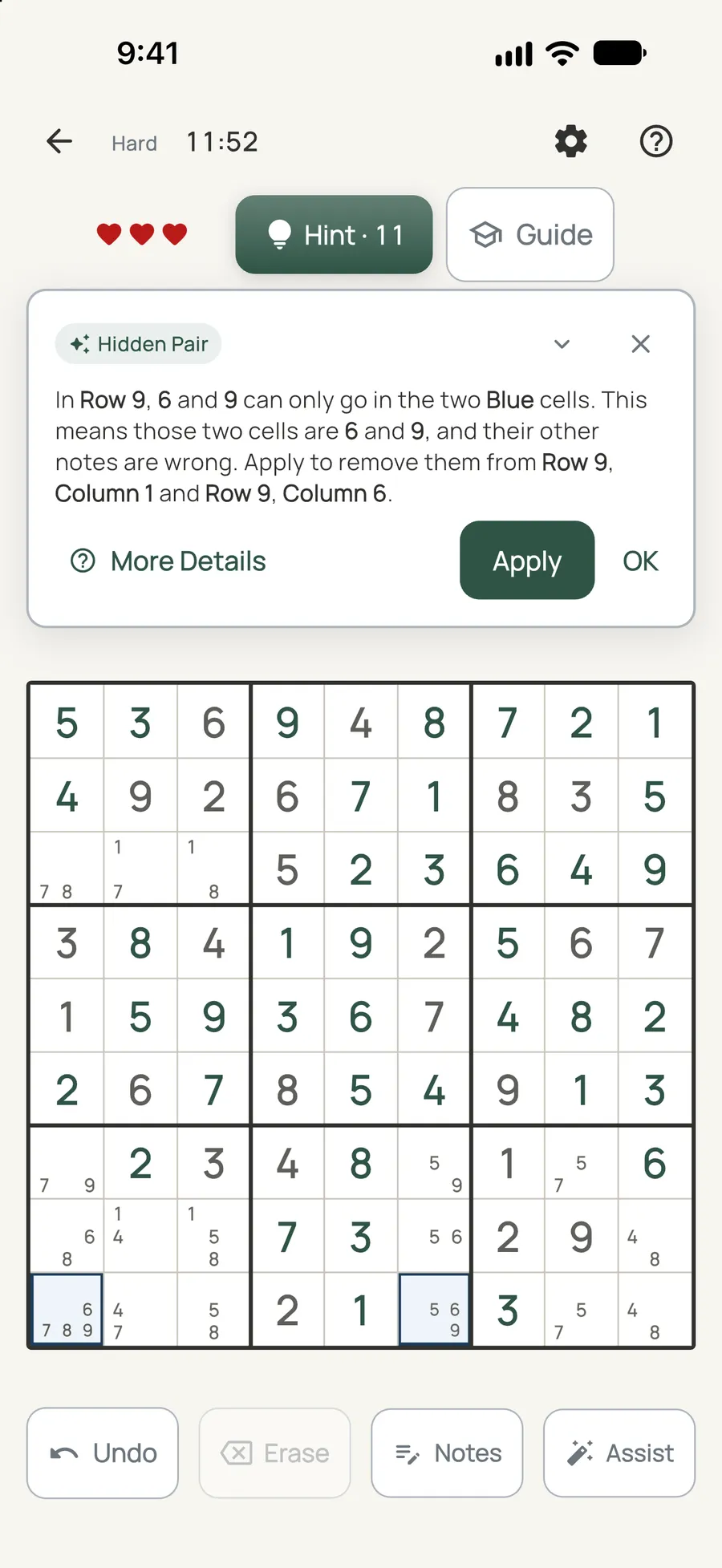
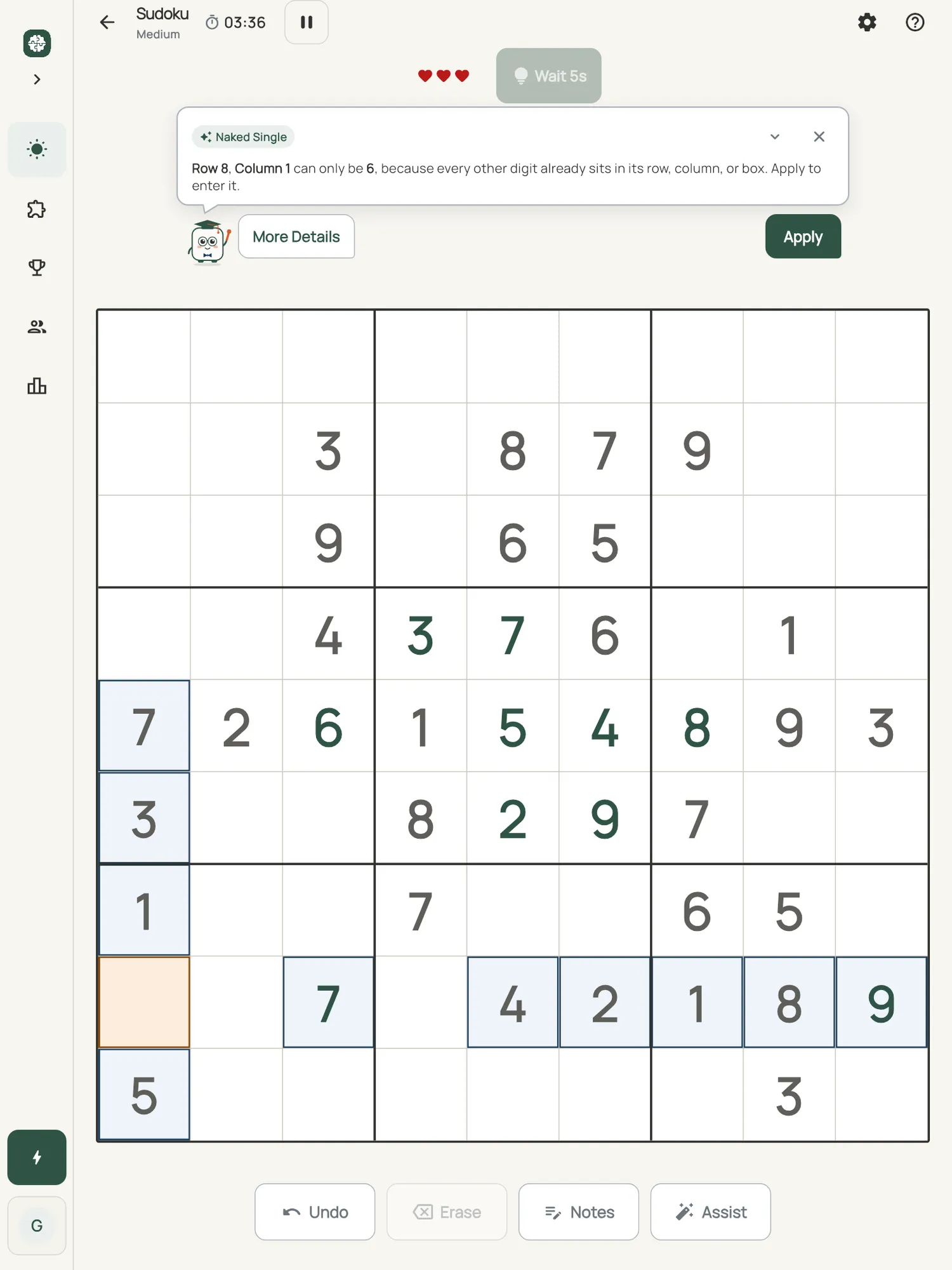
A hint lights the cells its step depends on in Blue, Pink and Orange, names the technique on the card, and explains the step in a sentence that also gives each cell's row and column. More Details opens the full reasoning. Nothing on the board changes until you press Apply; the ✕ closes the card and leaves the board as it was.
The expected time a board is scored against is 4 minutes at Easy and about 27 minutes at Extra Hard. The timer is there for your stats and the leaderboards; take as long as you like.
The Rules
- 1
Fill the Grid
Every row, every column and every 3×3 box holds the digits 1 to 9.
- 2
No Duplicates
Each digit appears only once in any row, column or 3×3 box.
- 3
Use Logic
Every board can be worked out from the digits already there. Look for the only digit a square can hold, or the only square in a row, column or box that can hold a digit.
- 4
A Wrong Digit Costs a Heart
A digit that does not belong in a square costs a heart the moment you place it. Changing it to another wrong digit costs nothing more, and notes are always free. In practice you have three hearts a board; in the daily set, and in Today's Sudoku, they never run out.
 Professor Tile's Sudoku School Lesson 1: How Sudoku Works
Watch on YouTube
Professor Tile's Sudoku School Lesson 1: How Sudoku Works
Watch on YouTube
The real screens.
Every picture on this page is the app itself, on a board from the game.
Where Sudoku Comes From
Sudoku was first published in the United States. Howard Garns, a retired architect from Connersville, Indiana, is the most likely author of the puzzles that Dell Magazines began printing in 1979 under the name Number Place. They ran without a byline, but his name appears among the contributors of every issue of *Dell Pencil Puzzles and Word Games* that carried one.
In April 1984 Maki Kaji, president of the Japanese publisher Nikoli, introduced the puzzle in Japan as *Sūji wa dokushin ni kagiru*, roughly “the digits must be single”. Kaji later cut that to Sudoku by keeping the first character of each word.
It reached British newspapers in November 2004, when *The Times* began printing it, and spread from there.
How the Levels Differ
Every difficulty uses the same 9×9 grid. What changes is how many digits you start with and the hardest technique the board requires. Easy starts with about 38 of the 81 squares filled in, and every square can be found with a Naked Single or Hidden Single. Medium starts with about 29 and, once or twice a board, needs a move from the pair and triple tier: a Naked Pair, Hidden Pair, a triple, a Pointing Pair or a Box/Line Reduction.
Hard starts with about 24 and needs one or two moves from BUG, X-Wing, Unique Rectangle or Y-Wing. Extra Hard also starts with about 24 but needs at least three of those moves, spread across at least two places where you get stuck, and never more than two in a row before a square falls. About one Extra Hard board in six also needs a W-Wing or a quad, and about one in 20 a Swordfish or XYZ-Wing.
17 techniques, easiest first.
In Dayzle the hint and the solver are one engine, so these are the steps it takes to solve a Sudoku board, from the first you'll meet to the rarest. Each one has its own worked example and a clip of the hint on a real board.
Professor Tile also teaches them one at a time in short video lessons, on YouTube and Instagram.
Beginner
Advanced
More number games.
Numbers
Mini Sudoku
Sudoku on a 6×6 grid
Numbers
Abacus
Fill the grid so every cage's arithmetic works out
Numbers
Tally
Cross-sums — make every row and column add up
Numbers
Tally Hive
Cross sums in three directions, on a hexagon
Numbers
Terminus
Route one unbroken line that serves every stop
Numbers
Terminus Hive
The same line, through every hex
Today's five are waiting.
Download it free on the App Store or Google Play, or log in and play today's set right in your browser. Same puzzles, same streak, wherever you play.