
Tally Hive
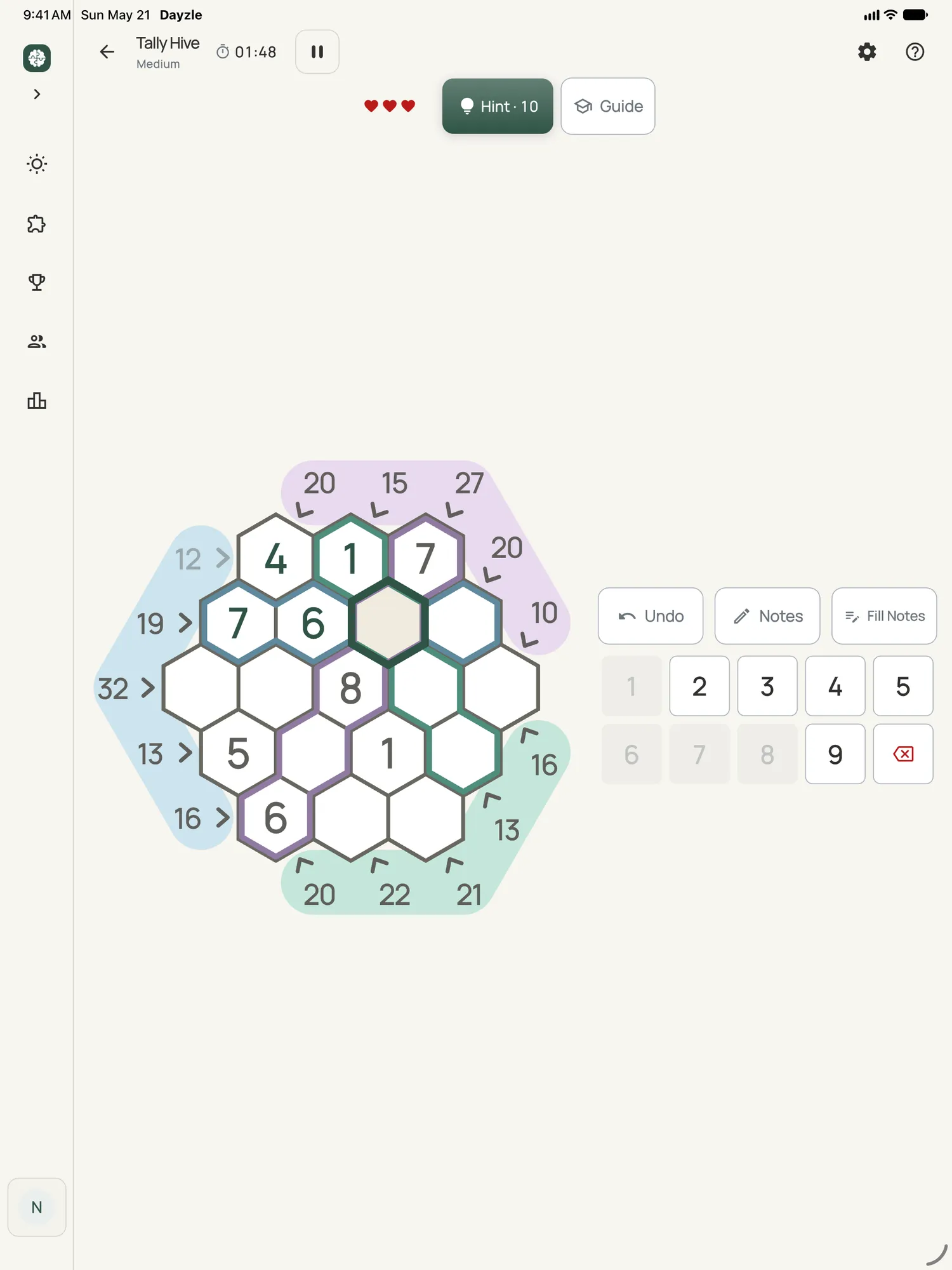
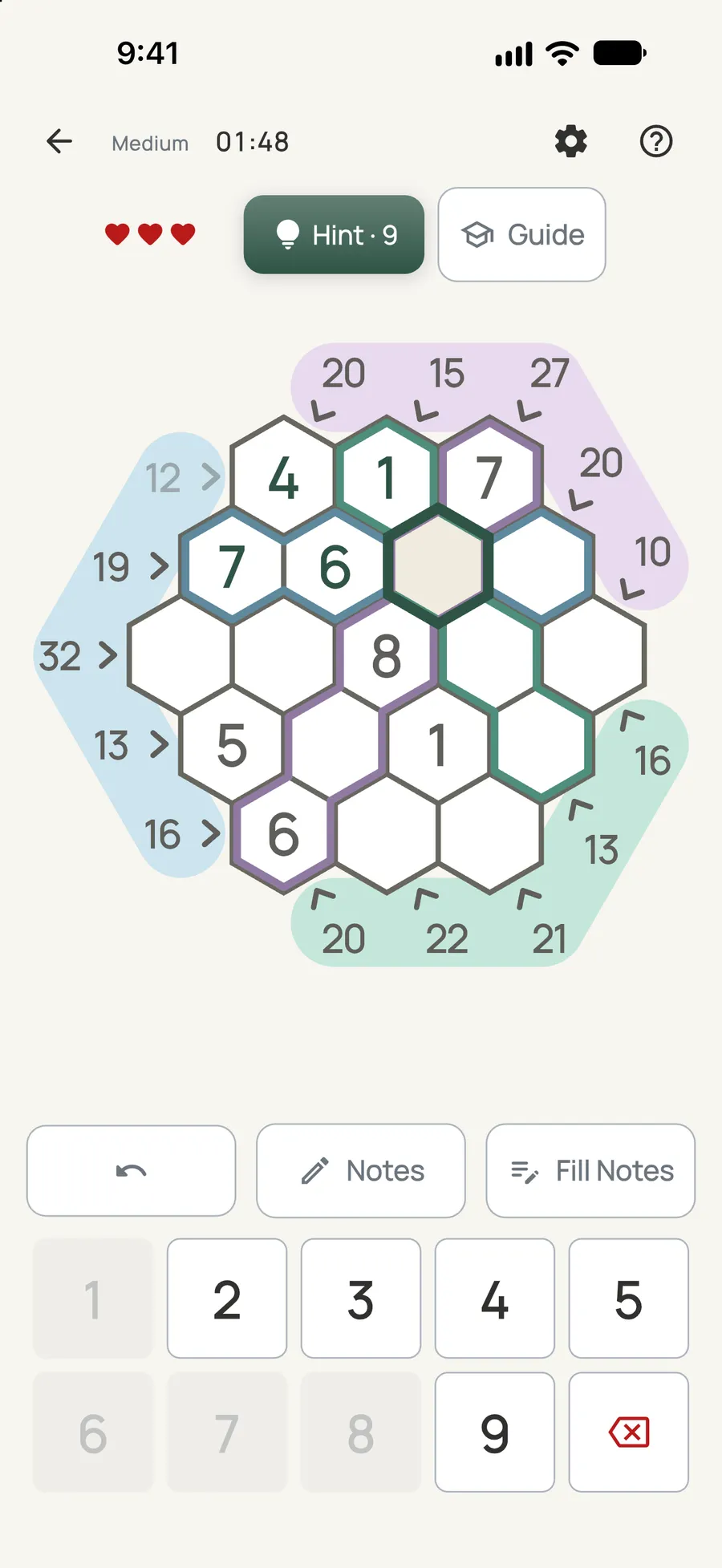
Put a digit from 1 to 9 in every cell of a hexagon so each line adds up to the number on the rim beside it. Every cell sits on three lines, so every digit has three totals to satisfy.


- Four levels: Easy to Extra Hard
- 7 techniques on its ladder
How Tally Hive Works

On a hexagon, lines of cells run in three directions: a Row, a Right Diagonal and a Left Diagonal. Each line's total is printed just outside the board, with a small chevron pointing along the line it belongs to. The three sets of totals sit on their own tinted bands around the rim, and selecting a cell lights all three of its lines.
There are no black squares: every cell is a play cell, and a few start filled in. When a line is finished and adds up, its total fades, so the numbers still bright on the rim are the ones you have left.
Tally Hive uses Tally's hints, techniques and controls, so a player who knows Tally already knows how to reason here. The board is 19 cells on Easy and Medium and 37 on Hard and Extra Hard. It is played from Practice and is not part of the daily set.
The Rules
- 1
Reach the Target
Fill every cell with a digit from 1 to 9 so each line of cells adds up to the number printed against it on the rim. The chevron beside a total points along the line it totals.
- 2
Three Lines, Every Cell
Each cell belongs to a Row, a Right Diagonal and a Left Diagonal. Select a cell and all three light up.
- 3
No Repeats in a Line
A digit cannot appear twice within the same line, though it may repeat in a different one.
- 4
Given Digits Are Fixed
Digits already on the board when you start stay put. Build your answer around them.
- 5
A Wrong Digit Costs a Heart
A digit that does not belong in a cell costs a heart the moment you place it. Changing it to another wrong digit costs nothing more, and notes are always free. You have three hearts a board.
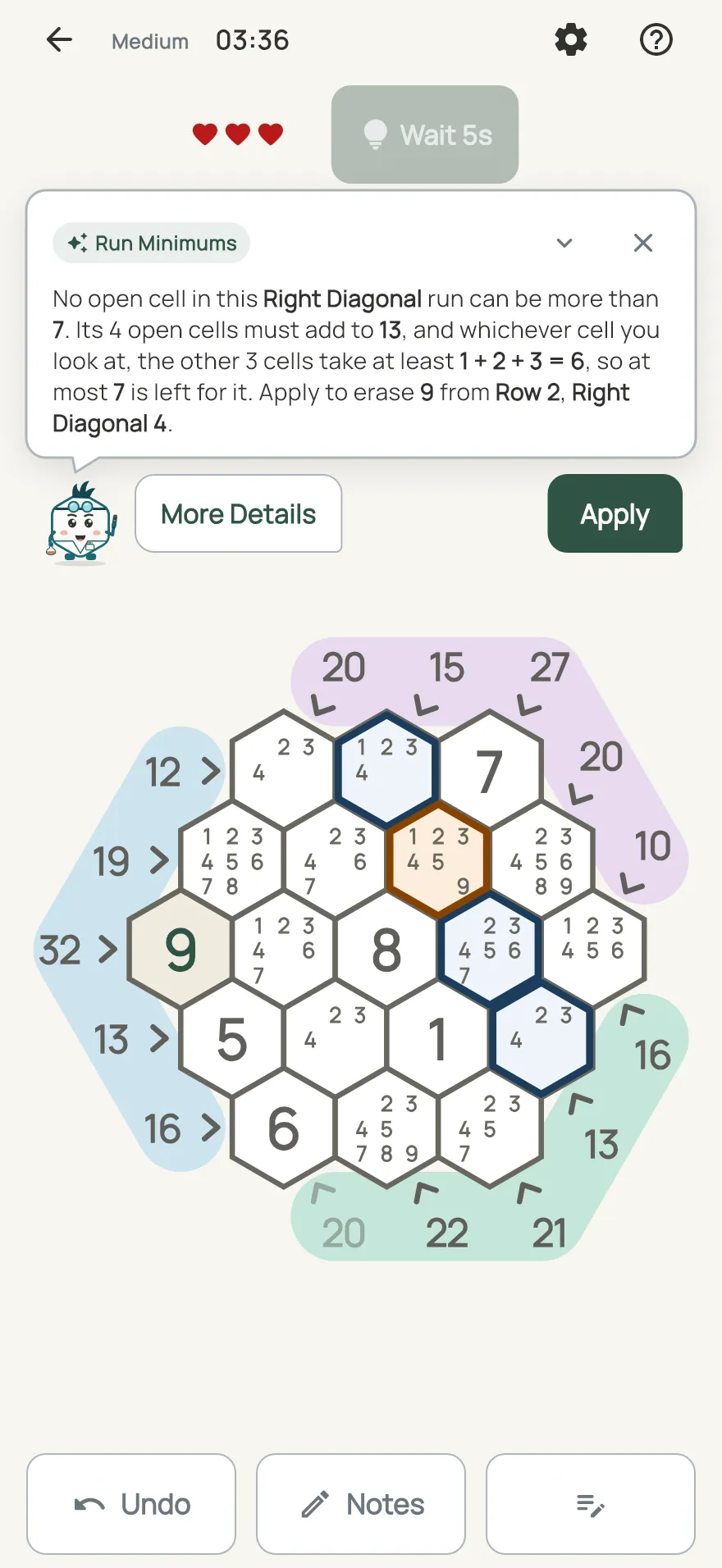
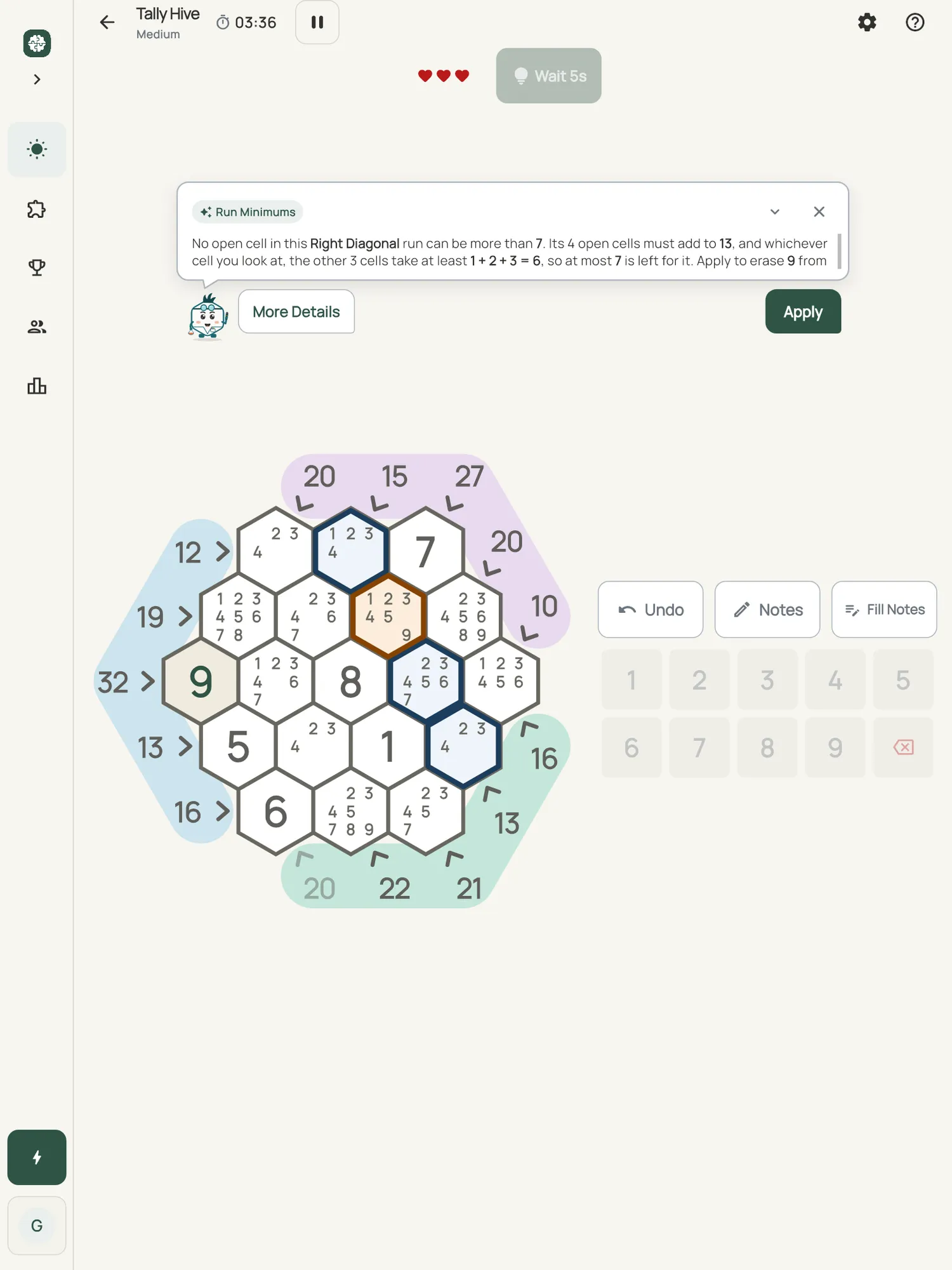
The real screens.
Every picture on this page is the app itself, on a board from the game.
Where Tally Hive Comes From
Tally Hive is Dayzle's Tally, a cross sums puzzle in the family Nikoli calls kakuro, moved onto a hexagon. Dayzle built it in September 2026.
Three things changed on the way. Each cell sits on three lines instead of two. The totals moved from clue squares inside the grid to the rim, because a hexagonal clue cell would have to carry up to three numbers, too small to read on a phone. And the board stops at 37 cells: on the next size up, the middle lines are nine cells long and hold every digit, so almost every cell could be filled by crossing out digits without adding anything up.
How the Levels Differ
Easy and Medium use a small hexagon of 19 cells. Easy gives more digits, about 11 cells to work out, and each can be settled from a line with one gap left. Medium gives fewer, about 14 cells to work out, and asks you several times a board to weigh two empty cells of a line together.
Hard and Extra Hard use a bigger hexagon of 37 cells. Hard asks, once or twice a board, for a line with three or four empty cells worked out together, and the rest is pairs and totals. Extra Hard asks two or three times for a line with four or more empty cells, with a few three-cell lines around them.
7 techniques, easiest first.
In Dayzle the hint and the solver are one engine, so these are the steps it takes to solve a Tally Hive board, from the first you'll meet to the rarest. Open one for a worked example and a clip of the hint teaching it on a real board.
Run Total Basic A line with one empty cell left: its total minus the digits already in it is that cell's digit.
Say a Right Diagonal totals 9 and already holds 2 and 4, with one cell empty. 2 + 4 = 6, and 9 − 6 = 3, so the empty cell is 3.
On Easy this is nearly the whole game: each cell you fill can leave one of its other two lines with a single gap.


Naked Single Beginner A cell where only one digit is not already used on its three lines, or with one note left.
Go through 1 to 9 for a cell and skip every digit already on its Row, Right Diagonal or Left Diagonal. If only one is left, it goes in that cell. With notes, it is a cell with one note left.

Run Minimums Intermediate The other empty cells of a line take at least 1 + 2 + …, which caps how big each cell can be.
Say the three empty cells of a Row have to add up to 9. Any two of them take at least 1 + 2 = 3, with no digit twice, which leaves at most 6 for the third. No empty cell in that row can be more than 6.

Run Maximums Intermediate The other empty cells of a line take at most 9 + 8 + …, which sets how small each cell can be.
Say the two empty cells of a Left Diagonal have to make 15. The other cell can take at most 9, so neither cell can be less than 6: notes 1 to 5 come out of both.

Partner Check Intermediate In a line with two empty cells, each note needs a partner that is still pencilled in the other cell.
Whatever goes in one of the two cells decides the other. Say they must make 10. A 5 would need another 5, which repeats, so 5 comes out. And if one cell is down to 3 or 4, the other can only be 7 or 6.

Naked Pair Intermediate Two cells on one line with the same two notes and nothing else.
Say two cells of a Row both have only the notes 2 and 7. Between them they use up the 2 and the 7, so every other cell on that row loses those notes.

Sum Combinations Advanced List every way a line's empty cells could still make its total, and drop any note that fits none of them.
Write out every set of digits the empty cells could still hold, using only their notes and no digit twice. Say three empty cells must make 24: the only way is 7, 8, 9, so every other note in them comes out.
This is what Hard and Extra Hard boards are built around: a few lines with three, four or more empty cells where nothing simpler works.

More number games.
Numbers
Tally
Cross-sums — make every row and column add up
Numbers
Terminus Hive
The same line, through every hex
Numbers
Sudoku
The classic 9×9, with hints that name each technique
Numbers
Mini Sudoku
Sudoku on a 6×6 grid
Numbers
Abacus
Fill the grid so every cage's arithmetic works out
Numbers
Terminus
Route one unbroken line that serves every stop
Today's five are waiting.
Download it free on the App Store or Google Play, or log in and play today's set right in your browser. Same puzzles, same streak, wherever you play.