
Mini Sudoku
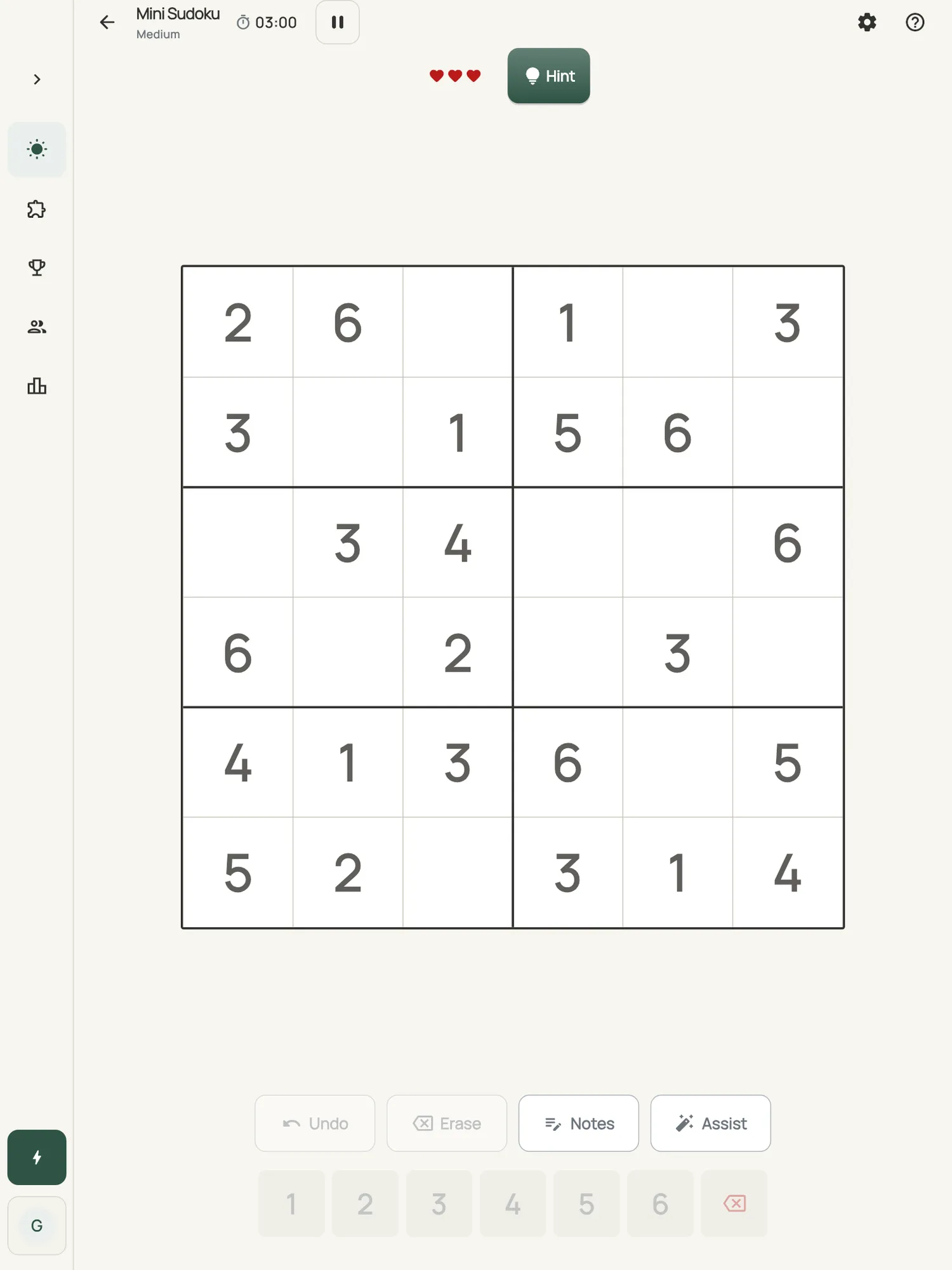
Sudoku on a 6×6 grid, with digits 1 to 6 and boxes two rows tall and three columns wide. On Easy it is a 4×4 with digits 1 to 4.


- Four levels: Easy to Extra Hard
- 7 techniques on its ladder
How Mini Sudoku Works

Every row, column and box holds each digit once, exactly as in full Sudoku. The grid is smaller, so boards are short: the expected time a board is scored against is 30 seconds on Easy and about 2 minutes on Extra Hard. A full 9×9 at Extra Hard is scored against about 27 minutes.
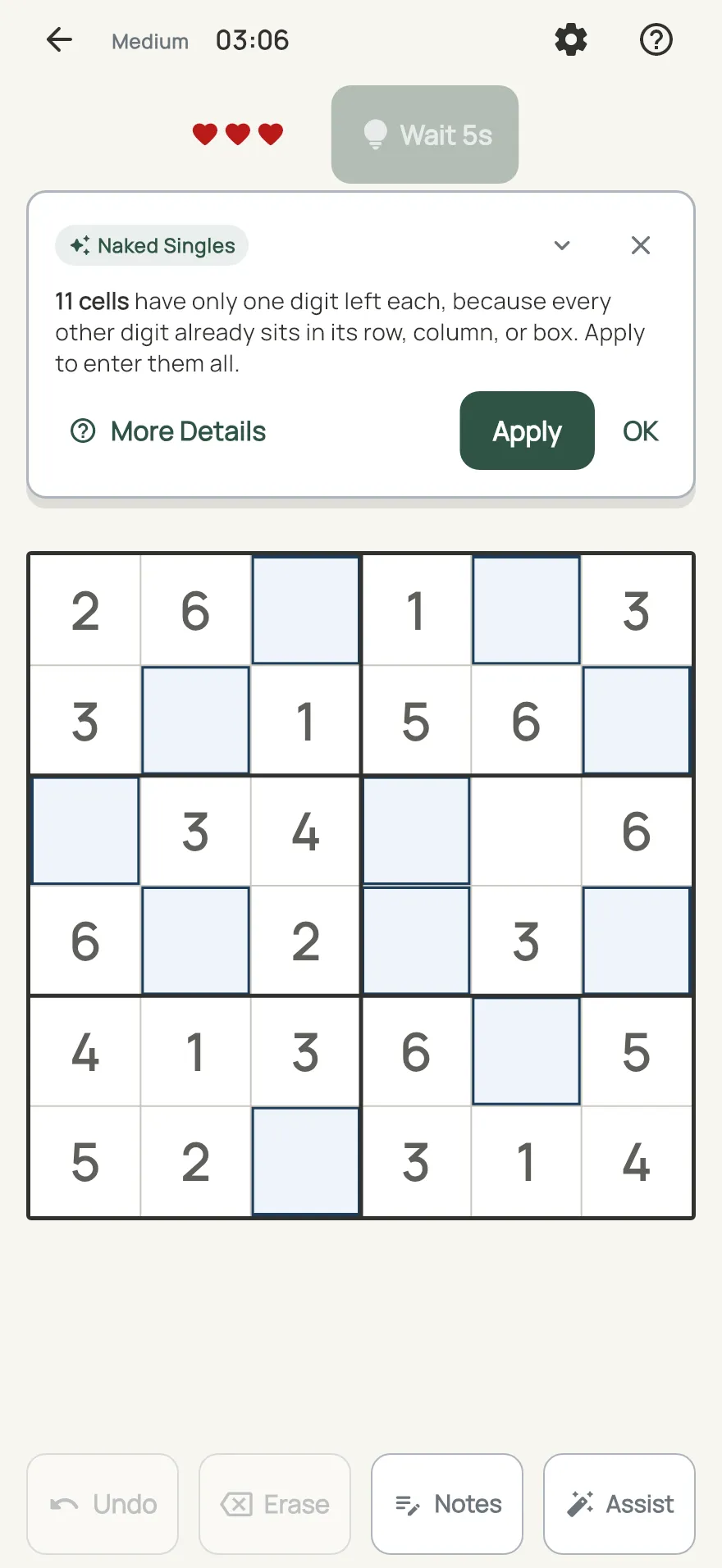
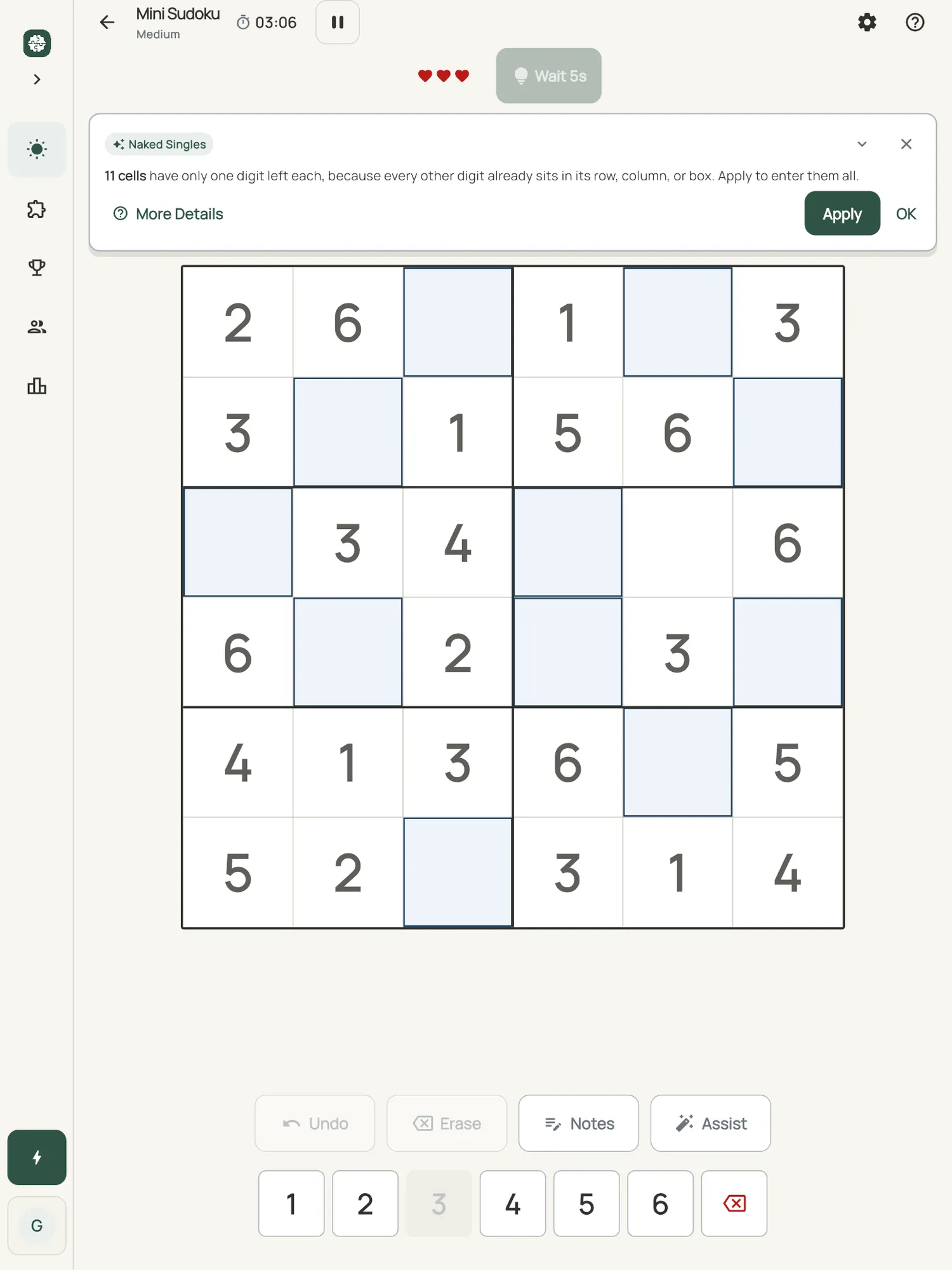
Mini Sudoku runs on the same engine as Dayzle's full Sudoku: the same notes, the same way of placing digits, and the same hints, which light the cells a step depends on and name the technique. What you learn on one carries over to the other. It is also the Sudoku that comes up in the daily set, where a full 9×9 would be too long.
The keypad only shows the digits the grid can hold, 1 to 4 on a 4×4 and 1 to 6 on a 6×6.
The Rules
- 1
Fill the Grid
Every row, column and box holds each digit once. Easy is a 4×4 grid with 2×2 boxes and digits 1 to 4; every other difficulty is a 6×6 grid with 2×3 boxes and digits 1 to 6.
- 2
No Duplicates
A digit never repeats within a row, column or box.
- 3
Use Logic
Look for the only digit a square can take. Every board can be worked out without guessing.
- 4
A Wrong Digit Costs a Heart
A digit that does not belong in a square costs a heart the moment you place it. Changing it to another wrong digit costs nothing more, and notes are always free. In practice you have three hearts a board; in the daily set they never run out.
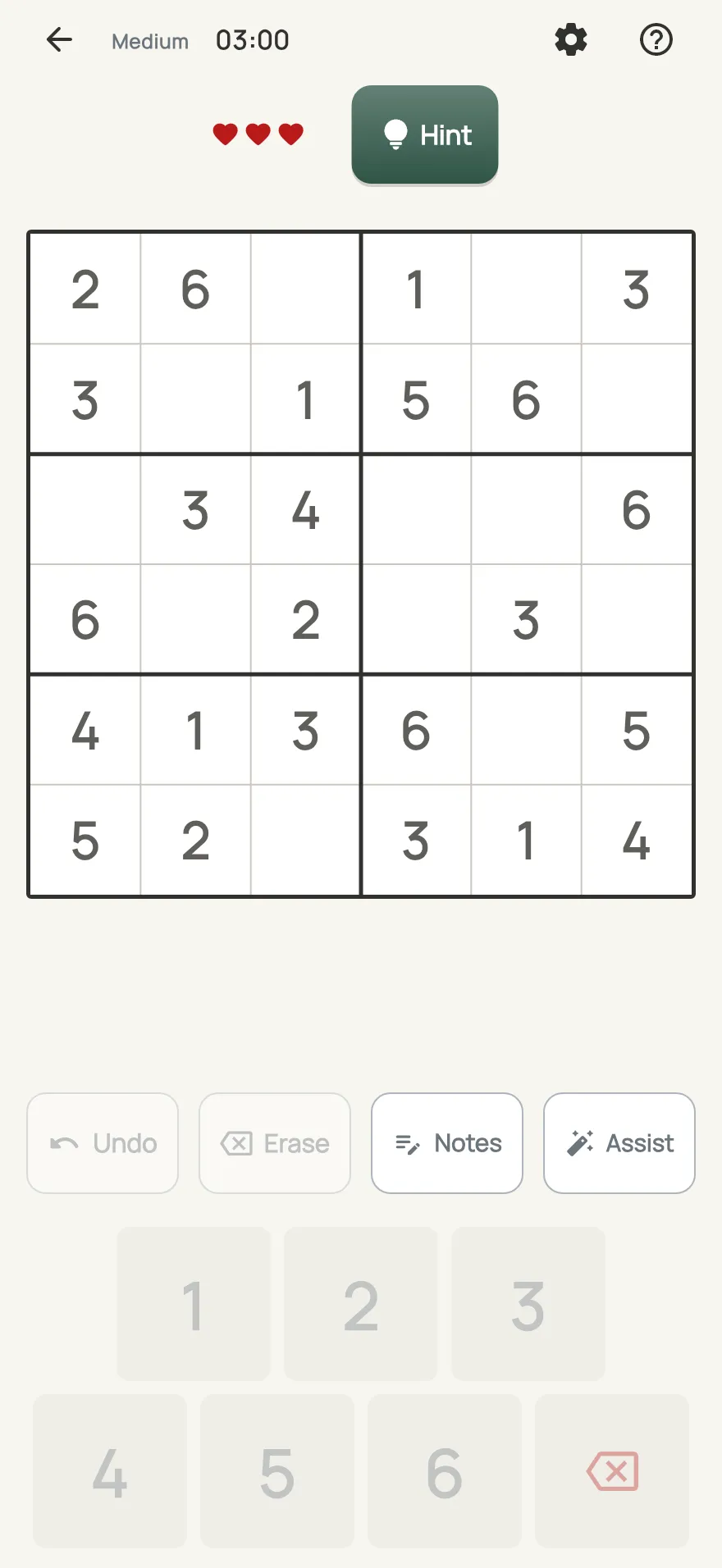
The real screens.
Every picture on this page is the app itself, on a board from the game.
Where Mini Sudoku Comes From
Mini Sudoku is Sudoku with fewer digits: the 9×9 grid with 3×3 boxes becomes a 6×6 grid with boxes two rows by three columns, or a 4×4 with 2×2 boxes. Every rule and every technique of the full game still applies.
Dayzle added it because a full Sudoku board proved too long for one slot in a five-game daily set. Mini Sudoku keeps the rules and fits in a few minutes. The full 9×9 has its own daily board, Today's Sudoku.
How the Levels Differ
Easy is a 4×4 grid with about 7 of its 16 squares filled in. Every 4×4 puzzle with one answer can be solved with Naked Singles and Hidden Singles alone. Medium is a 6×6 grid with about 22 of its 36 squares filled in, and every square falls to a Naked Single.
Hard starts with about 17 digits, and one board in ten needs a Hidden Single. Extra Hard starts with about 11, every board needs a Hidden Single, and one board in 20 needs an X-Wing or a BUG; those are also the only boards where a Naked Pair, Hidden Pair or Pointing Pair comes up. The daily Hard board is always one that needs a Hidden Single, and the daily Extra Hard board is always one that needs an X-Wing or BUG.
7 techniques, easiest first.
In Dayzle the hint and the solver are one engine, so these are the steps it takes to solve a Mini Sudoku board, from the first you'll meet to the rarest. Open one for a worked example and a clip of the hint teaching it on a real board.
Naked Single Beginner An empty square where every digit but one is already in its row, column or box.
Pick an empty square whose row, column and box are nearly full. Say Row 2 already holds 1, 3 and 6, and Column 5 holds 2 and 4. The square where they cross can only be 5.
With notes, it is a square with one note left. That note is its digit.


Naked Pair Intermediate Two squares in one row, column or box whose notes are the same two digits.
Say two squares in Column 2 have only the notes 4 and 6. Between them they will hold the 4 and the 6, so every other square in Column 2 loses its 4 and 6 notes.

Pointing Pair Intermediate Inside one box, every note for a digit sits in the same row or column.
Say in the box at Rows 1–2, Columns 4–6, every note for 5 is in Row 1. The box's 5 is somewhere in Row 1, so Row 1's squares in Columns 1–3 cannot be 5: take those notes out.
BUG Advanced Every empty square has exactly two notes except one, which has three.
If every empty square had exactly two notes, you could swap each one to its other note and every rule would still hold, so the puzzle would have two answers. A puzzle with one answer can never end up like that.
When only one square still has three notes, count how often each of its three digits appears as a note in its row, its column and its box. The one that appears an odd number of times is the square's digit.

X-Wing Advanced One digit whose notes, in two rows, sit in only the same two columns.
Say in Row 1 and Row 4 the notes for 3 sit only in Column 2 and Column 5. One row puts its 3 in Column 2 and the other in Column 5, whichever way round, so both columns get their 3 from these rows. Every other square in Columns 2 and 5 loses its 3 note.
It works the same with rows and columns swapped.
More number games.
Numbers
Sudoku
The classic 9×9, with hints that name each technique
Numbers
Tally
Cross-sums — make every row and column add up
Numbers
Tally Hive
Cross sums in three directions, on a hexagon
Numbers
Abacus
Fill the grid so every cage's arithmetic works out
Numbers
Terminus
Route one unbroken line that serves every stop
Numbers
Terminus Hive
The same line, through every hex
Today's five are waiting.
Download it free on the App Store or Google Play, or log in and play today's set right in your browser. Same puzzles, same streak, wherever you play.