
Lattice
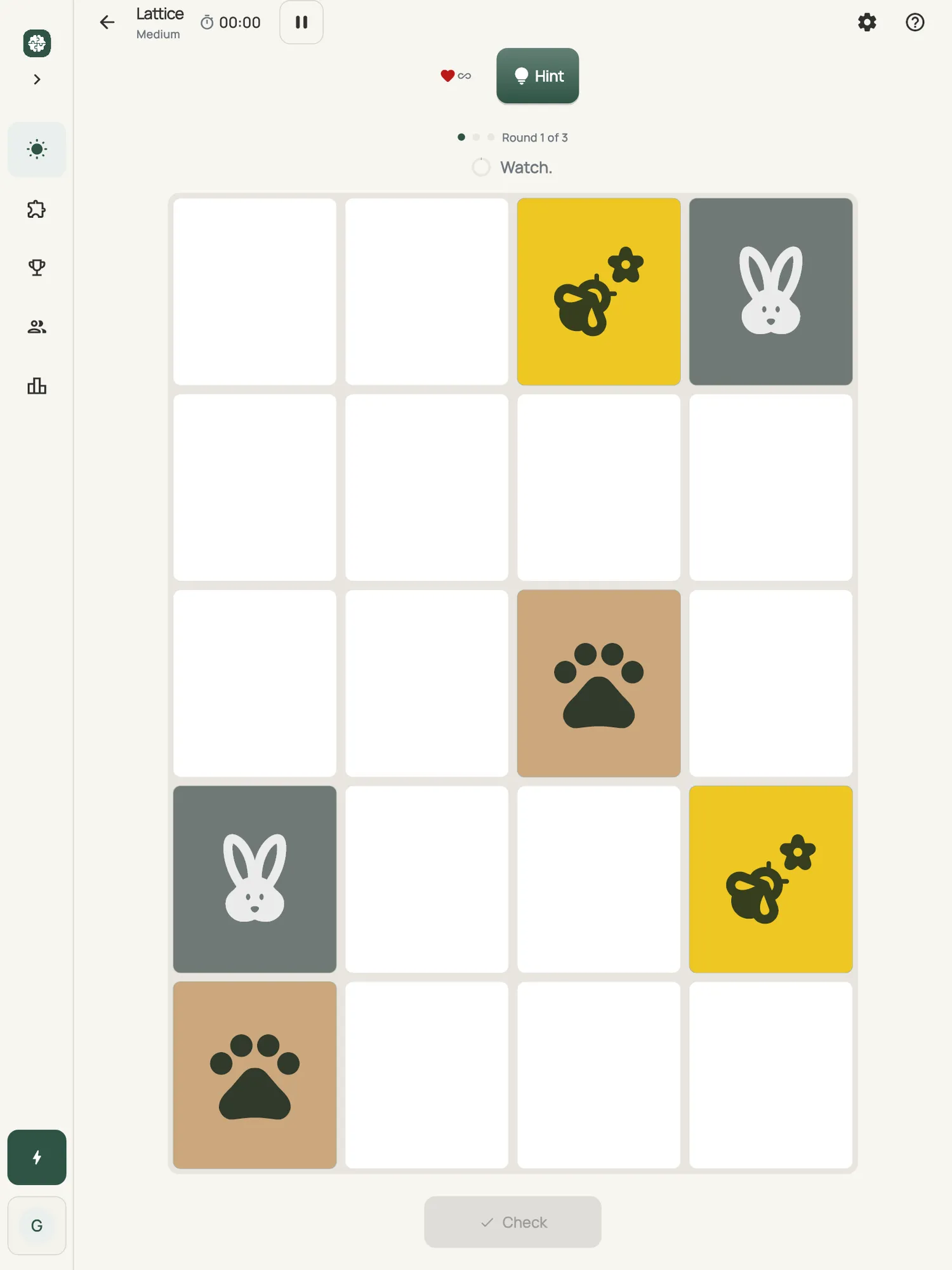
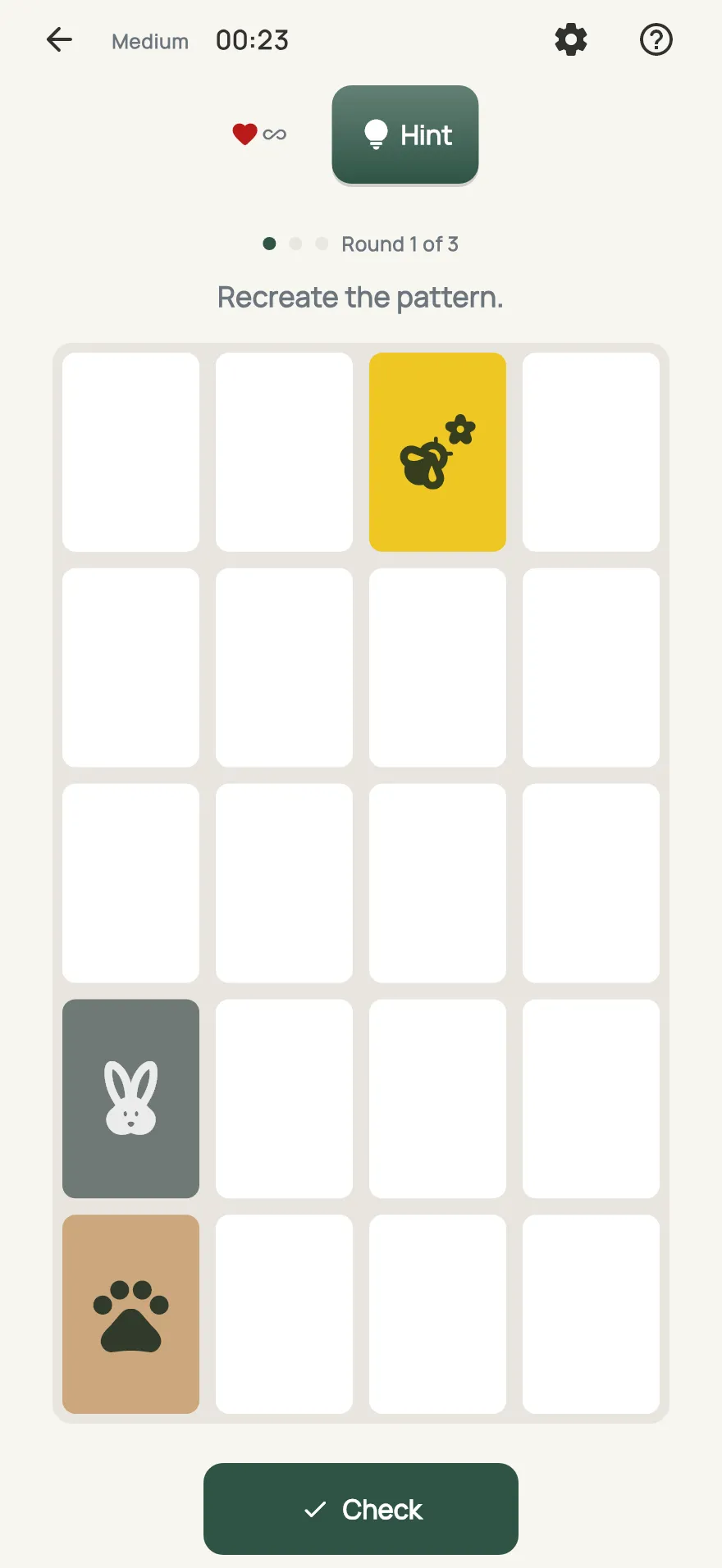
A pattern of filled squares shows for a few seconds, then hides. Tap it back.


- Four levels: Easy to Extra Hard
How Lattice Works

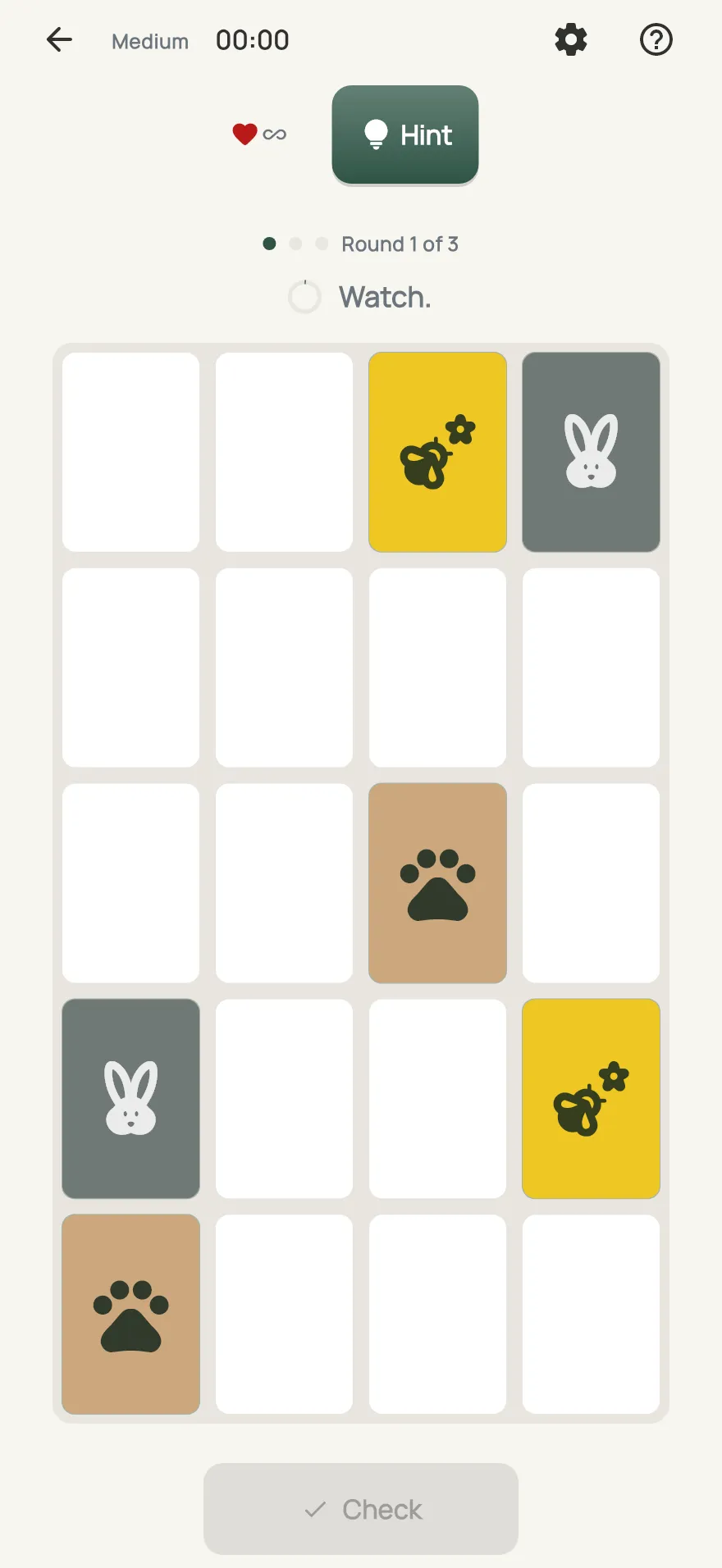
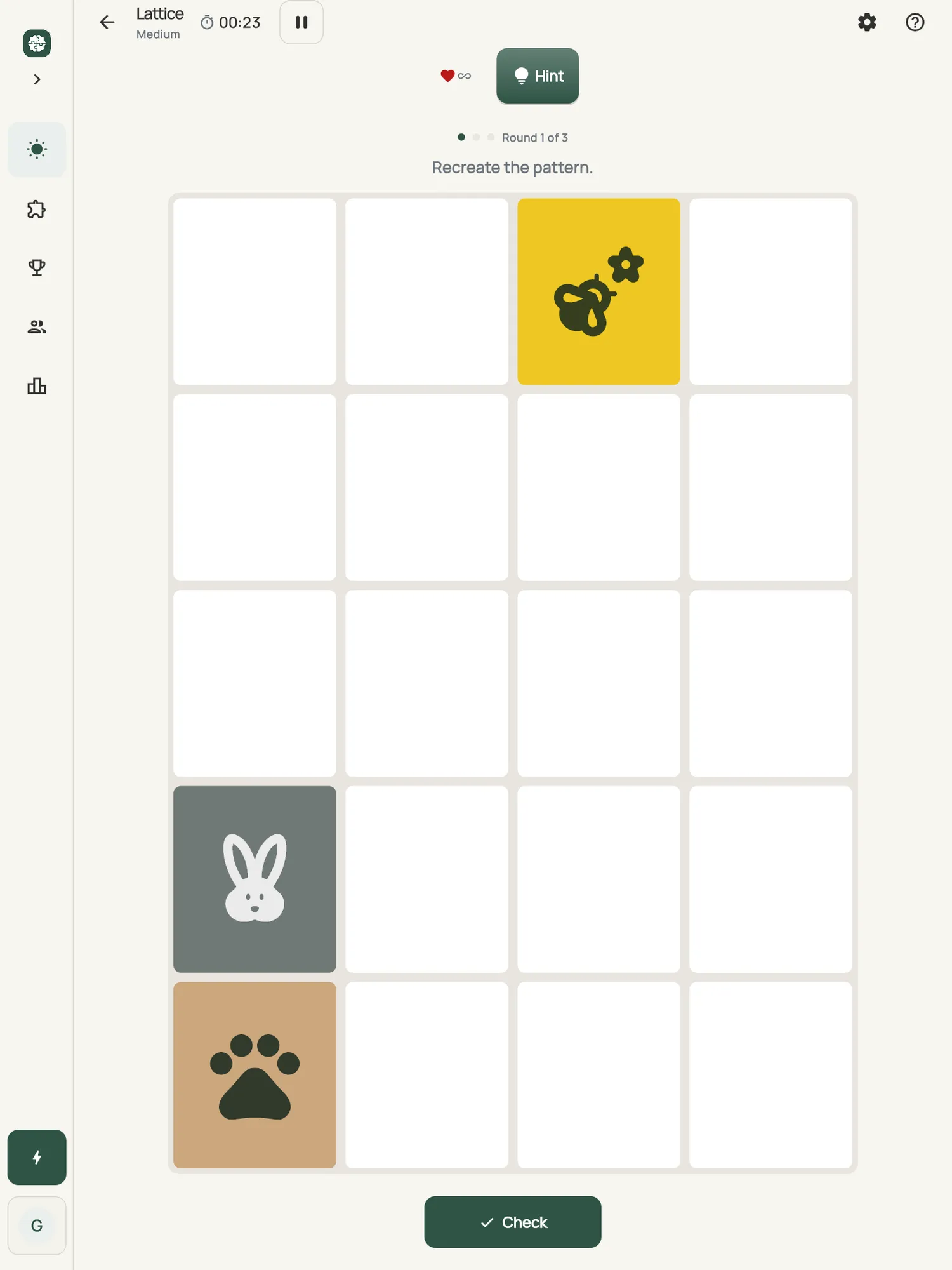
Lattice shows a pattern of filled squares on a small grid, hides it, and asks you to tap it back. A session is three rounds, each with a new pattern. A round starts when you tap Start, then counts down 3, 2, 1 before the pattern appears.
Each filled square shows one of three animals on its own colour: a bee on yellow, a bunny on grey and a bear's paw on brown. On Easy and Medium the animals are decoration. From Hard up, tapping a square opens a picker, and you choose the animal that was on it as well as getting the place right.
When you have marked what you remember, tap Check. The board shows what you got, what you missed and what you marked that was not in the pattern. The clock runs only while you can tap, so the countdown and the look are not timed.
A setting called Memorise Time changes how long the pattern stays up: Relaxed shows it half again as long, and Brisk about two thirds as long.
The Rules
- 1
Watch the Pattern
Study which squares are filled before the pattern hides.
- 2
Recreate It
Tap the squares you remember, then tap Check.
- 3
Round by Round
A session is three rounds, and each round shows a fresh pattern to recall.
- 4
Animals Count From Hard Up
Each filled square shows an animal in its own colour. From Hard up, tapping a square opens a picker: choose the animal that was on it, as well as getting the place right. On Easy and Medium the animals are decoration, and only the places are scored.
- 5
A Stray Mark Costs a Quarter Point
Lattice never takes a heart. Each square you get right scores a point, and a square you miss scores nothing. A square you mark that was not in the pattern takes a quarter point off. From Hard up, the right square with the wrong animal scores half.
The real screens.
Every picture on this page is the app itself, on a board from the game.
Where Lattice Comes From
In 1972 Philip Corsi, a researcher at McGill University, set nine identical blocks on a board and tapped out sequences for people to repeat. The Corsi block-tapping test became a standard way of measuring spatial memory: remembering places, the way repeating a phone number tests remembering digits.
Lattice is a game built on the same kind of memory. Corsi's test asks for the order the blocks were tapped in. Lattice shows the whole pattern at once and asks where the squares were, and from Hard up which animal was on each one. It is scored in points, with half a point for a square in the right place with the wrong animal.
How the Levels Differ
Easy fills 5 squares of a 4×4 grid and shows them for 4 seconds. Medium fills 6 squares of a 4×5 grid for 3.5 seconds. On both, only the places count.
Hard fills 5 squares of a 5×5 grid and asks for every square's animal as well, shown for 6.1 seconds. Extra Hard fills 7 squares of a 5×5 grid, all with their animals, shown for 7 seconds. The look is longer on the top bands because there is more to hold, and each band asks you to take it in faster than the one below.
How a board gets harder.
Lattice has no technique ladder because nothing on the board can be worked out: each square is either remembered or not. A harder band asks you to hold more at once. The app counts a square whose animal you must name as three things to hold: the square, the animal, and which animal went on which square. So Easy asks for 5 things in 4 seconds, Medium 6 in 3.5 seconds, Hard 15 in 6.1 seconds and Extra Hard 21 in 7 seconds.
More visual games.
Visual
Mirror
Flip the cards, find the pairs
Visual
Crowns
One crown per row, column, and colour — none touching
Visual
Crowns Hive
Star Battle on a hexagon: one crown per line, three ways
Visual
Equinox
Balance suns and moons in every row
Visual
Mosaic
Fit the pieces to cover the board exactly
Visual
Mosaic Hive
Pack polyhex pieces into a hexagonal board
Today's five are waiting.
Download it free on the App Store or Google Play, or log in and play today's set right in your browser. Same puzzles, same streak, wherever you play.