
Mirror
Turn two cards at a time and find the matching pairs. Remember where each symbol was.


- Four levels: Easy to Extra Hard
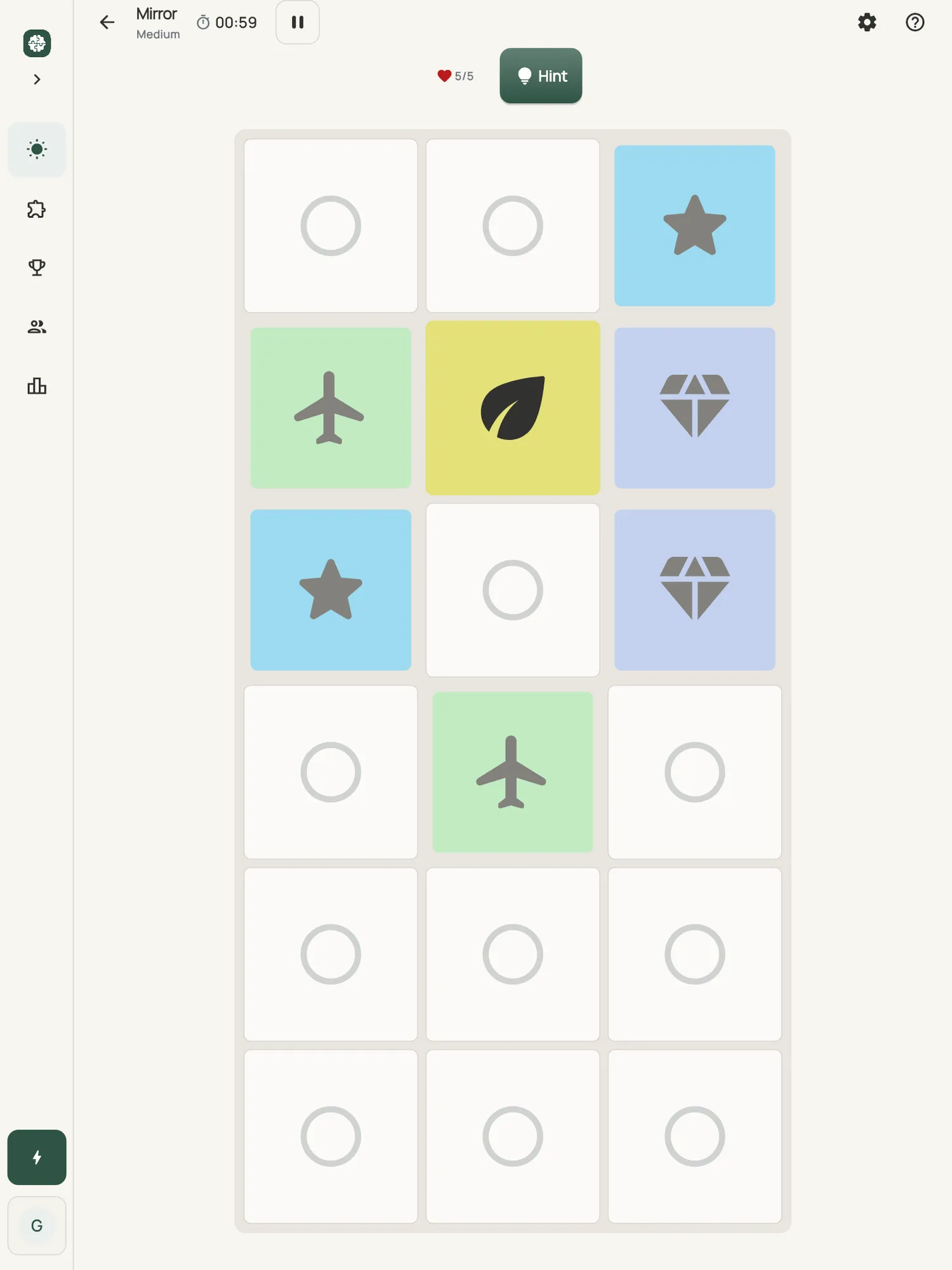
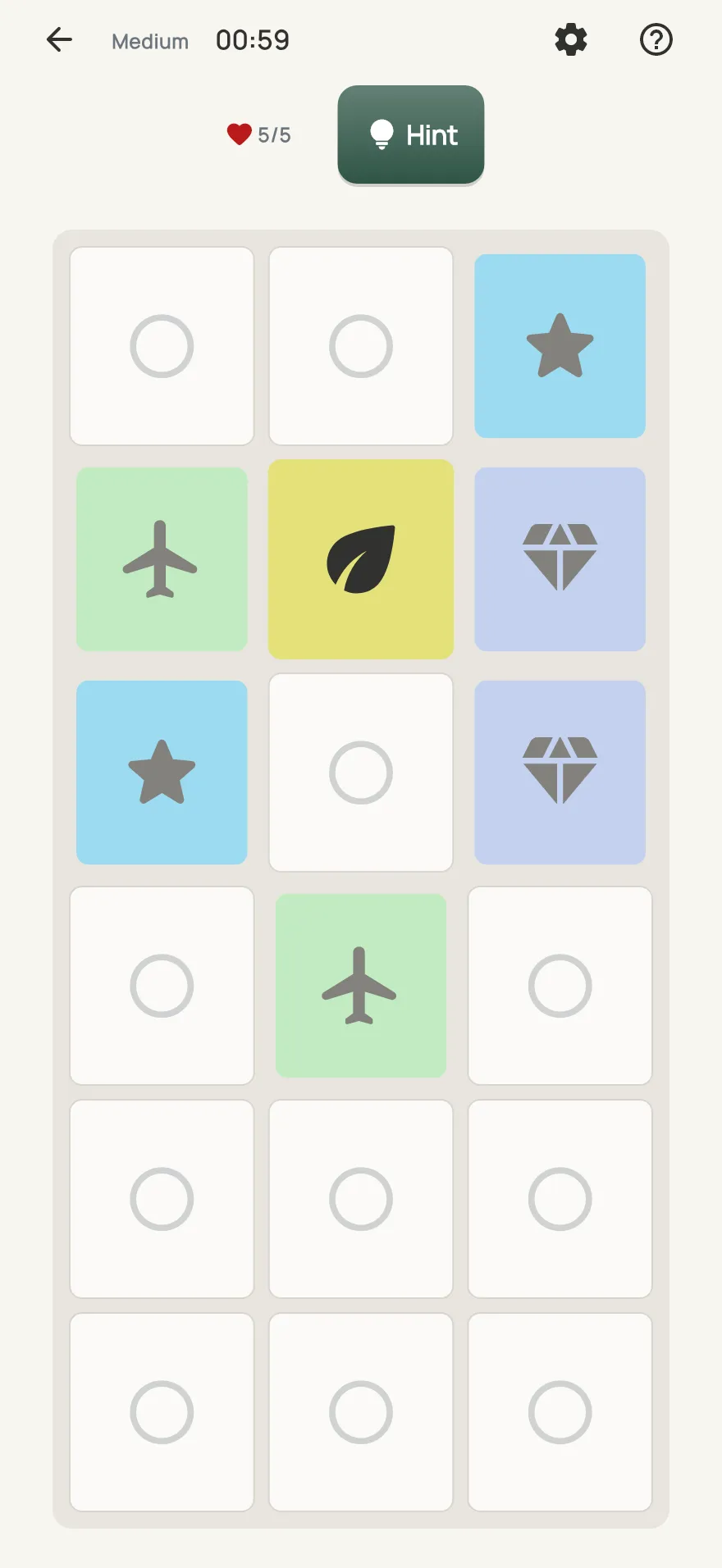
How Mirror Works

Mirror deals a grid of face-down cards. Each symbol, such as a leaf, a star or a crescent moon, is on exactly two cards. Every symbol has its own outline, so no two symbols can be mistaken for each other, and each card's colour gives you a second thing to remember it by.
A pair you find stays face-up. A mismatch stays face-up too. On Easy your next card can pair with either of the two showing; from Medium up, the older card turns back over after 1.5 seconds and only your newest card can be paired.
Turning cards you have never seen costs nothing, because that is how you learn the board. A miss counts as a mistake only when you had already seen the card you needed.
A hint only uses cards you have already had face-up. The first press draws a Blue border around up to three face-down cards, one of which is the match; ask again and the border moves to the exact card alone. If you haven't seen the match yet, the hint says so and marks nothing.
The Rules
- 1
Flip Two Cards
Tap a card to reveal it, then tap another to look for its match.
- 2
Cards Stay Face-Up
A matching pair stays face-up, and so does a mismatch. On Easy your next card pairs with either of the two showing. From Medium up, the older one turns back over after a moment, so you match against your newest card.
- 3
Remember the Board
Recall where each symbol sat to clear the whole board.
- 4
Only a Fresh Miss Costs a Heart
Turning cards you have never seen costs nothing. Missing a match when one of the cards was face-up in your last few flips costs a heart. Forgetting a card from longer ago counts as a mistake, but costs no heart. A practice board has five hearts, and hearts never run out in the daily set.
Where Mirror Comes From
Mirror is the pairs card game, played with the same rules almost everywhere and known by many names, among them Memory, Pairs and Pexeso. In Japan it is shinkei-suijaku, which translates roughly as "nerve weakening", a medical term for nervous exhaustion borrowed as a joke about the game.
Dayzle keeps the classic rules and changes three things. After a mismatch your newest card stays face-up, so your next card can still pair with it, and on Easy both cards stay up. Turning a card you have never seen is never a mistake. And a heart is spent only when you forget a card you saw in your last few flips; forgetting one from longer ago counts as a mistake but costs no heart.
How the Levels Differ
Easy deals 12 cards (6 pairs), Medium 18 (9 pairs), Hard 20 (10 pairs) and Extra Hard 32 (16 pairs). On Easy a third card can pair with either of the two showing; from Medium up only the newest card can.
What costs a heart also loosens as the board grows. A miss spends a heart only if you saw the card you needed within your last few flips: 2 on Easy, 3 on Medium, 4 on Hard or 5 on Extra Hard. The one or two cards you have turned up right now don't count toward that number. Forgetting a card from further back counts as a mistake and costs no heart.
How a board gets harder.
Mirror has no technique ladder because there is nothing to work out: every good move comes from remembering where a card was. A harder board is a bigger one to hold in memory, 6 pairs on Easy, 9 on Medium, 10 on Hard and 16 on Extra Hard, and from Medium up only your newest card can be paired, so a remembered partner for the older card is no help until you turn it up again.
More visual games.
Visual
Lattice
Watch the pattern, then recreate it from memory
Visual
Crowns
One crown per row, column, and colour — none touching
Visual
Crowns Hive
Star Battle on a hexagon: one crown per line, three ways
Visual
Equinox
Balance suns and moons in every row
Visual
Mosaic
Fit the pieces to cover the board exactly
Visual
Mosaic Hive
Pack polyhex pieces into a hexagonal board
Today's five are waiting.
Download it free on the App Store or Google Play, or log in and play today's set right in your browser. Same puzzles, same streak, wherever you play.