
Landmark
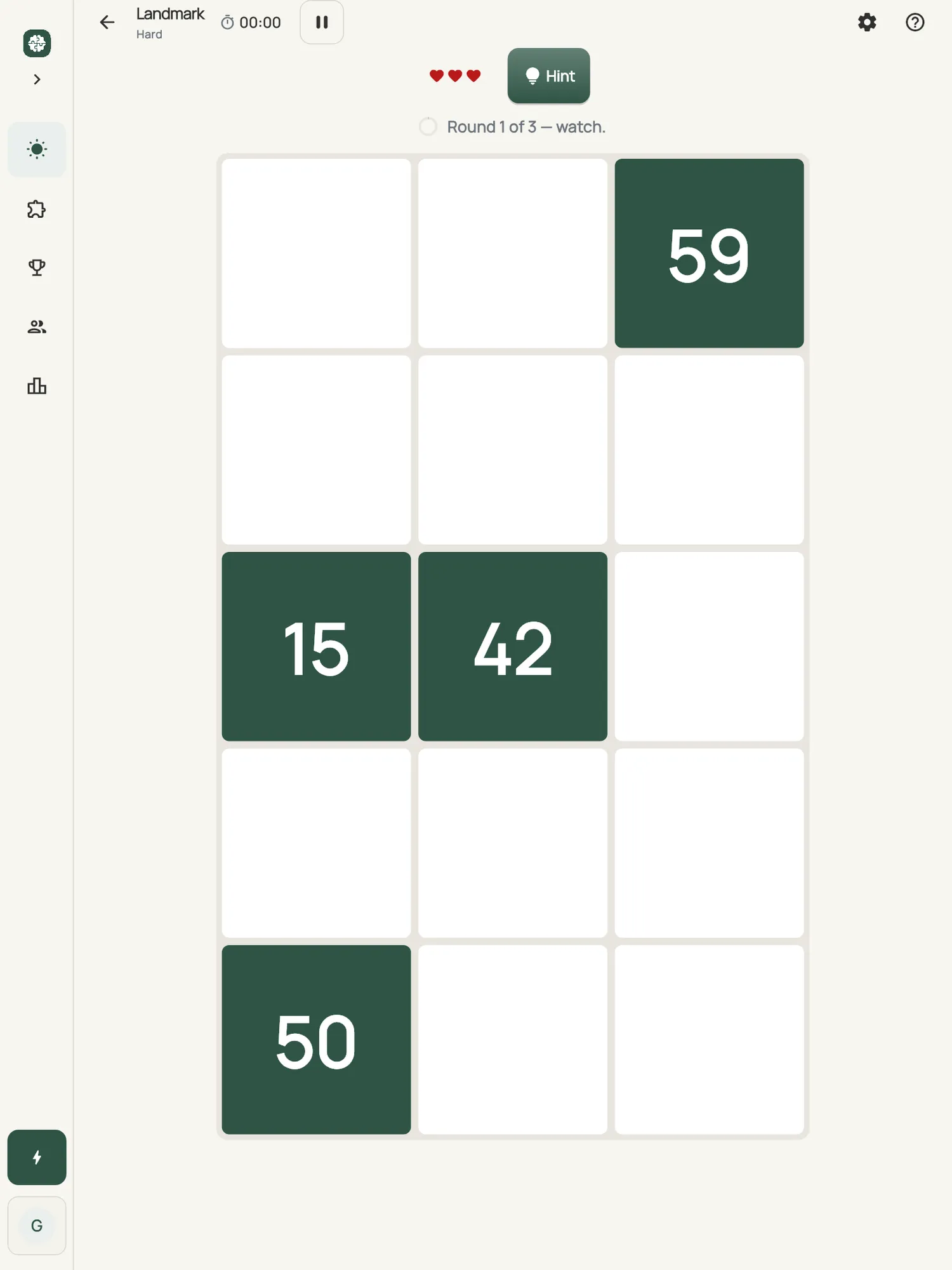
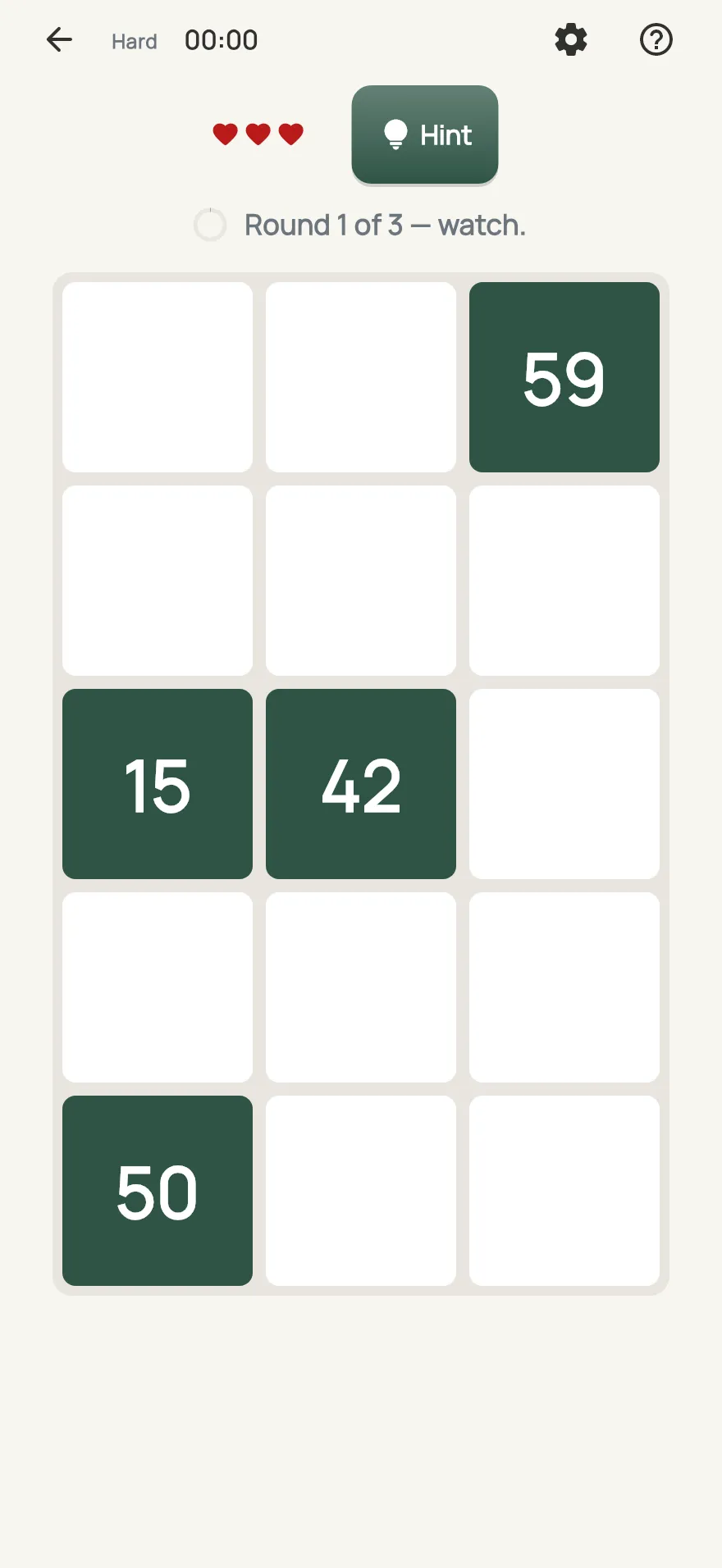
The board shows you where a few numbers sit, then hides them. You point at where each one was.


- Four levels: Easy to Extra Hard
How Landmark Works

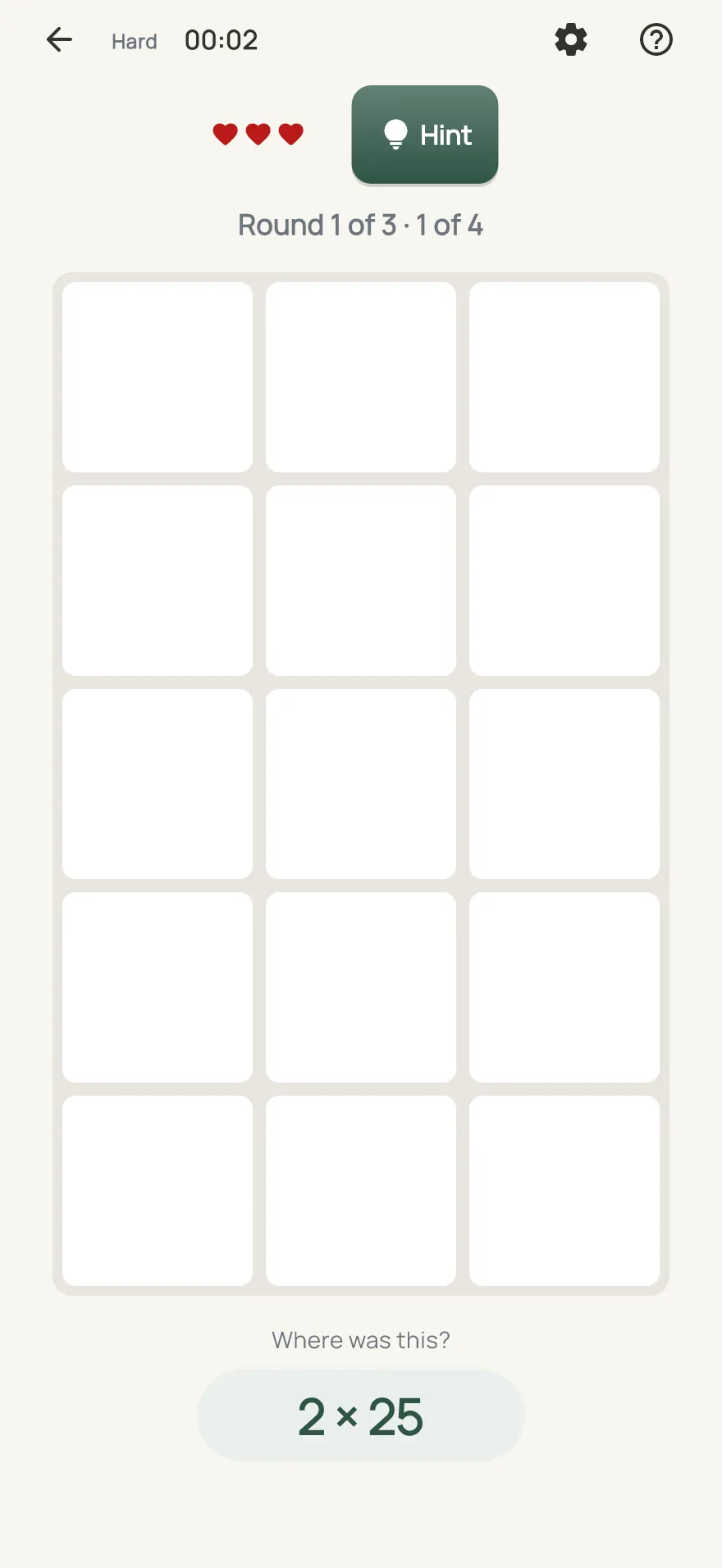
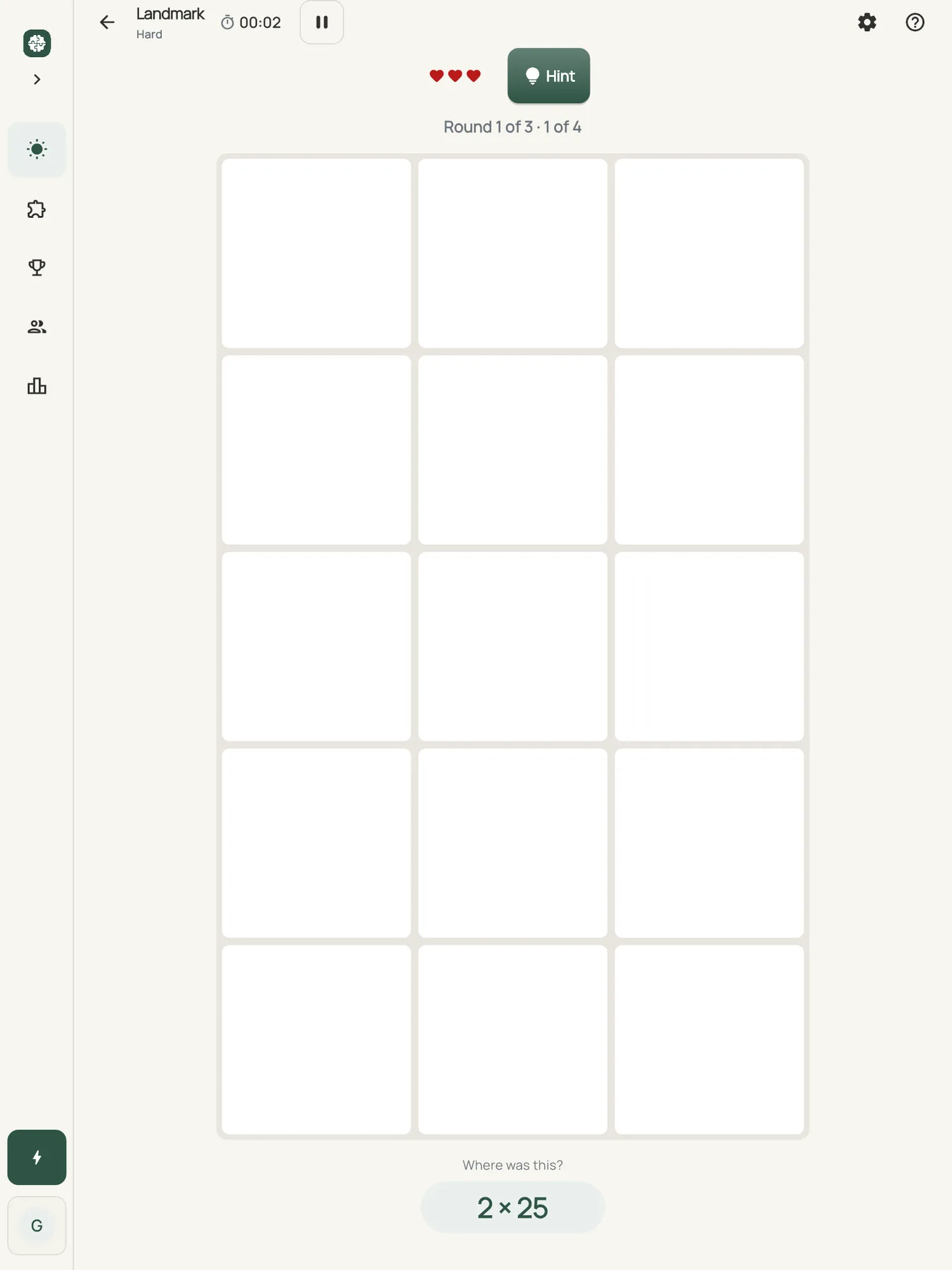
A session is three rounds. Each round, a handful of numbers appear in the cells of a small grid for a few seconds, then the grid hides them. The questions come one at a time, in shuffled order: “Where was this?” You tap the cell you remember the number in.
On Easy and Medium the question shows the number itself. On Hard and Extra Hard it shows a sum or a product that works out to it, such as 17 × 3 or 39 + 12, so you do the arithmetic first and then remember where 51 was. That pairing of arithmetic and recall is why Landmark sits with the number games.
Each question is asked once. A right answer puts the number back on the board for the rest of the round; a wrong one counts as a mistake and the game moves on. A hint makes the right cell pulse, and the tap is still yours.
The Rules
- 1
Watch the Placements
Note where each number sits before the board hides.
- 2
Answer the Prompts
When asked about a number, tap the cell it was in.
- 3
A Few per Round
Each round places a handful of numbers: 2 on Easy, up to 5 on Extra Hard. A session is three rounds.
- 4
Arithmetic on the Hard Boards
Higher up, the question arrives as a calculation, such as “where was 17 × 3?”, so you work it out, then remember.
- 5
A Wrong Cell Costs a Heart
Tapping the wrong cell costs a heart, and you get no second try at that question. If your last heart goes mid-round, the round still finishes first. In practice you have three hearts a session; in the daily set they never run out.
The real screens.
Every picture on this page is the app itself, on a board from the game.
Where Landmark Comes From
Tying things to places so you can find them again is one of the oldest memory techniques on record, the method of loci. Roman writers, Cicero among them, told how the Greek poet Simonides of Ceos named the guests of a banquet hall that had collapsed by remembering where each of them had been sitting.
Landmark uses the same pairing of a thing and a place, with the cells of a grid as the places and numbers as the things. Dayzle first called it Compass and renamed it in August 2026, because a compass points a direction and this game asks you to remember a position.
How the Levels Differ
Easy is a 3×4 grid with 2 numbers a round, all from 1 to 9, and 6 seconds to look; the question names the number. Medium is 3×5 with 3 numbers a round and 5 seconds.
Hard is 3×5 with 4 numbers a round, now from 10 to 99, 4 seconds to look, and every question is a sum or a product. Extra Hard is 4×6 with 5 numbers a round, 3 seconds to look, and the questions are still arithmetic. Across three rounds that is 6, 9, 12 and 15 questions.
How a board gets harder.
Landmark has no technique ladder because there is nothing to deduce: the answer is where the number was, and a hint simply shows that cell. A harder board asks you to hold more numbers for less time, from 2 numbers and 6 seconds on Easy to 5 numbers and 3 seconds on Extra Hard. From Hard up the numbers have two digits, and each question is a calculation you finish before the remembering starts.
More number games.
Numbers
Sudoku
The classic 9×9, with hints that name each technique
Numbers
Mini Sudoku
Sudoku on a 6×6 grid
Numbers
Tally
Cross-sums — make every row and column add up
Numbers
Tally Hive
Cross sums in three directions, on a hexagon
Numbers
Abacus
Fill the grid so every cage's arithmetic works out
Numbers
Terminus
Route one unbroken line that serves every stop
Today's five are waiting.
Download it free on the App Store or Google Play, or log in and play today's set right in your browser. Same puzzles, same streak, wherever you play.