
Span
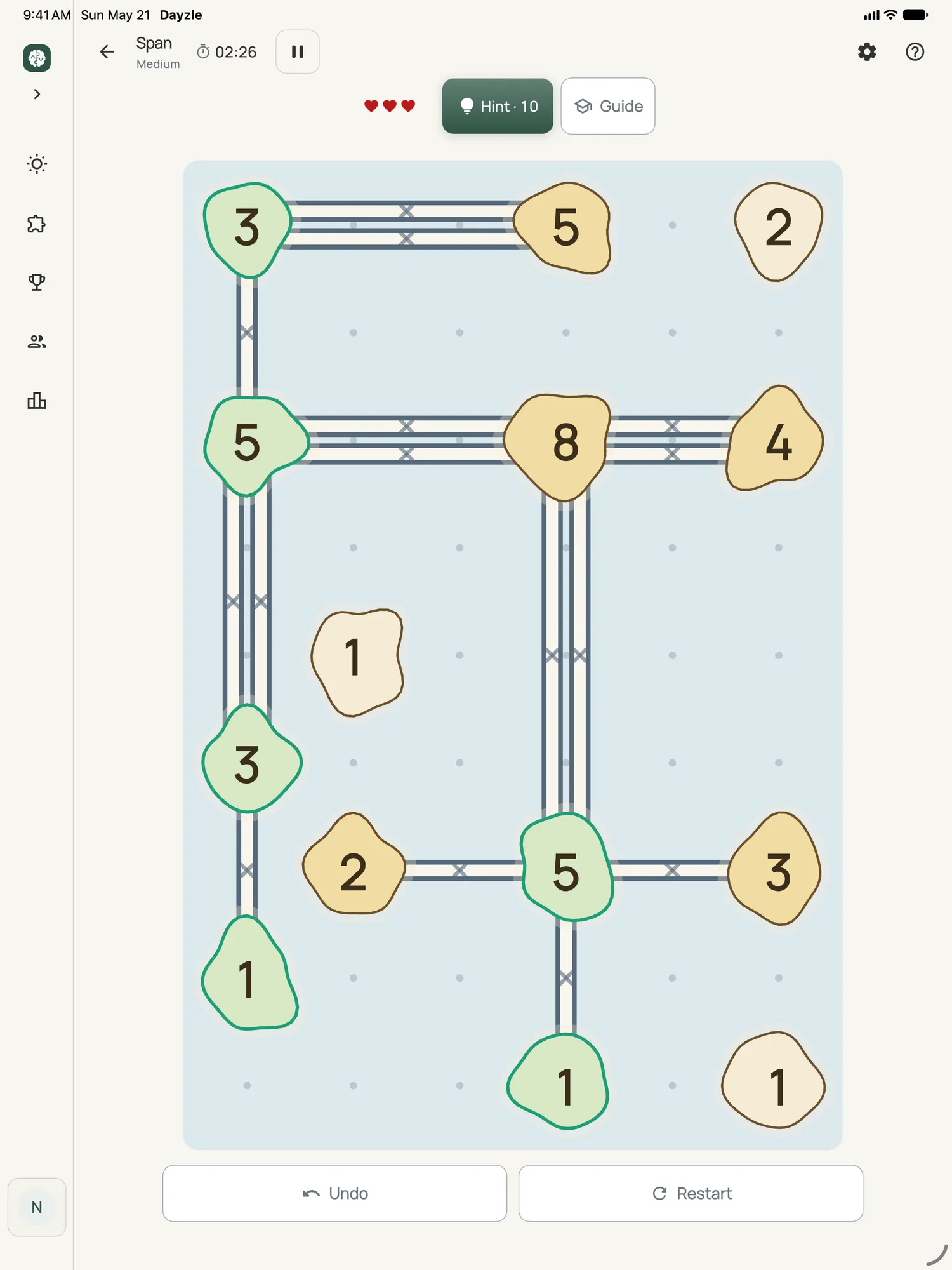
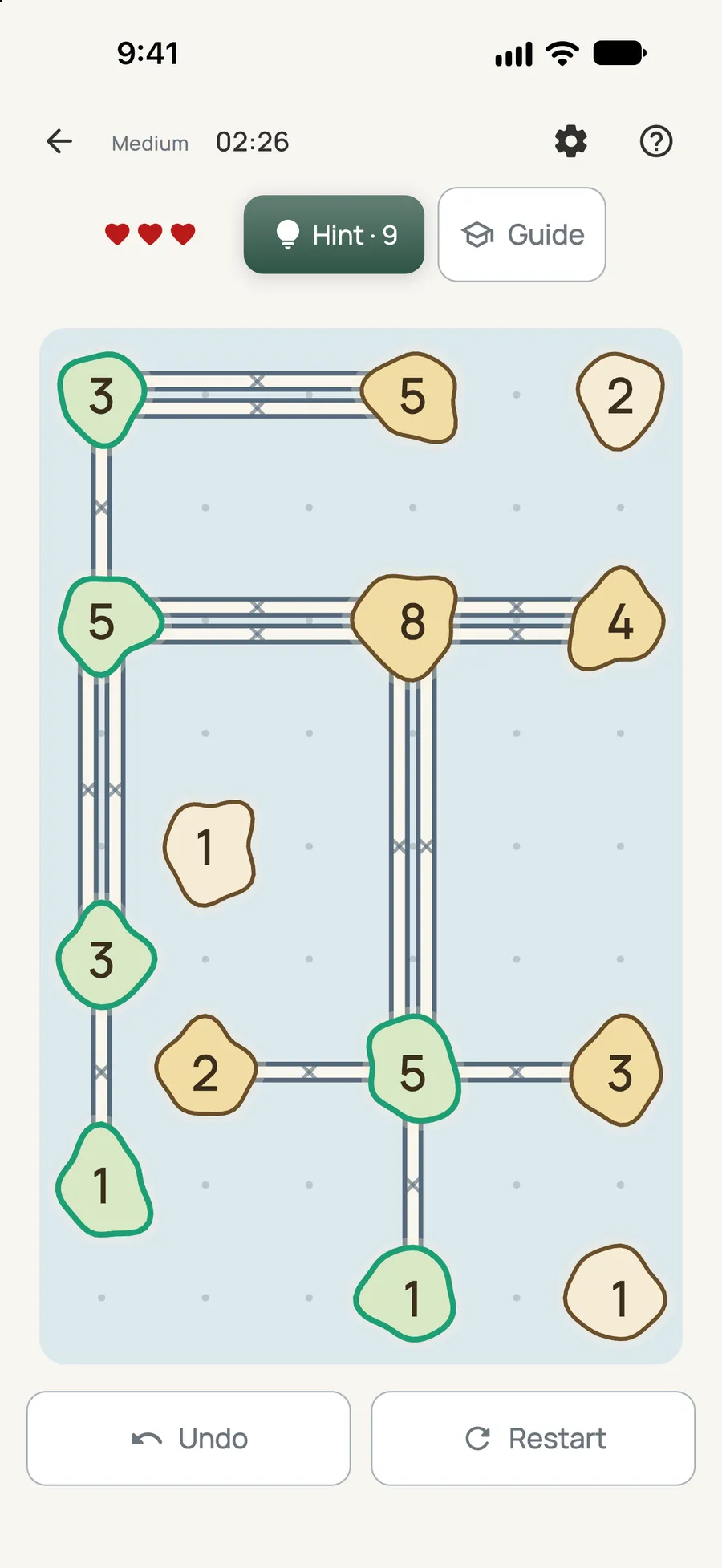
Join the islands with bridges. The number on an island is exactly how many bridge ends meet there, and when you are done every island can be reached from every other.


- Four levels: Easy to Extra Hard
- 9 techniques on its ladder
How Span Works

Islands sit in open water, each marked with a number from 1 to 8. You lay bridges between islands that face each other across the water: straight across or straight down, never crossing another bridge, and at most two between any one pair. A double bridge counts as two ends at each island.
Tap an island, then a neighbour it can reach, to lay a bridge; tap the neighbour again to double it. Tap a bridge to take it down, or drag from island to island to lay one.
The last rule is easy to miss: every number can be right and the board still unfinished, if the bridges leave one group of islands with no way to the rest. When the network is complete, a light travels every bridge on the board to show it is one connected piece.
The Rules
- 1
Count the Ends
The number on an island is exactly how many bridge ends meet there. A double bridge counts as two.
- 2
Tap, Then Tap
Tap an island, then tap a neighbour it can reach, to lay a bridge between them. Tap the neighbour again to double the bridge; two is the most a pair can carry, so a third tap adds nothing. To take a bridge down, tap the bridge itself. Dragging from island to island lays a bridge too.
- 3
Straight, and Never Crossing
Bridges run straight across or straight down, and no bridge may cross another. At most two bridges join any one pair.
- 4
One Network
When the board is done, every island is reachable from every other. All the numbers can be right and the board still unfinished if one group of islands is cut off from the rest.
- 5
A Wrong Bridge Costs a Heart
A bridge that gives an island more ends than its number, or leaves the board impossible to finish, costs a heart the moment you lay it. Laying that same bridge again costs nothing more, and taking a bridge down is always free. In practice you have three hearts a board; in the daily set they never run out.
The real screens.
Every picture on this page is the app itself, on a board from the game.
Where Span Comes From
Span is the bridge-building puzzle the Japanese publisher Nikoli calls Hashiwokakero, “build bridges”. It first appeared in the magazine *Puzzle Communication Nikoli* in September 1990, and in English it is published as Bridges or Hashi.
It is a rare number puzzle where the number is not a value in a cell but a count of connections. Dayzle added it in August 2026 for that reason: most of its other number games put digits in a grid, and Span reads a 4 as “four bridge ends meet here”.
How the Levels Differ
Easy is a 5×7 board with 10 islands, Medium 6×9 with 14, Hard 7×10 with 18, and Extra Hard 7×11 with 24. Every board can be solved by the techniques below without guessing, and has one answer.
Each difficulty also requires a harder technique. Easy boards need Every Span Full and go no further than All Ends Met. Medium boards need Never Together or Sealed Off one to three times. Hard boards need Sealed Off on a group of three or more islands, three to six times. Extra Hard boards need One Step Ahead two to five times.
9 techniques, easiest first.
In Dayzle the hint and the solver are one engine, so these are the steps it takes to solve a Span board, from the first you'll meet to the rarest. Open one for a worked example and a clip of the hint teaching it on a real board.
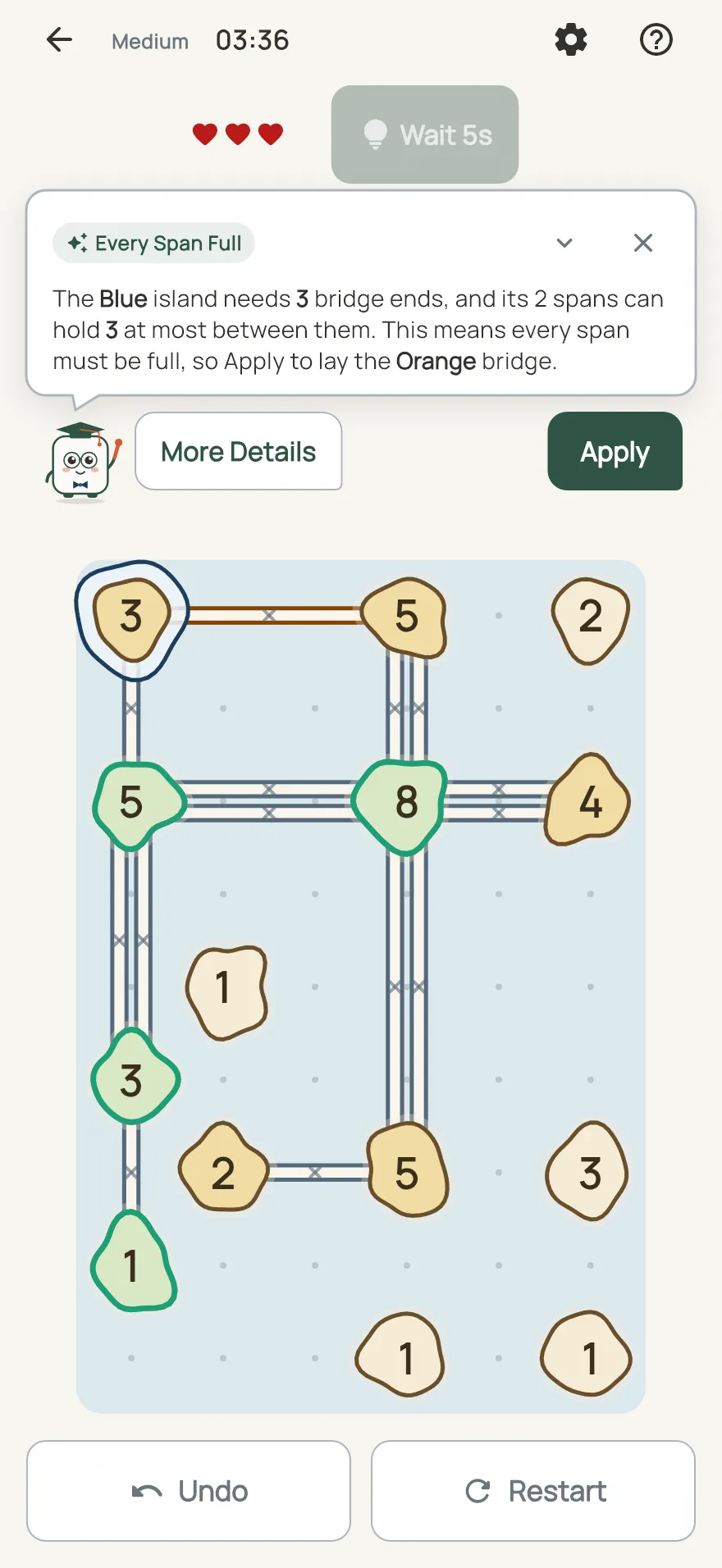
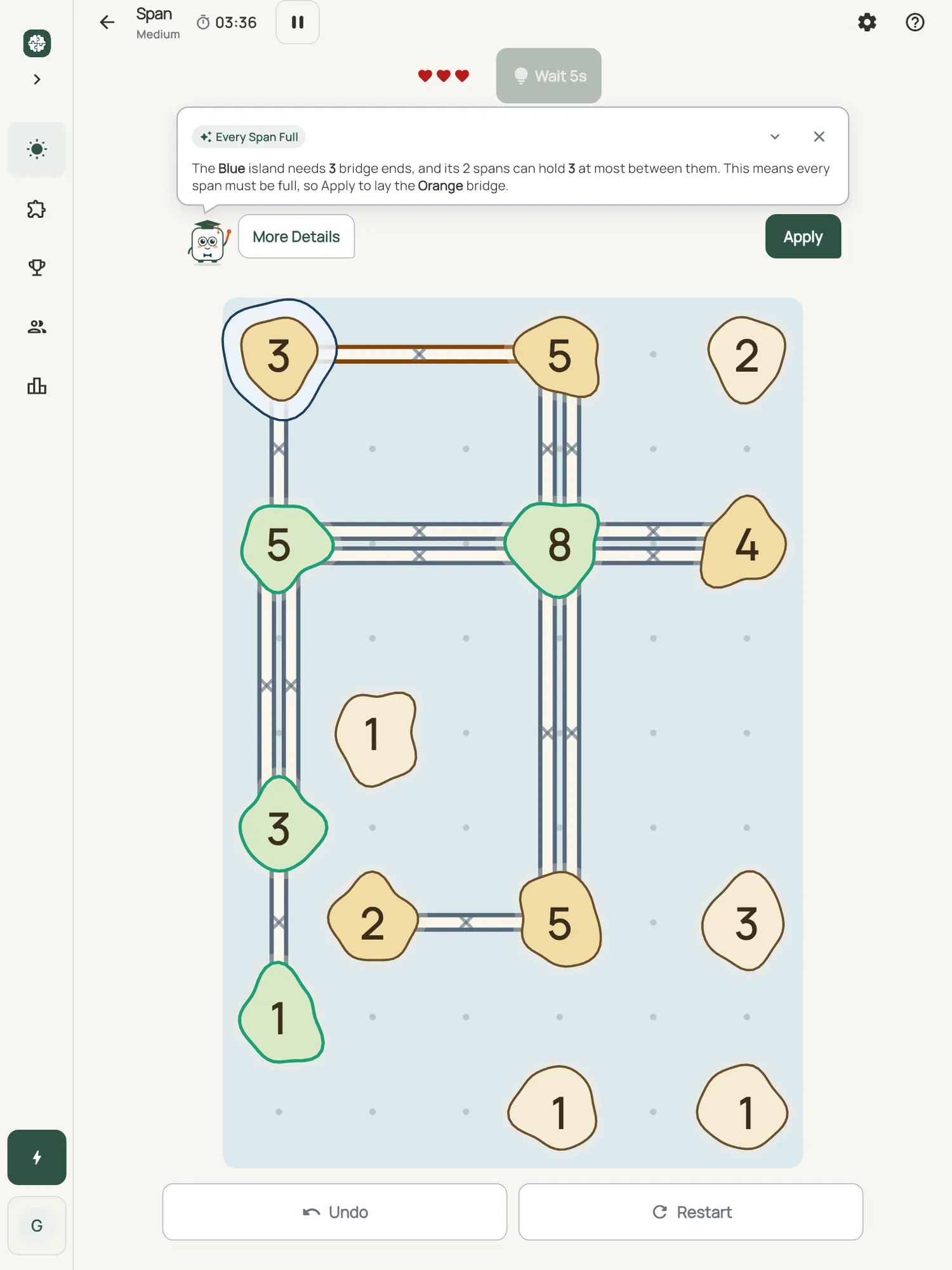
Every Span Full Beginner An island whose number equals the most bridges its spans could hold between them.
A span is the open water between an island and the nearest island in a straight line from it, left, right, up or down. Add up the most bridges each of an island's spans could hold: 2 each, or fewer when the island at the other end is nearly full. If the total is exactly the island's number, there is no room to spare, and every span gets as many bridges as it can take.
Say a 4 sits in a corner with two neighbours. Two spans of 2 make exactly 4, so both get a double bridge. Corners, edges and islands next to a 1 are the best places to start.


No Crossing Beginner A span that would run across a bridge already on the board is closed.
Bridges never cross. Once a bridge runs across a stretch of water, any span between two other islands that would pass through it counts for nothing, and those islands' numbers have to be made up from their other spans.
One Short Basic An island whose spans could give it just one more than its number: every span with room for 2 gets at least one bridge.
Say a 3 sits in a corner with two neighbours, so its spans could hold 4 at most, one more than it needs. If either span stayed empty, the other could give it only 2, one short. So each span gets at least one bridge.
Whether either gets a second is still open, so lay only the single bridges.

Count the Ends Basic What an island's other spans can give, or have already been given, limits what one span carries.
Take one span of an island and count the rest. If the other spans can hold at most m bridges, this span has to carry at least the island's number minus m. If the island already has bridges promised elsewhere, this span can carry at most what is left.
Say a 3 already has two bridges on its other spans. The span you are looking at can take at most 1.
All Ends Met Basic An island that already has every bridge end it needs takes no more.
Once a 2 has a double bridge, or a single bridge on each of two spans, it is full. Every other span that touches it closes, which often forces the island at the other end of one of those spans.
Never Together Basic Two islands that would use up all their ends on each other can never be joined that way.
Two 1s side by side can never be joined: the bridge would use up both islands' only ends and leave the pair cut off from the rest of the board. The same goes for a double bridge between two 2s. So that span stays empty, or single, and the islands have to find their ends elsewhere.
Sealed Off Intermediate A bridge that would use up every end left in a joined group of islands while the rest of the board is still out of reach.
This is Never Together for a bigger group. Say you have joined three islands, and one more bridge between two of them would leave all three with every end they need, with no bridge going out. That group could never be joined to the others, so that bridge is out, and the group's last free end has to point elsewhere.
Only Way Out Advanced A joined group with only one span left that can lead to the rest of the board must use it.
Look at the groups of islands you have joined. Every island has to reach every other, so each group needs at least one bridge out. Count the spans that lead out of a group and can still take a bridge. If there is only one, it gets a bridge, whatever the numbers say.
One Step Ahead Expert Suppose a span stays as it is, follow what the numbers force, and see whether some island runs short.
When counting settles nothing and every group still has more than one way out, test a span in your head. Leave it exactly as it is, and fill in the bridges the numbers force from there. If some island ends up unable to get the ends it needs, the span cannot stay as it is, and one more bridge goes on it.
It is one supposition deep, never a chain of guesses, and Extra Hard boards are built to need it a few times each.

More number games.
Numbers
Sudoku
The classic 9×9, with hints that name each technique
Numbers
Mini Sudoku
Sudoku on a 6×6 grid
Numbers
Tally
Cross-sums — make every row and column add up
Numbers
Tally Hive
Cross sums in three directions, on a hexagon
Numbers
Abacus
Fill the grid so every cage's arithmetic works out
Numbers
Terminus
Route one unbroken line that serves every stop
Today's five are waiting.
Download it free on the App Store or Google Play, or log in and play today's set right in your browser. Same puzzles, same streak, wherever you play.